Almost nobody is retraining into AI
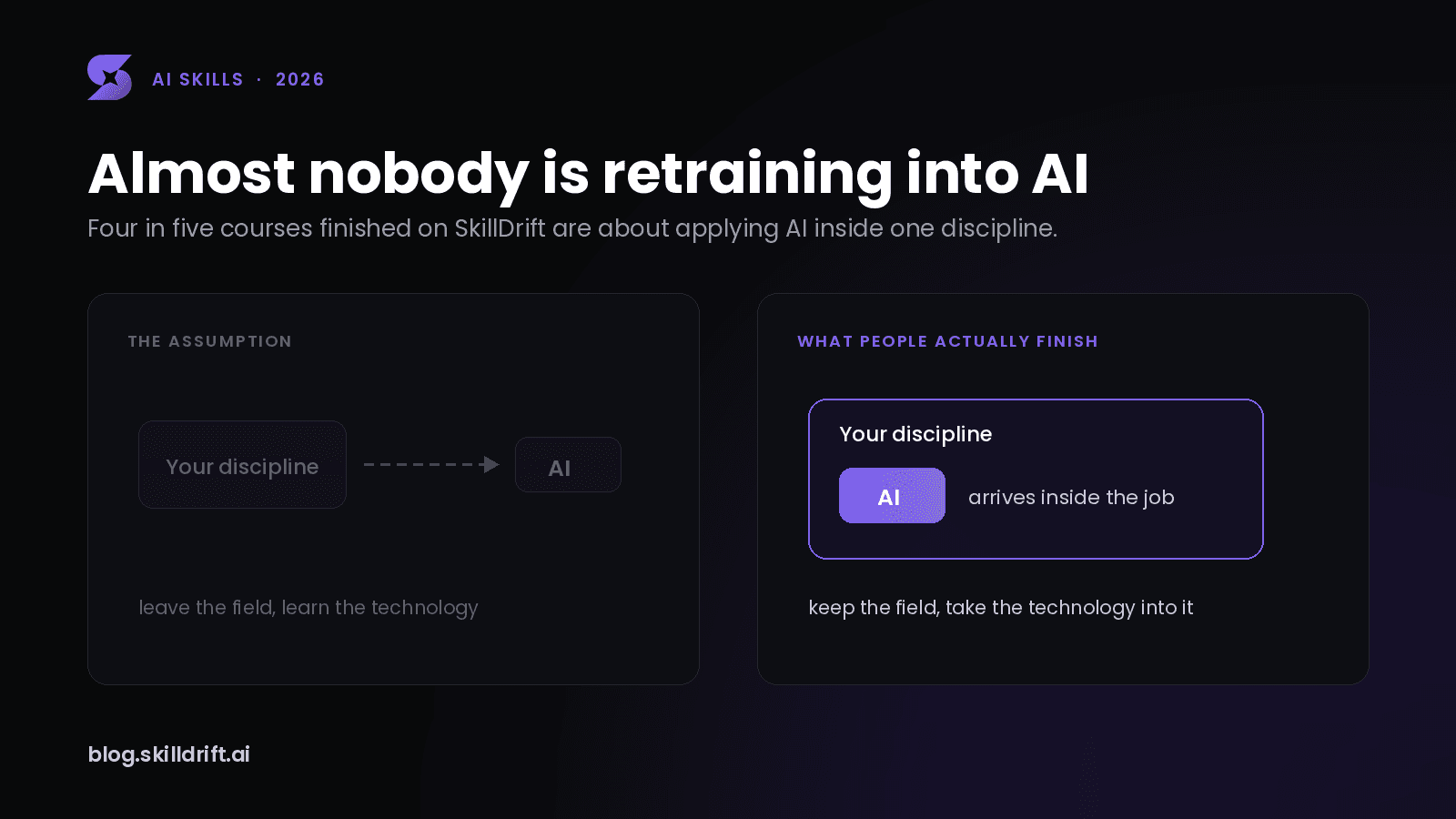
The public conversation about AI skills has one shape. Learn Python. Learn the models. Move into AI before the job you have disappears. Every skills report, every corporate training budget and most university curriculum reform runs on that assumption.
We were in a position to check it, so we did.
SkillDrift watches people close skill gaps. When somebody finishes a course on the platform we record what the course was, and that record is a small but honest view of what people choose to learn when nobody is choosing for them. We looked at every course anyone has finished, sorted by what the course was actually about.
What the numbers say
Four in five completions were about applying AI inside one named discipline. The rest were a general technical or AI course.
People are not moving into AI. They are taking it into the job they already hold.
The disciplines are wider than the AI skills conversation usually reaches. They include mechanical engineering, manufacturing engineering, electrical and electronics engineering, electronics and communication, healthcare and life sciences, HR transformation, sales and business development, customer service and support, finance and accounting, financial analysis, cybersecurity, design, system administration operations, cloud and DevOps, software engineering, full stack development, data and analytics, data science and machine learning.
Two courses carry more than half the volume between them, one in software engineering and one in data and analytics. The finding does not rest on those two. Take both out of the count entirely and the rest still lands in the same place, a clear majority studying AI inside their own field.
We had run the same count a week earlier, on a smaller base. It returned the same answer, within a point. In the days between, the number of people finishing courses grew by more than a quarter, new course names appeared, and two disciplines that were absent from the first reading turned up in the second. The ratio barely moved. That is the part worth paying attention to. The answer did not change when the question was asked again of a larger and slightly different population.
We should be straight about what this is and is not. It is the whole history of the platform rather than a quarterly sample, and SkillDrift is young, so this is not a market-wide statistic and we are not presenting it as one. What makes it worth writing down is not the volume. It is that the same pattern holds right across nineteen different disciplines, including several that rarely appear in any discussion of AI skills at all.
One case, and why it matters more than the count
A systems administrator with fifteen years in endpoint and patch management finished a course on SkillDrift recently. They did not begin with an introduction to machine learning.
They took AI for system administration operations, and the sprint that mattered to them was the one on automation and governance. The problem in front of them was not what a language model is. It was what happens when a copilot is put into an estate that has to stay patched, audited and compliant, and who answers for it when it acts.
An introduction to machine learning would never have touched that problem. It is not a worse course. It is a course about something else.
What a skill gap actually is
This is the part that gets lost.
A skill gap is not a subject. It is the distance between what a person can do today and what the role in front of them is asking for. That distance is not the same for a maintenance engineer and a recruiter, even when the underlying technology is identical. The engineer needs to know what an AI assisted inspection changes about a maintenance schedule. The recruiter needs to know what happens to a shortlist when the screening is automated and a candidate challenges the outcome.
Both of those are AI skills. Neither of them is taught by a course called Introduction to AI, because a course called Introduction to AI is the same course for everybody who takes it.
That is the structural problem with training built around a subject. The subject is fixed before anyone knows who is in the room. The gap is not. The gap belongs to a person and a role, and it changes as soon as either one moves.
Why this should change what gets measured
If you run learning and development, the question worth asking is not how many people completed an AI course. It is whether the course closed a gap that actually sat between that person and the work they do.
If you run a career centre, the same question applies to a cohort. A ranking of in demand skills written about another market, or about the industry in general, will point everyone at the same syllabus. The gaps your own graduates carry are not the same gaps.
And if you are choosing what to learn next for yourself, the useful move is to stop asking what skills are in demand and start asking what is missing between your own experience and a specific role you want. Those two questions produce very different answers, and only one of them is about you.
Where to start this week
If the distance between your experience and the role you want is the thing that matters, the useful first step is to see that distance written down.
- Upload your resume at app.skilldrift.ai and see the skills that sit between you and the role you actually want, named individually.
- Take the gap that is costing you the most and turn it into a learning roadmap built for that gap.
- As you complete the roadmap, the gap closes in real time, so the next thing worth learning is visible instead of guessed at.
Prefer to do it on your phone? SkillDrift is on Google Play and the Apple App Store.
Four in five people on our platform are already learning this way. They are not changing careers. They are refusing to let the one they have go stale.