Beyond the GPA: Why "Proof of Competence" is the New Metric for Academic Success
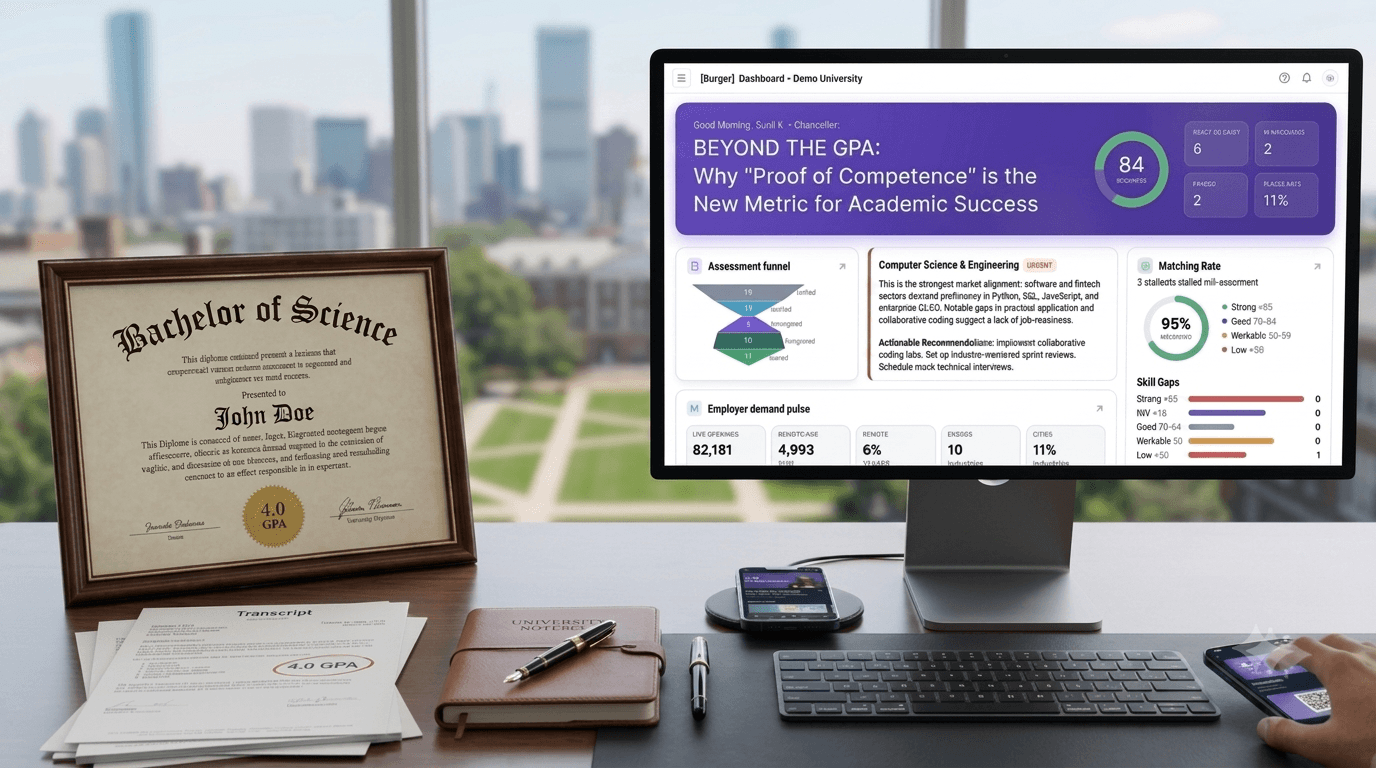
For decades, the standard covenant between higher education and the global workforce was straightforward: a high GPA from a reputable institution served as a proxy for capability, securing a graduate a high-leverage role. Today, that covenant is broken.
As enterprise operations digitize and market demands fluctuate at an unprecedented pace, the traditional transcript has lost its predictive value for employers. A 4.0/9.0 GPA proves discipline and compliance within a structured academic environment; it does not, however, prove immediate job readiness or specific micro-skill proficiency.
The global talent market is shifting from a pedigree-based model to a strict meritocracy of verified proof. To remain relevant, higher education must shift its primary metric of institutional success away from lagging indicators like graduation rates, and toward leading metrics: skill velocity and immediate targeted placement.
1. The Employer’s Paradigm Shift: Why Transcripts Fail Where Micro-Skills Succeed
Global employers - particularly in technology, financial services, and advanced engineering are systematically decoupling their hiring processes from institutional prestige. When an enterprise seeks a professional to optimize a cloud infrastructure or engineer a machine learning pipeline, a broad grade in "Computer Science II" offers insufficient data.
Employers require granular visibility into specific technical and operational competencies. Traditional transcripts compress four years of diverse learning into a single, ambiguous letter grade, creating an information asymmetry that increases hiring risk and prolongs time-to-productivity.
The Rise of the Verified Micro-Skill
In contrast, targeted micro-skills isolate and validate discrete capabilities. Rather than verifying that a candidate holds a general business degree, modern hiring systems look for competence in data-driven growth strategies, predictive financial modeling, or specific enterprise software architectures.
Live Example: Major global enterprise employers, including IBM, Google, and Accenture, have explicitly stripped degree requirements from a significant percentage of their technical and operational roles. Instead, they rely on technical assessments and validated portfolio evidence. When a candidate can prove proficiency in a specific micro-skill such as Kubernetes Deployment at Scale or Data Pipeline Optimization - the hiring decision moves from a speculative evaluation to a deterministic match.
2. The Professional Portfolio: Bypassing Entry-Level Tiers and Maximizing Leverage
For entry-to-mid-level professionals, relying on a resume stacked with course titles often results in being funneled into generic, lower-tier entry roles. Breaking out of this cycle requires moving from claiming capability to proving it.
When professionals accumulate a portfolio of industry-validated competencies, they effectively alter the dynamics of the interview process. Proof of competence bridges the experience gap, allowing younger professionals to negotiate from a position of verified utility.
Instead of following the traditional pathway where science honors lead to a generic entry-level role and slow corporate promotion, candidates who present verified micro-skills can systematically bypass administrative filtering. They enter directly into high-leverage, mid-tier, execution-focused roles on an accelerated trajectory.
The Financial and Structural Return on Competence
- Accelerated Placement: Professionals who present discrete, verified skills bypass traditional rotational programs, moving directly into specialized roles.
- Premium Compensation: Salary negotiation is fundamentally an assessment of risk mitigation. When an applicant provides a clear record of technical or analytical capability, the employer's onboarding risk drops significantly, justifying premium starting salaries and structured sign-on incentives.
3. The Institutional Mandate: From Graduation Rates to Skill Velocity
For university leadership, the strategic priority is clear: the value proposition of higher education is under active scrutiny by students, parents, and policymakers alike. Measuring institutional health purely through graduation rates or annual enrollment figures is no longer sustainable.
The modern academic institution must optimize for skill velocity - the rate at which a student acquires, validates, and deploys contemporary, market-relevant skills relative to shifting macroeconomic demands.
If a curriculum takes three years to adapt to an industry shift, its graduates are structurally obsolete upon graduation. Academic success must be redefined as the agility with which an institution maps its foundational theory to granular, real-world competencies that employers can instantly identify and trust.
4. The SkillDrift Architecture: Enterprise-Grade Infrastructure for Higher Education
Transitioning an institution from a traditional grading paradigm to a dynamic competence ecosystem requires sophisticated underlying infrastructure. The SkillDrift University Edition provides the framework necessary to bridge the gap between academic instruction and global employment opportunities, embedding actionable skill-building directly into the student lifecycle.
Asynchronous, In-Built Micro-Learnings
One of the most significant challenges universities face is the friction involved in constantly overhauling core curricula to match real-time market trends. SkillDrift solves this structural bottleneck by providing a robust ecosystem of in-built micro-learnings.
Students are empowered to engage with these highly targeted, industry-specific modules asynchronously, at their own pace. This self-serve model vastly reduces the friction between the university administration and the student body. Institutions can maintain their rigorous, foundational degree structures, while students independently acquire the exact, up-to-the-minute micro-skills that global employers are actively demanding.
Dynamic B2B Employability Dashboards
SkillDrift operates as a translation layer between academic progress and live market demand. Through a centralized B2B dashboard, university chancellors and department heads gain real-time visibility into the actual job readiness of their cohorts.
- Granular Competency Tracking: The platform translates a student's engagement with micro-learnings into a standardized matrix of actionable capabilities.
- Predictive Institutional Insights: Leadership can track aggregate employability metrics, identifying precise skill gaps within their student body relative to current hiring trends long before the graduation cycle concludes.
The Aggregated Market Matching & Targeted Upskilling Engine
The core operational leverage of the SkillDrift architecture lies in its ability to centralize real-world demand and create an optimized, friction-free path to employment for students.
- Comprehensive Opportunity Aggregation: Rather than relying on isolated institutional partnerships, SkillDrift collates extensive job and internship opportunities from platforms across the entire digital ecosystem. This gives students a holistic view of the active global labor market within a single interface.
- Automated Gap Analysis: When a student aligns their profile with these live market opportunities, the platform automatically diagnoses their precise technical and operational skill gaps. It identifies exactly what stands between the student and a high-leverage role.
- Targeted Remediation & Direct Feedback Loops: Once a gap is identified, SkillDrift points the student directly to the specific, in-built micro-learnings required to plug that deficit.
- Frictionless Signaling for Employers: As students systematically complete these modules and upskill on the platform, their objective job-matching metrics steadily improve. This upward trajectory provides a clear, high-fidelity signal to employers that the candidate possesses the exact, verified micro-skills required for the role. By removing the guesswork from hiring, the platform drastically reduces friction between expanding enterprises and qualified student talent.
Conclusion: The Road Forward for Higher Education
The democratization of knowledge means that information itself is no longer a scarce commodity. The value of modern education lies not in the gatekeeping of content, but in the rigorous, targeted development of capability.
Universities that continue to benchmark success against historical GPA metrics risk institutional misalignment with the global economy. By embracing a framework centered on asynchronous skill-building and dynamic market matching, forward-thinking institutions can ensure their graduates possess the precise skill velocity required to lead the modern workforce. Through integrated infrastructure like SkillDrift, academia and enterprise can finally speak the same language: the language of verified capability.
Looking to know more, drop us an email at sales@skilldrift.ai
Where to start this week
Proof of competence is not something you wait for. It is something you start building this week.
- Upload your resume at app.skilldrift.ai and see your gaps against the role you actually want.
- Take the highest impact gap and start the roadmap for it.
- Run one mock interview for that target role and read the report honestly.
Prefer to do it on your phone? SkillDrift is on Google Play and the Apple App Store.
Proof only counts if it is readable. Find out what a good ATS score actually means, check whether your resume is ATS friendly, and see how AI analyzes your resume before deciding the transcript is the problem.
A GPA describes what you did. Evidence describes what you can do next.