Communication is still the most requested skill in job postings. Python has closed nearly two thirds of the gap.
This is the second reading from the SkillDrift Jobs Index. The first, published on 11 September, answered a level question: which skills the whole index asks for most. The answer was communication, ahead of Python. This reading answers the harder question, which is what is changing, and from here we publish a reading every month.
We hold 371,304 job listings in our index, and every one of them is read for the skills it asks for. We are adding roughly 29,000 a week at the moment, against roughly 16,000 a week in June, so this is a live index rather than a fixed snapshot. This piece compares two thirty day windows of what arrived: 16 June to 15 July, and 15 August to 13 September. That is 194,959 postings between them. A level tells you where things stand. A direction tells you what to do about it.
Which skills are employers asking for most in 2026?
Communication first, Python second, and Python has closed nearly two thirds of the distance between them in a single quarter.
Communication appears in 16.40 percent of postings in the recent window. Python appears in 13.19 percent. Three months earlier those figures were 17.96 and 9.18. Communication has not collapsed. Python has risen underneath it.
Every engineering skill rose, and almost every human skill fell
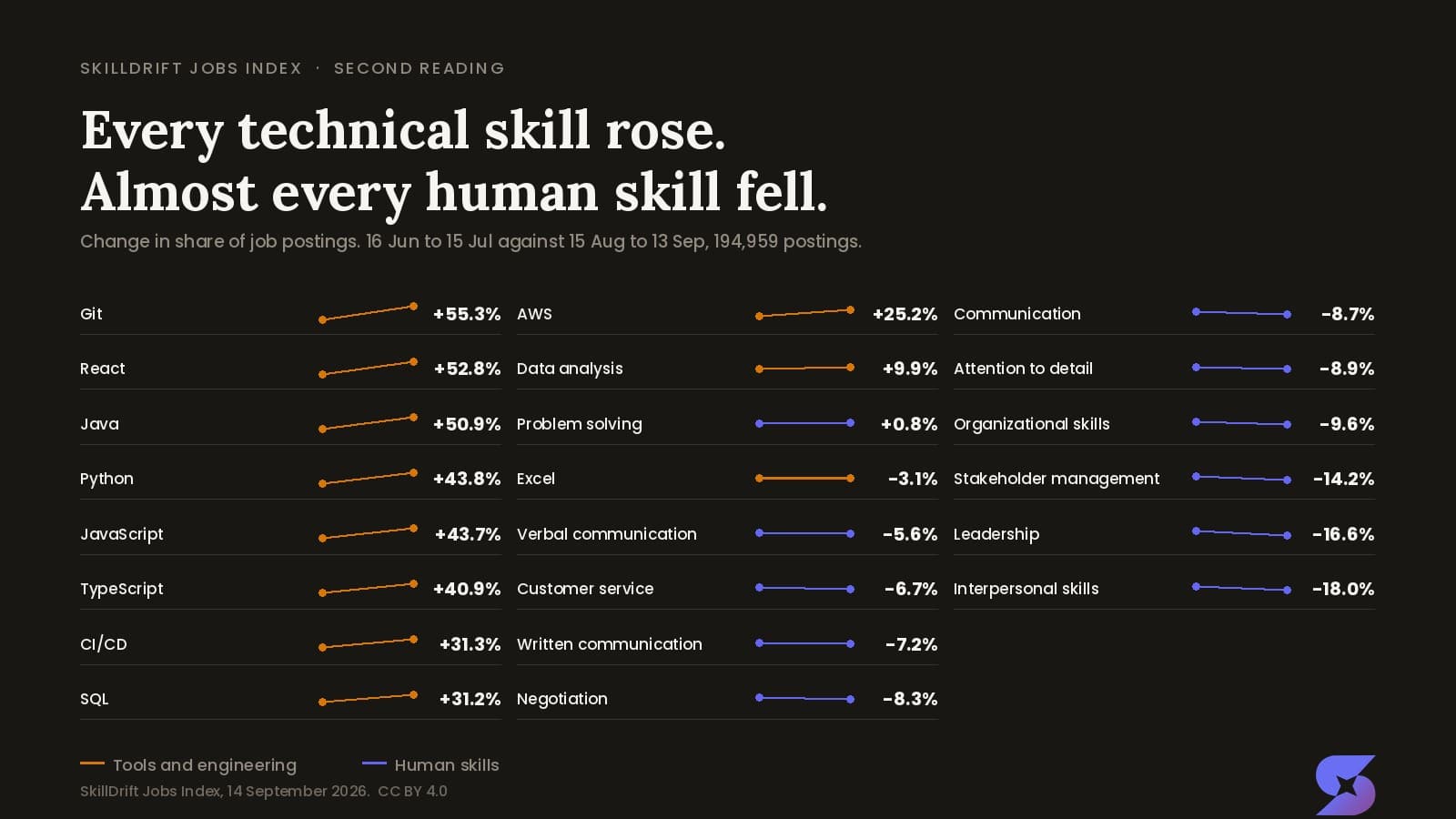
Here is each skill as a share of all postings, in the earlier window and the recent one. Rising first.
- Git, 5.10 to 7.92, up 55.3 percent
- React, 3.58 to 5.46, up 52.8 percent
- Java, 4.14 to 6.25, up 50.9 percent
- Python, 9.18 to 13.19, up 43.8 percent
- JavaScript, 5.82 to 8.37, up 43.7 percent
- TypeScript, 2.79 to 3.93, up 40.9 percent
- CI/CD, 4.25 to 5.58, up 31.3 percent
- SQL, 7.96 to 10.45, up 31.2 percent
- AWS, 3.70 to 4.63, up 25.2 percent
- Data analysis, 4.76 to 5.23, up 9.9 percent
- Problem solving, 8.78 to 8.85, up 0.8 percent
Now falling.
- Excel, 5.36 to 5.20, down 3.1 percent
- Verbal communication, 3.86 to 3.64, down 5.6 percent
- Customer service, 4.17 to 3.89, down 6.7 percent
- Written communication, 4.54 to 4.21, down 7.2 percent
- Negotiation, 3.48 to 3.19, down 8.3 percent
- Communication, 17.96 to 16.40, down 8.7 percent
- Attention to detail, 6.51 to 5.93, down 8.9 percent
- Organizational skills, 4.32 to 3.91, down 9.6 percent
- Stakeholder management, 7.33 to 6.29, down 14.2 percent
- Leadership, 3.56 to 2.96, down 16.6 percent
- Interpersonal skills, 3.99 to 3.27, down 18.0 percent
Every engineering skill we track rose. Every human skill fell except problem solving, which held flat. A split that clean is unusual enough to be worth stating carefully rather than dramatically.
How we counted this
Each figure is a skill's share of all job postings that entered the index in that window, not its share of some selected basket. We tried the basket version first and discarded it, because a basket weighted toward engineering skills pushes every other skill down automatically as those skills rise. It made communication look roughly twice as weak as it is.
The denominator is therefore actual posting volume: 68,319 postings in the earlier window and 126,640 in the recent one. The index grew over the period, which is why shares rather than counts are the only honest comparison.
The obvious objection, and the test we ran
If we simply started collecting more software jobs, every engineering skill would rise and every human skill would fall, and this whole piece would be about our own pipeline rather than about employers.
That did happen, partly. Software went from 18.41 percent of the postings we took in to 22.17 percent. So the objection is real and it needed testing rather than dismissing.
The test is whether that shift alone could produce the movement we see. Take Python. For a change in the software share of that size to explain a rise from 9.18 to 13.19, Python's rate inside software postings would have to exceed its rate everywhere else by 106.6 percentage points. A rate cannot differ by more than 100. So it is not possible, even if Python appeared in every software posting and in none anywhere else.
Run the same arithmetic on communication and it implies a negative rate, which is also impossible.
Both moves are larger than any change in our mix can account for. What employers ask for inside each industry changed, not only how many postings each industry contributed.
What this does not say
Four limits, stated plainly.
This is our index, not a census of the labour market. It is a large sample of what we ingest.
The test above bounds how much our own intake mix could be contributing. It does not reduce that contribution to zero, and no study of this kind separates the two perfectly.
Ninety days is one comparison between two windows. It is not a trend line, and one quarter is not a direction of travel.
And a skill appearing in a posting is a statement of what an employer wrote down. It is not proof of what the job actually needs.
What to do with this if you are planning a move
The useful reading is not that communication stopped mattering. It plainly has not, since it is still the most requested skill in the index by a clear margin. The useful reading is that the ground moves faster than most people check.
If you last looked at a job description for your target role a year ago, the list has changed underneath you, and the specific skills that changed are the ones worth naming rather than guessing. The first reading of this index sets out the full ranking, which is the place to start if you want the level rather than the direction. Once you have both, running a skill gap analysis on yourself is how you turn either one into a list you can act on.
Upload your resume to SkillDrift and it reads it against the role you actually want, names each skill you are missing rather than returning a single score, and builds the learning path that closes those gaps. As you close them your resume updates and your match scores move with it.
If you would rather work in the app, SkillDrift is on the App Store and on Google Play, on one profile across web, iOS and Android.
Licence, method and how to cite this
This data is published under a Creative Commons Attribution 4.0 International licence. You may use these figures, including commercially, with attribution.
Snapshot date: 14 September 2026. Index size at snapshot: 371,304 listings. Study corpus: 194,959 postings. Windows: 16 June to 15 July 2026 and 15 August to 13 September 2026. Skill shares are calculated against total postings ingested per window.
Suggested citation: SkillDrift Jobs Index, second reading, "Communication is still the most requested skill in job postings. Python has closed nearly two thirds of the gap", 14 September 2026, blog.skilldrift.ai.
Readings are published monthly. If you want a cut we have not published, such as a different window or a different set of skills, write to sales@skilldrift.ai and we will run it.