How ATS Systems See You in 2026 (And How to Hack Them)
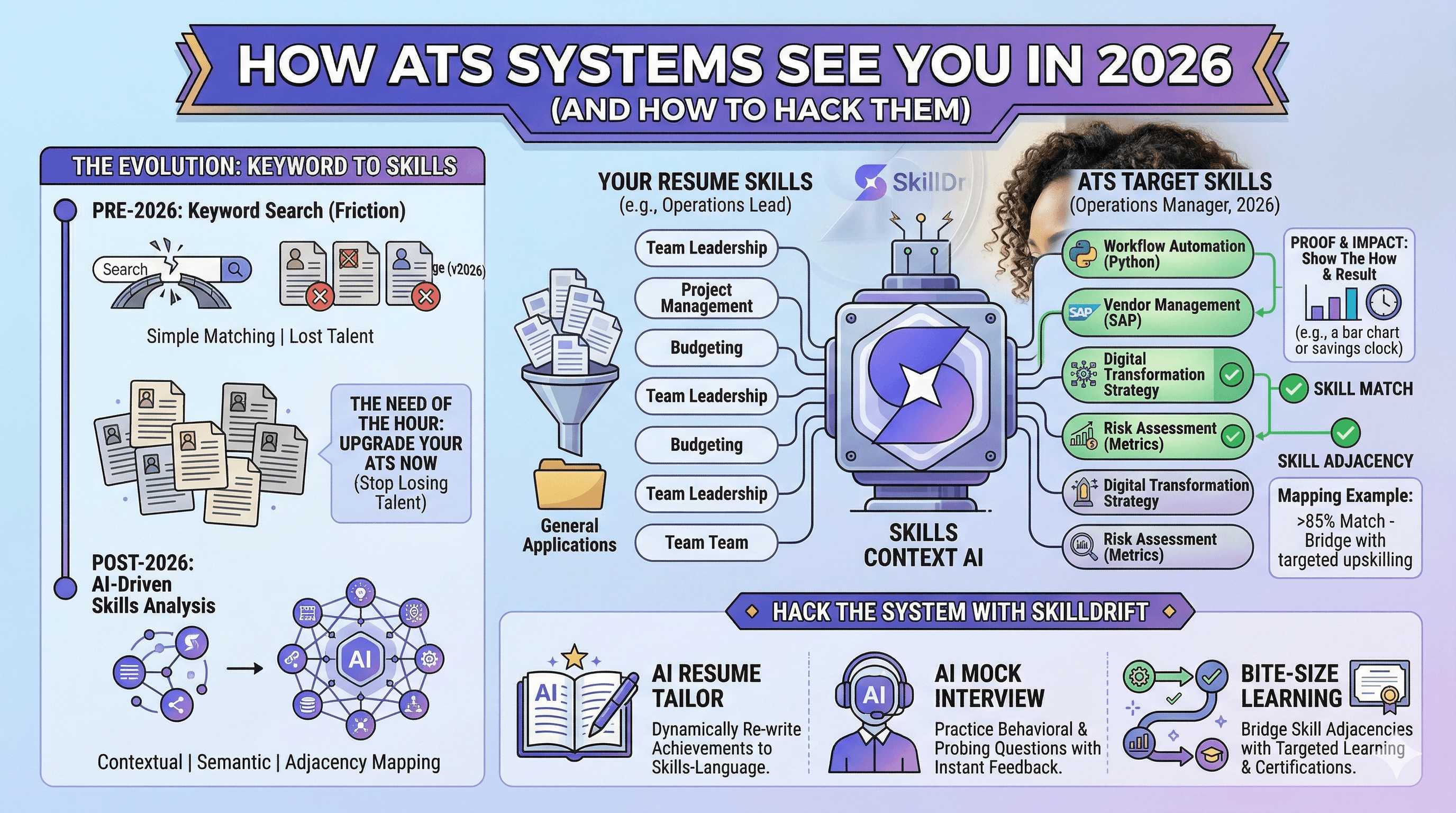
If you’ve applied for a job anytime in the last decade, you already know the feeling. You send your carefully crafted resume into the digital void, cross your fingers, and wait for a response that often never comes.
For years, the Applicant Tracking System (ATS) has been the ultimate gatekeeper, treating human potential like a giant game of digital bingo. But the rules of the game are fundamentally changing right beneath our feet. As we navigate through 2026, the modern ATS is evolving from a passive document reader into an active, intelligent analyzer of your real-time skills footprint.
Here is a deep dive into how hiring algorithms are shifting, why companies desperately need to upgrade their infrastructure today, and how you can "hack" the new system to land your next role.
The Ghost of ATS Past: The Keyword Friction
Before we talk about where we are going, we need to understand the broken system we are leaving behind. The legacy ATS models that dominated the 2010s and early 2020s were essentially glorified, rigid search engines based on Boolean logic. They operated on strict keyword matching, parsing for static nouns rather than actionable verbs.
If an employer needed a "Project Manager" with "Agile" experience, the ATS scanned for exactly those words.
The Result? Massive job market friction. Brilliant candidates were automatically rejected because they used the term "Scrum Master" instead of "Agile," or "Operations Lead" instead of "Project Manager." A candidate could have five years of hands-on experience doing the exact job the employer needed, but because they didn't speak the specific "ATS dialect," they were discarded.
Employers desperately wanted your exact skill set, but they literally couldn't find you buried under a pile of perfectly keyword-stuffed (but often underqualified) resumes. It created a lose-lose situation: ghosted candidates and empty corporate desks.
The 2026 Imperative: Why Companies Are Forced to Upgrade Now
As we discussed in our recent post, The $5.5 Trillion Skills Gap: Why Companies Can't Find You (Even When You're Qualified), the global economy is bleeding trillions of dollars. But this isn't due to a talent shortage; it’s an infrastructure failure.
To survive in this market, companies are realizing they must urgently replace their legacy ATS software. It is no longer an optional IT upgrade; it is a critical business imperative. Relying on archaic keyword searches actively harms businesses by blinding them to the highly qualified talent sitting right in their own applicant pools. Every day a position sits open because of a bad ATS filter, companies lose money, product roadmaps stall, and existing teams burn out.
The companies waking up to this reality are currently migrating to next-generation, AI-driven ATS platforms. And when they do, the system stops caring about your past job titles and starts looking for your verified capabilities.
How the Modern AI-Driven ATS Sees You
Powered by contextual AI and semantic search, these modern systems process information much closer to how a human hiring manager does. They understand skill adjacency, context, and trajectory.
- They Understand Semantic Context (Reading Between the Lines): Legacy systems looked for exact matches. Modern AI understands synonyms and related concepts. If you were an "Event Coordinator," the AI knows you possess logistics, vendor management, and budget tracking skills, even if you didn't explicitly list those exact phrases.
- They Measure Skill Depth and Proof: Anyone can write "Leadership" on a resume. The 2026 ATS analyzes how you describe your achievements to gauge the depth of your skills. It looks for metrics, scope, and action-oriented results rather than just checking off a list of buzzwords.
- They Map "Skill Adjacencies": This is the biggest game-changer. If a job requires a specific proprietary software you haven't used, but you have deep expertise in three highly similar competing platforms, the AI flags you as having a "high skill adjacency." It tells the employer: This candidate doesn't have the exact tool, but their learning curve will be practically zero.
- They Track Market Trends: They know which skills are currently trending and dynamically cross-reference your experience with the real-time demands of the role and industry standards.
To the modern ATS, you are no longer a static PDF. You are a dynamic cluster of capabilities and potential.
How to "Hack" the Modern ATS
You can't trick an AI with white text, invisible ink, or mindless keyword stuffing anymore. The new "hack" is radical clarity, deep contextual alignment, and proving your adaptability. Here is how you beat the bots in 2026:
- Ditch the Title Focus: Stop worrying if your previous title perfectly matches the job description. Instead, break down your past roles into the core competencies, technologies, and methodologies you actively executed.
- Show the "How" and "Impact" (The Verb > The Noun): Don't just list "Data Analysis." The AI looks for context. Use bullet points that explain how you used the skill and the measurable result it generated.
- Bad: "Used Python for data analysis."
- Good: "Automated financial reporting using Python, reducing weekly processing time by 15 hours and increasing data accuracy."
- Highlight Skill Agility: Modern systems reward candidates who show a trajectory of continuous learning. Highlight recent certifications, self-taught software skills, and cross-functional projects that prove you can bridge skill adjacencies quickly.
- Keep the Formatting Clean but the Content Rich: While AI is better at reading complex layouts than old parsers, it still prefers clean, logical structures. Spend less time on fancy graphics and more time ensuring your bullet points tell a cohesive story of capability.
Enter SkillDrift: Your AI Counter-Offensive
If companies are finally adopting advanced AI to screen you, it only makes sense to use advanced AI to prepare yourself. You can't bring a static document to an algorithmic arena.
That’s where SkillDrift comes in.
We built SkillDrift specifically to navigate the evolving 2026 hiring landscape. Our platform ensures that when the modern ATS scans your profile, it sees exactly what it’s looking for:
- The AI Resume Tailor: Stop guessing what the algorithm wants. Our Resume Tailor analyzes the specific job description you're targeting and cross-references it with your existing experience. It dynamically rewrites and translates your past achievements into the exact contextual skills-language the modern ATS is programmed to flag as a top-tier match - without fabricating experience.
- Mock Interview Tools: Getting past the ATS is only step one. Once the AI flags you as a match, you need to prove it. SkillDrift’s AI-driven Mock Interviews simulate the exact behavioral and skill-probing questions you’ll face based on your newly tailored resume. Practice in real-time, get instant feedback on your delivery, and walk into the real interview with absolute confidence.
- Bite-Sized Learning & Targeted Certifications: Continuous upskilling is the ultimate ATS hack. SkillDrift provides bite-sized learning modules with in-built resources designed to bridge your specific skill adjacencies. We offer targeted certification pathways based directly on your career aspirations, ensuring your profile is always evolving to meet market demands.
The era of the resume black hole is finally ending. Employers are waking up and buying the tools to find the right skills, which means you need the tools to showcase them accurately.
Don't let legacy software or transitioning algorithms decide your worth. Take control of your career narrative with SkillDrift today.
Start by uploading your resume for us to analyze your current skills or build ATS friendly resume.
Built for progressive talent.
If you want to see what a parser makes of your own document first, the ATS resume checker rates it and names what is holding it back.
Customer service postings often name the tools, and the customer service skills page shows the skills employers ask for, from ticketing and CRM systems to live chat.
Where to start this week
If the ATS is reading skills rather than keywords, the fix is to have the skills.
- Upload your resume at app.skilldrift.ai and see your gaps against the role you actually want.
- Take the highest impact gap and start the roadmap for it.
- Run one mock interview for that target role and read the report honestly.
Prefer to do it on your phone? SkillDrift is on Google Play and the Apple App Store.
Want to see how a screening system reads your own resume before you apply? Run it through the ATS score checker and look at which parts of the role it could not find.
You cannot hack a scanner that reads what you can actually do. You can only close the gap.