Interview Questions for Freshers in 2026: What They Test and How to Practise Them
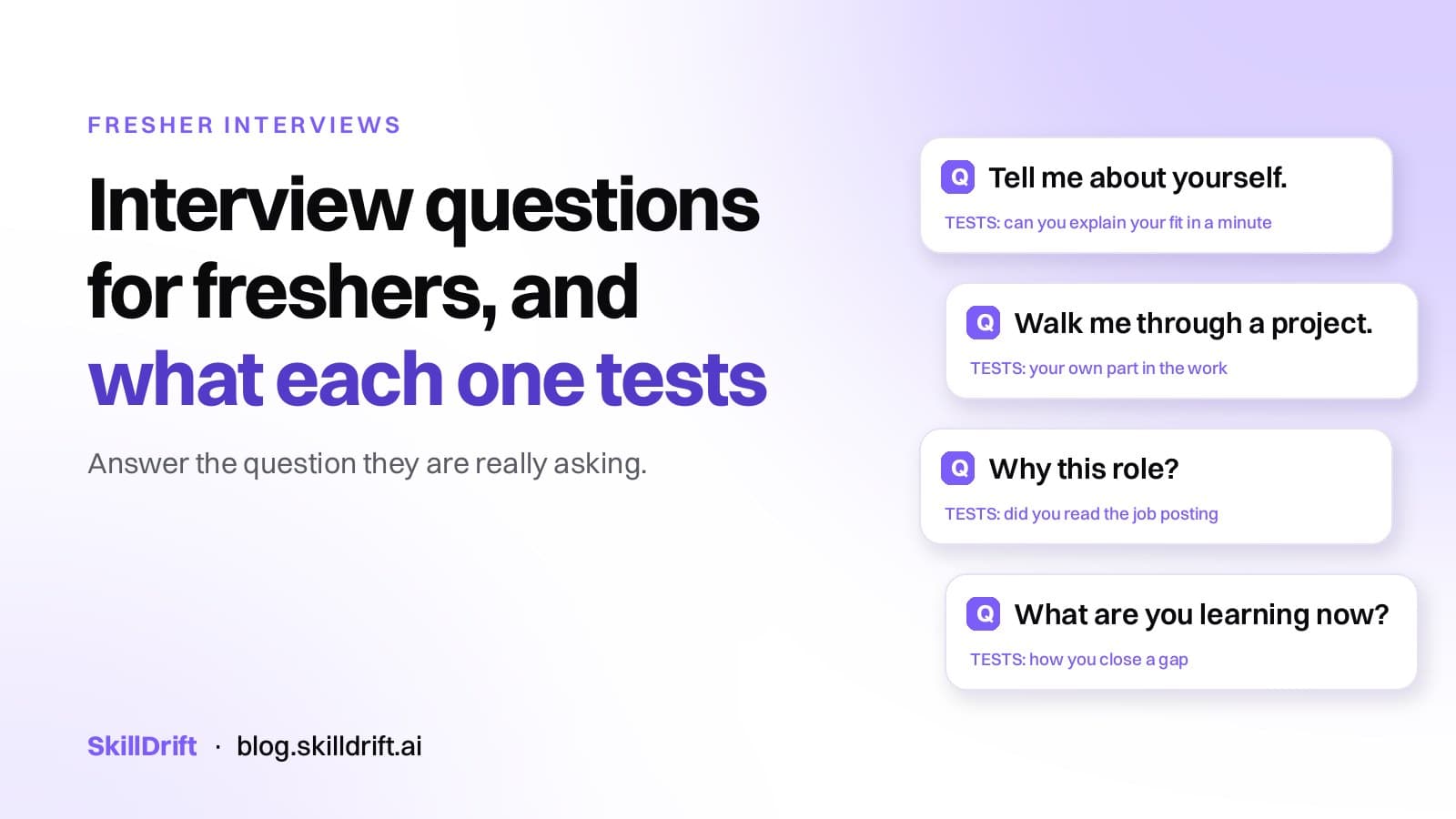
Most fresher interviews ask the same ten or so questions. Each one tests something specific: whether you can explain your fit, whether you read the job posting, and whether you can show a skill with real work. Prepare for what each question tests, and practise out loud against one real posting.
What does an interviewer test in a fresher interview?
An interviewer cannot judge years of experience, because a fresher has none. So the questions test five other things:
- Whether you can explain who you are and why this role fits, in about a minute.
- Whether you know the basics of the field the role sits in.
- Whether you can show a skill with something you have actually done: a project, an internship, coursework or volunteer work.
- How you learn and solve problems when you do not know the answer.
- How you work with other people.
Every common question maps to one of these. Once you know which one a question tests, the answer is easier to plan.
What are the most common interview questions for freshers?
Tell me about yourself.
It tests whether you can explain your fit in a minute. Keep it to three parts: what you studied or did, one piece of work you are proud of, and why this role is the next step. Leave out your full history.
Why do you want this role?
It tests whether you read the job posting. Name two things the posting asks for and connect each one to something you have done or are learning. A general answer about the company's reputation leaves that question open.
Walk me through a project.
It tests your own part in the work. Say what the problem was, what you did yourself, the tools you used and what happened at the end. If it was a group project, be clear about which part was yours.
What are your strengths?
It tests whether you can back up a claim. Pick one strength the posting asks for and give one example that shows it.
What is your weakness?
It tests self awareness. Name a real skill you are still building, and say what you are doing about it this month.
Tell me about a time you worked in a team.
It tests how you work with others. Use one example with a clear situation, your action and the result. Group assignments, college events and internships all count.
Tell me about a mistake you made.
It tests how you learn. Describe the mistake briefly, then spend most of the answer on what you changed afterwards.
What are you learning right now?
It tests how you close a gap. Name a skill the role needs, how many hours a week you give it, and what you can already do with it.
Where do you see yourself in three years?
It tests whether this role is a step in a plan. Describe the next role you want and the skills you will build here to reach it.
Do you have any questions for us?
It tests interest. Ask one question about the work itself, for example what a new joiner works on in the first three months.
What are the common HR interview questions for freshers?
The HR round checks practical fit more than skill. Expect these:
- What salary do you expect? Give a range based on what similar roles in your city pay, and say you are open to discussion.
- Are you willing to relocate or work shifts? Answer honestly. A yes you cannot keep causes problems later.
- When can you join? Give a real date, including any notice or exam dates.
- Why is there a gap in your education or your resume? Give the reason in one sentence and say what you did in that time.
How do you answer interview questions with no work experience?
Use the work you have done outside a job. A college project, an internship, a hackathon, a freelance task or a volunteer role can all show a skill. Describe each one the same way: the situation, what you did, and the result. Interviewers for fresher roles expect examples from these places.
How should a fresher practise interview questions?
- Pick one real job or internship posting for the role you want.
- List the skills it names. Count which ones appear most often if you read several postings for the same title.
- For each skill, prepare one short story from your own work that shows it.
- Practise out loud. Written answers read well and often sound different when spoken.
- Get feedback on each answer, fix the weakest one, and practise again.
The point of step 2 is to know what the interview will test before you walk in. To see what postings in your field ask for, start with skills in demand, by role and industry.
What does SkillDrift do for fresher interviews?
SkillDrift starts with your goal. Choose "First job or internship", upload your resume, and SkillDrift scores every job and internship out of 100 against it. It is built for people with less than a year of experience as well as for experienced professionals, so the internships you see are matched to what you can already show.
When you find a role you want, you can practise the interview for that exact job. There are three ways to practise:
- Text interview: you type answers to questions written for that job and your resume. You get a score out of 10, your hire chance, feedback and a strong answer for every question.
- Voice practice: you hear each question and record a spoken answer. The report adds how clearly and confidently you spoke, and your answers transcribed.
- Live interview: a live interviewer asks, listens and follows up, like the real round.
Every report ends with what to fix next, and the gaps it finds can become a learning roadmap. When you finish a roadmap, the certificate goes onto your resume and the jobs that ask for that skill score higher. This is what we call closed loop career development: measure the gap, close it, prove it, then measure again.
Frequently asked questions
How many questions are asked in a fresher interview? It varies by employer. Prepare for the ten above and expect a follow-up on each.
Should I memorise my answers? Memorise your stories and let the wording change. A memorised answer sounds flat, and follow-up questions break it.
What if I do not know the answer to a technical question? Say what you do know, explain how you would find the rest, and do not guess.
Is the HR round harder than the technical round? It is different. The technical round tests skill; the HR round tests whether the practical details work for both sides.
Where to start this week
- Pick one posting for the role you want and list the skills it names.
- Prepare one story for each of the three skills it names most.
- Or check your resume against real jobs on SkillDrift, then practise the interview for the one you want.
Prefer your phone? SkillDrift is on Google Play and the Apple App Store.
Know someone preparing for their first interview? Send them this list.
Every interview question tests something. Find out what, and answer that.