Python's share of job postings rose by three quarters in ten weeks
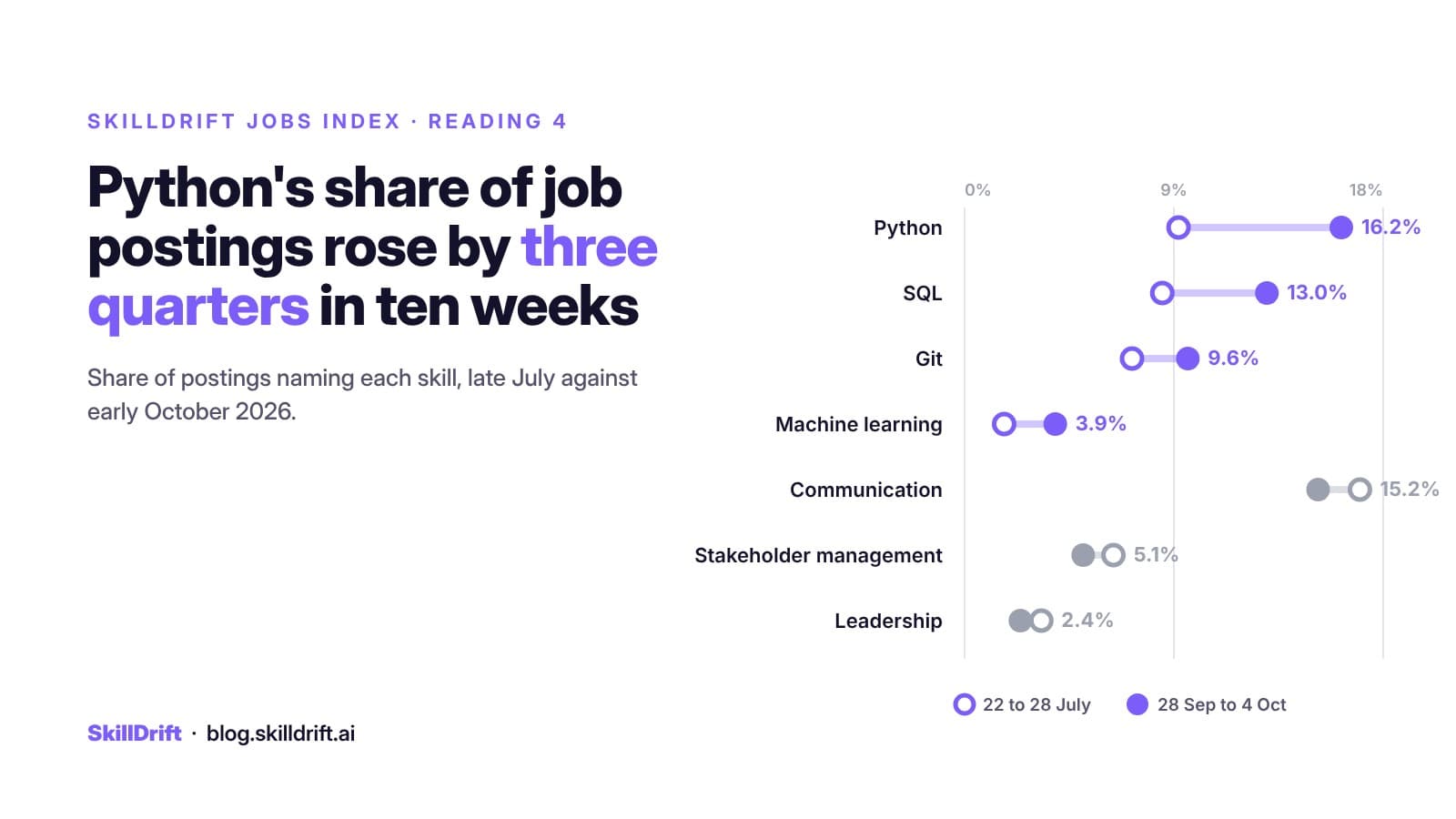
Fourth reading from the SkillDrift Jobs Index. 23 October 2026.
Key findings
- Python is now named in one job posting in six. In late July it was one in eleven. Its share rose from 9.2 per cent to 16.2 per cent between 22 July and 4 October 2026.
- Data skills rose with it. SQL went from 8.5 to 13.0 per cent, and machine learning more than doubled, from 1.7 to 3.9 per cent.
- Postings name broad people skills less often. Communication fell from 17.0 to 15.2 per cent, stakeholder management from 6.4 to 5.1 per cent, and leadership from 3.3 to 2.4 per cent.
- The skills employers name moved within one quarter. Hiring on degrees and years of experience cannot keep up with that pace. Hiring on skills can.
The skills that rose
Share of postings naming each skill, first week of the window (22 to 28 July) against the last week (28 September to 4 October).
- Python, 9.2 to 16.2 per cent, up 76 per cent
- SQL, 8.5 to 13.0 per cent, up 53 per cent
- Git, 7.2 to 9.6 per cent, up 32 per cent
- Java, 4.9 to 6.9 per cent, up 41 per cent
- React, 5.0 to 6.4 per cent, up 29 per cent
- Excel, 5.1 to 6.1 per cent, up 20 per cent
- Data analysis, 4.8 to 5.8 per cent, up 20 per cent
- Docker, 3.0 to 4.1 per cent, up 35 per cent
- Machine learning, 1.7 to 3.9 per cent, up 129 per cent
- Power BI, 2.4 to 3.3 per cent, up 35 per cent
- Tableau, 1.4 to 1.9 per cent, up 39 per cent
- Generative AI, 0.8 to 1.3 per cent, up 74 per cent
Python and SQL added the most points. Machine learning and generative AI grew fastest, from a small base.
The skills postings name less often
- Communication, 17.0 to 15.2 per cent, down 11 per cent
- Stakeholder management, 6.4 to 5.1 per cent, down 21 per cent
- Customer service, 4.1 to 3.4 per cent, down 18 per cent
- Leadership, 3.3 to 2.4 per cent, down 28 per cent
- Time management, 3.2 to 2.7 per cent, down 16 per cent
- Sales, 2.9 to 2.2 per cent, down 25 per cent
- Project management, 2.8 to 2.0 per cent, down 29 per cent
Communication is still named in more than one posting in seven. The likely reason for the fall: postings spend more of their lines on tools and data work, and people skills are tested at interview.
How Python got there
Share of postings naming Python, by week.
- Week of 27 July, 9.5 per cent
- Week of 10 August, 10.1 per cent
- Week of 24 August, 13.7 per cent
- Week of 7 September, 16.2 per cent
- Week of 14 September, 17.5 per cent
- Week of 28 September, 16.2 per cent
The rise came in two steps, in late August and in early September. Python passed communication on 13 September and stayed ahead to the end of the window. The software share of the index also grew in this period. The Python and communication moves are larger than that change in mix can produce, so they happened inside industries.
Where the market is going
Data skills are rising as a group. SQL, Excel, data analysis, Power BI and Tableau all rose together. The direction points to more roles where people are expected to pull, read and present their own numbers.
AI demand shows up as foundation skills. Generative AI is still named in about one posting in 75. Python, SQL and machine learning, the skills AI systems are built and run with, added far more. Employers are hiring people who can build with AI and work with its data.
Skills move faster than job titles. Job titles change slowly. The skills postings name moved within one quarter. A resume written for the summer market may already be out of date.
Why skills based hiring is the way to go
A degree is earned once. Years of experience grow at one year a year. The most requested technical skills rose by half or more in ten weeks. Only a hiring process built on skills can track a market that moves at that speed.
The case is already made at scale. LinkedIn's Economic Graph found in March 2025 that a skills based approach could expand the talent pool for a typical job by 6.1 times. Practice has not caught up. A 2024 study by Harvard Business School and the Burning Glass Institute found that dropping degree requirements changed fewer than 1 in 700 hires in 2023.
The gap between intent and practice is a measurement problem. Employers need to see a skill proven, and candidates need to know which skills to prove. When both sides work from the skills in live postings, a hiring decision can rest on what a person can do today.
What to do with this if you are planning a move
Read the postings for the role you want, every few weeks. Close the gaps that appear in most of them, and put the proof on your resume.
If you are aiming at data work, the data engineer skills page lists what postings ask for, from SQL and Python to data pipelines. For any other role group and industry, see skills in demand by role and industry.
- Upload your resume to SkillDrift and see your gaps against the role you want.
- Every job and internship in the index is matched against your resume and scored out of 100.
- Each gap becomes a learning roadmap, and the gap closes as you work through it.
The app is also on Google Play and the Apple App Store.
About the data
The SkillDrift Jobs Index reads every posting that enters it and records the skills the posting names. A share is the percentage of postings entering the index in a period that name a skill. This reading covers 322,170 postings that entered the index between 22 July and 4 October 2026, across 18 industries. Spelling variants of the same skill are counted together. As at 20 October 2026 the index holds 609,663 live postings.
Suggested citation: SkillDrift Jobs Index, fourth reading, 23 October 2026. blog.skilldrift.ai. Licensed under Creative Commons Attribution 4.0. For a cut by role, industry or week, ask and we will pull it.