40% of Jobs Are Changing. Stop Asking Chatbots to Guess Your Future.
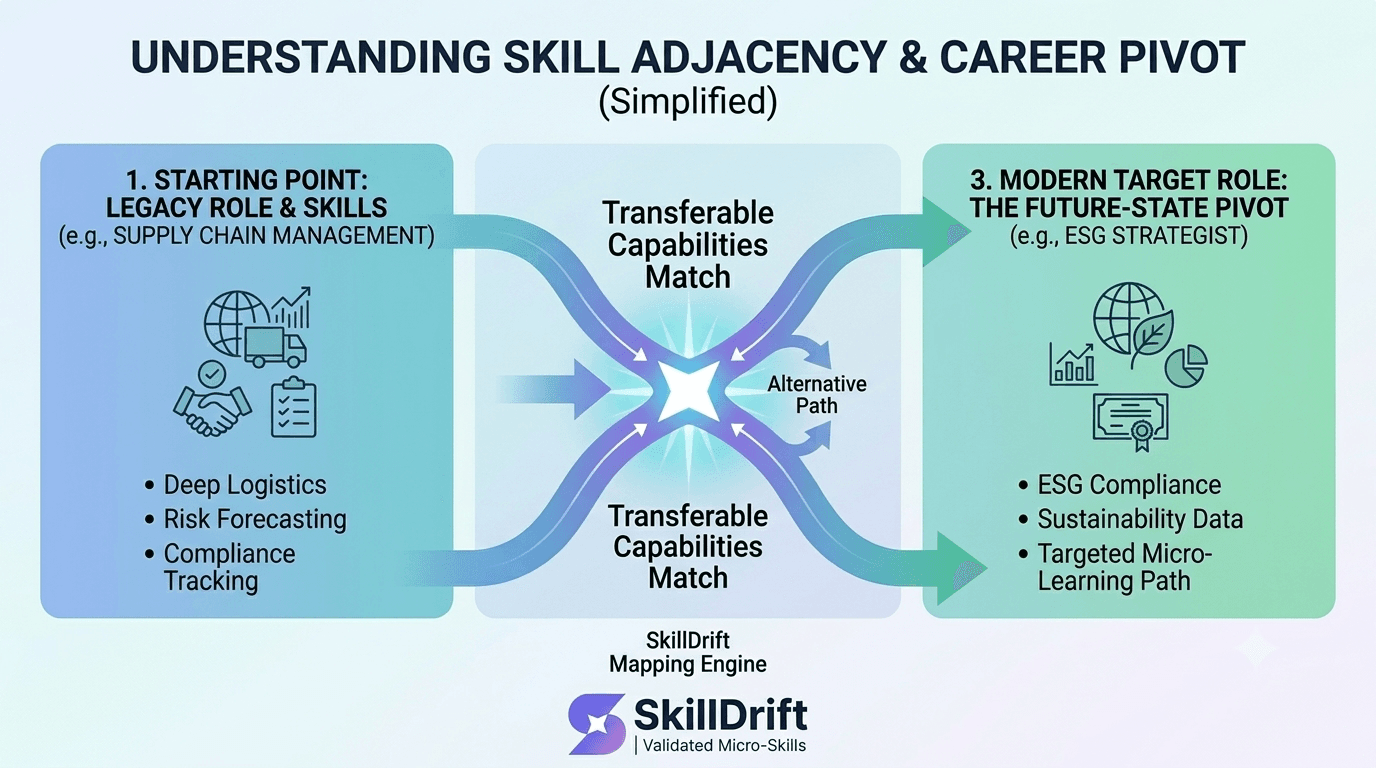
For decades, career progression was a straightforward calculation: earn a degree, enter a vertical industry, and climb the ladder rung by rung. Today, that ladder has been replaced by a complex, rapidly shifting web. The World Economic Forum estimates that over 40% of core skills required for existing jobs will change in the next few years.
Faced with this volatility, professionals across the globe from London to Singapore, New York to Mumbai, are understandably anxious. Millions have turned to generative AI for guidance. We prompt chatbots to rewrite our resumes, optimize our LinkedIn profiles, and ask, "What should my next career move be?"
While conversational AI is a fantastic tool for generating text, relying on it to plan your livelihood exposes a critical flaw: Algorithms understand syntax, but they do not understand talent architecture. A generic LLM can only provide a static list of suggestions. It leaves you stranded with the heavy lifting of figuring out the how, when, and where.
Here is why your next career pivot requires a validated map and active progression management, not an educated guess.
The Danger of "Hallucinated" Pathways
When you ask a standard AI model for career advice, it synthesizes the "average" advice found on the internet. It doesn't analyze live labor markets, and more importantly, it cannot objectively validate your unique baseline of experience.
Imagine a mid-career professional looking to pivot. The standard AI advice is almost always a cliché: "Learn Python," "Get certified in Agile," or "Pivot to digital marketing." This advice is not only generic, it is dangerous. It ignores a professional's rich, accumulated "skill adjacencies" - the underlying capabilities that can seamlessly transfer to a completely different industry.
True career mobility isn't about starting over; it's about translating what you already know into a new context.
Real-World Skill Adjacencies in Action
When we look at careers through the lens of structured talent data, incredible pivots become visible.
- The Supply Chain to Sustainability Pivot: Consider a traditional Supply Chain Manager wanting to transition into the booming field of ESG (Environmental, Social, and Governance). A generic AI might suggest a costly, multi-year master's degree in environmental science. The Reality: A deep talent architecture recognizes that this professional already possesses 80% of the required skills: vendor auditing, risk forecasting, global logistics mapping, and compliance tracking. They don't need a new degree; they need a targeted micro-credential in carbon accounting frameworks.
- The Communications to Tech Pivot: Take a senior Corporate Communications expert worried about generative AI automating their job. The standard advice is to "learn to code." The Reality: Tech companies are desperately seeking professionals for AI Ethics, Governance, and UX (User Experience) Research. The communications expert’s core competencies - empathy, complex stakeholder negotiation, narrative structuring, and behavioral analysis are precisely the skills needed to bridge the gap between engineering teams and end-users.
- The Legacy Tech to Future-State Pivot: A software engineer who spent 15 years working on legacy banking systems might feel left behind by the cloud computing boom. The Reality: Their deep understanding of data security, legacy system constraints, and enterprise-scale architecture makes them an ideal candidate for Cloud Migration Strategy. They simply need to map their foundational knowledge to modern AWS or Azure frameworks.
Generic LLMs Suggest. SkillDrift Manages Progression.
This is where the paradigm must shift. Professionals do not need conversational platitudes; they need a dynamic career GPS. They need a system that treats skills as objective, quantifiable data points and maps them against the real-time requirements of global enterprises.
This is the exact problem we are solving at SkillDrift.
We built SkillDrift because we recognized that the global workforce doesn't need another chatbot. It needs a validated ecosystem. While a standard LLM provides surface-level suggestions, SkillDrift actively manages your career progression. We process what an individual has actually accomplished, break it down into authenticated micro-skills, and map those capabilities against live market demands.
SkillDrift acts as the connective tissue between human potential and enterprise reality. It allows individuals to stop guessing and start targeting the exact micro-skills needed to bridge the gap to their next role providing the exact same data-backed clarity that enterprise HR leaders use to make hiring decisions.
Own Your Trajectory
The future of work will not be kind to generalists who rely on static resumes, nor will it be won by those who blindly follow automated career advice. The professionals who thrive in the coming decade will be those who possess a clear, verified inventory of their capabilities and the architectural insight to know exactly where the market needs them next.
But insight without action is merely observation. You need to know exactly what you are missing and exactly how to bridge that gap.
Instead of guessing what your next move should be, upload your current resume to SkillDrift to get a comprehensive skill gap analysis. The moment you create your profile, we map your existing capabilities against the real-time demands of global enterprises, instantly surfacing highly matching jobs and internships that align perfectly with what you can already do.
Closing the Gap with In-Built Micro-Learning When there is a gap between your current profile and your target role, SkillDrift doesn't just point it out and leave you stranded. The platform provides in-built, highly personalized micro-learning modules targeted specifically at the skills you lack. As you complete these bite-sized courses, you actively close your skill gaps in real-time, and your job match score visibly improves dynamically on the platform. Running a skill gap analysis is how that list of gaps gets named in the first place.
The Ultimate ATS Shield Most importantly, as you acquire these new competencies, SkillDrift automatically adds these verified skills directly to your resume. With modern Applicant Tracking Systems (ATS) routinely filtering out up to 75% of applicants simply for missing exact keyword matches, this automated updating acts as a shield. It ensures your profile continuously mirrors what hiring managers are searching for, drastically reducing the risk of being filtered out by a machine and ensuring your true capabilities reach human eyes.
Stop asking chatbots to guess your future. Upload your resume to SkillDrift today, get your gap analysis, and let your validated skills map the exact route to your next role. Start here - https://app.skilldrift.ai or download our app from App Store or Play Store.
Where to start this week
A chatbot can guess at your next move. A gap analysis measures it.
- Upload your resume at app.skilldrift.ai and see your gaps against the role you actually want.
- Take the highest impact gap and start the roadmap for it.
- Run one mock interview for that target role and read the report honestly.
Prefer to do it on your phone? SkillDrift is on Google Play and the Apple App Store.
A chatbot cannot tell you which of those changes applies to you. Run a skill gap analysis against the role you want, build a career roadmap from the result, and read the 62% AI wage premium for what closing that gap is worth.
The forty percent is changing with or without you. Only one of those is a plan.