How to Build a Career Roadmap Step by Step
Introduction
A career roadmap is a dated plan that takes you from the role you have now to the role you want, built around the specific skills that separate the two. It is not a list of ambitions. It has stages, it has dates, and every stage closes a named gap.
Building a career without a roadmap is like navigating a city without a map; you might eventually get somewhere, but it is slow, confusing, and full of dead ends.
If you have read our Ultimate Guide to Career Planning in the Age of AI, you know why long term planning is essential. This article is the how.
What goes into a career roadmap?
Four things, and a plan missing any one of them is a wish list rather than a roadmap.
- A destination. One named role, not a direction. Senior product manager is a destination. More responsibility is not.
- A starting point. The skills you can evidence today, not the ones on your resume.
- The gap between them. The named skills the destination requires that you cannot yet evidence. This is the only part that actually does any work.
- Dated stages. Each one closing part of the gap, each one small enough to finish.
Most roadmaps fail on the third item. People plan the learning before they have run a skill gap analysis, so they study what is available rather than what is missing.
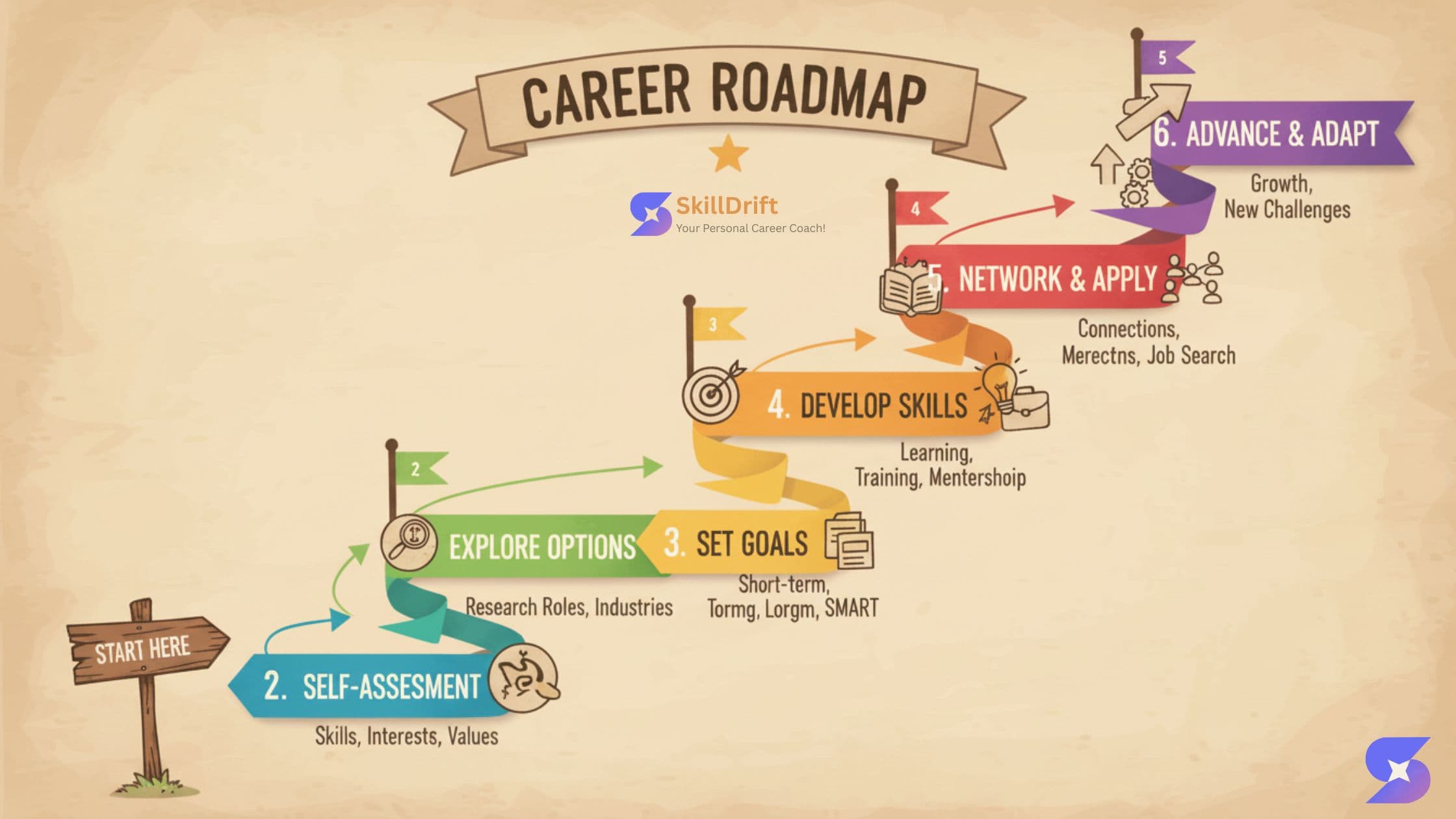
Step 1: Assess Where You Are
Start with a clear understanding of your current skills and experience:
- List your current skills
- Identify gaps that could block growth.
- Take stock of achievements and measurable outcomes.
Be specific about what having a skill means. There is a difference between having used a tool once and being able to carry a project with it. For each skill, write down the last piece of work where you used it and what the outcome was. If you cannot name one, the skill belongs in the gap column.
Pro Tip: SkillDrift's AI-powered resume analysis can benchmark your skills against peers and highlight growth opportunities.
Step 2: Define Your Long-Term Goals
Think 3-5 years ahead. Ask yourself:
- Do I want to lead a team, specialize in a niche, or move into a global role?
- How do personal aspirations (like work-life balance or entrepreneurship) fit in?
Having a clear North Star helps you focus your learning and opportunities.
Then turn the North Star into a job title. Take three live job descriptions for that title and read the requirements, not the responsibilities. The requirements are what you are being measured against. The responsibilities are what you will do once you are in.
Pro Tip: SkillDrift's AI-powered Aspiration analysis can benchmark your current skills against required skills and highlight growth opportunities.
Step 3: Break It Into Milestones
Divide your journey into short-term (1 year), medium-term (2 to 3 years), and long-term (4 to 5 years) goals.
Example: Ananya, a mid-level marketing manager, structured her career roadmap in stages:
- Stage 1: Learn data visualization and analytics tools.
- Stage 2: Earn an AI marketing certification.
- Stage 3: Lead AI-driven marketing projects.
Her story is featured in our pillar guide on long-term career planning.
Size each stage so it can be finished. A stage that takes eight months is not a stage, it is the whole plan wearing a disguise. If a stage cannot be completed in six to ten weeks at the hours you actually have, split it.
Step 4: Identify Skills to Stay Future-Ready
Focus on three skill categories:
- Technical Skills: AI tools, analytics, coding basics.
- Functional Skills: Problem-solving, project management, collaboration.
- Executive Skills: Strategic thinking, leadership, decision-making.
Align milestones with skill development so every step brings tangible progress.
Order them by what is blocking you, not by what interests you. The skill that appears in every job description for your target role and nowhere on your resume goes first, even when it is the least enjoyable one on the list.
Step 5: Review, Adjust, and Iterate
Industries change, AI evolves, and opportunities shift. Review your roadmap every 6-12 months:
- Adjust goals based on new skills or roles.
- Track progress in SkillDrift to stay on target.
- Celebrate achievements and refine milestones.
How long should a career roadmap be?
Three to five years for the destination, and no more than ten weeks for the stage you are currently working on.
Anything beyond five years is guesswork about an industry that will have changed. Anything shorter than three years usually describes a promotion rather than a career move, and a promotion does not need a roadmap, it needs a conversation with your manager.
The short horizon matters more than the long one. Most roadmaps are abandoned not because the five year goal was wrong but because the next step was too big to start on a Tuesday evening.
What is the difference between a career roadmap and a career path?
A career path is the route other people have taken. A career roadmap is the route you are going to take.
A career path is descriptive: analyst, senior analyst, manager. It tells you the shape of a profession, and it is useful for working out what is normal and what is possible.
A career roadmap is yours. It starts from the skills you personally have, accounts for the years you have already spent, and can skip stages that a traditional path assumes. Someone moving from teaching into instructional design does not follow a path. They build a roadmap.
Use a career path to choose the destination. Use a roadmap to get there.
Why do most career roadmaps fail?
Four reasons, in the order they usually bite.
- The gap was never measured. The plan lists courses that were available rather than skills that were missing, so learning happens and nothing changes.
- The stages were too large. A stage you cannot start this week is a stage you will not start.
- Nothing updates when you learn something. The roadmap is written once and becomes a historical document within a quarter.
- The proof never reaches the resume. You close a real gap and no employer finds out, because the resume still describes the person you were when you wrote the plan.
The last one is the most expensive and the least discussed. Learning that is invisible to a hiring system has no career effect, however real it was. If you are not sure yours is readable, start with what a good ATS score actually means.
How do you keep a career roadmap current?
Tie it to the gap rather than to the calendar. A roadmap reviewed every six months is out of date for five and a half of them.
The version that works updates itself as you learn:
- The gap list shrinks when a skill is genuinely acquired, not when a course is finished. That is also why random online courses rarely move a career.
- Completed learning is added to the resume automatically, so the document employers read stays in step with the person you have become.
- Each new job description you are interested in feeds fresh gaps back into the plan, because what a role requires in March is not what it requires in October.
This is what SkillDrift is built to do. Your gaps reduce in real time as you upskill, SkillDrift certificates are added to your resume when you complete a course, so the resume stays live, and you can share them to LinkedIn directly.
Conclusion
Creating a career roadmap is how you future-proof your growth in the AI era. For a deeper look at why long term planning matters and how it impacts your career trajectory, check out our Ultimate Guide to Career Planning in the Age of AI.
Create your personalized career Growth Roadmap with SkillDrift. Based on your SkillGap and Aspiration Analysis, choose the topics you want to focus on, select your preferred learning level, Basic, Intermediate or Advanced, and customize Technical, Functional or Executive training. Set your weekly learning hours, and SkillDrift will generate a tailored roadmap with curated articles, videos and recommended certifications from platforms like Coursera and edX to help you grow efficiently.
To see how the skills needed for a job differ across five common roles, with a simple template to find your own gap, read skills needed for a job.
If you are not sure which skill should come first on your roadmap, what should I learn next for my career sets out a ten minute method to find it from the job postings for your target role.
Where to start this week
A roadmap is only as good as the gap it is built on.
- Upload your resume at app.skilldrift.ai and see your gaps against the role you actually want.
- Take the highest impact gap and start the roadmap for it.
- Run one mock interview for that target role and read the report honestly.
Prefer to do it on your phone? SkillDrift is on Google Play and the Apple App Store.
Not sure what your target role asks for? Start with the skills needed for a job, role by role.
Step one of any roadmap is finding out where you are actually standing.