A Degree Opens the Door. Skills Build a Career.
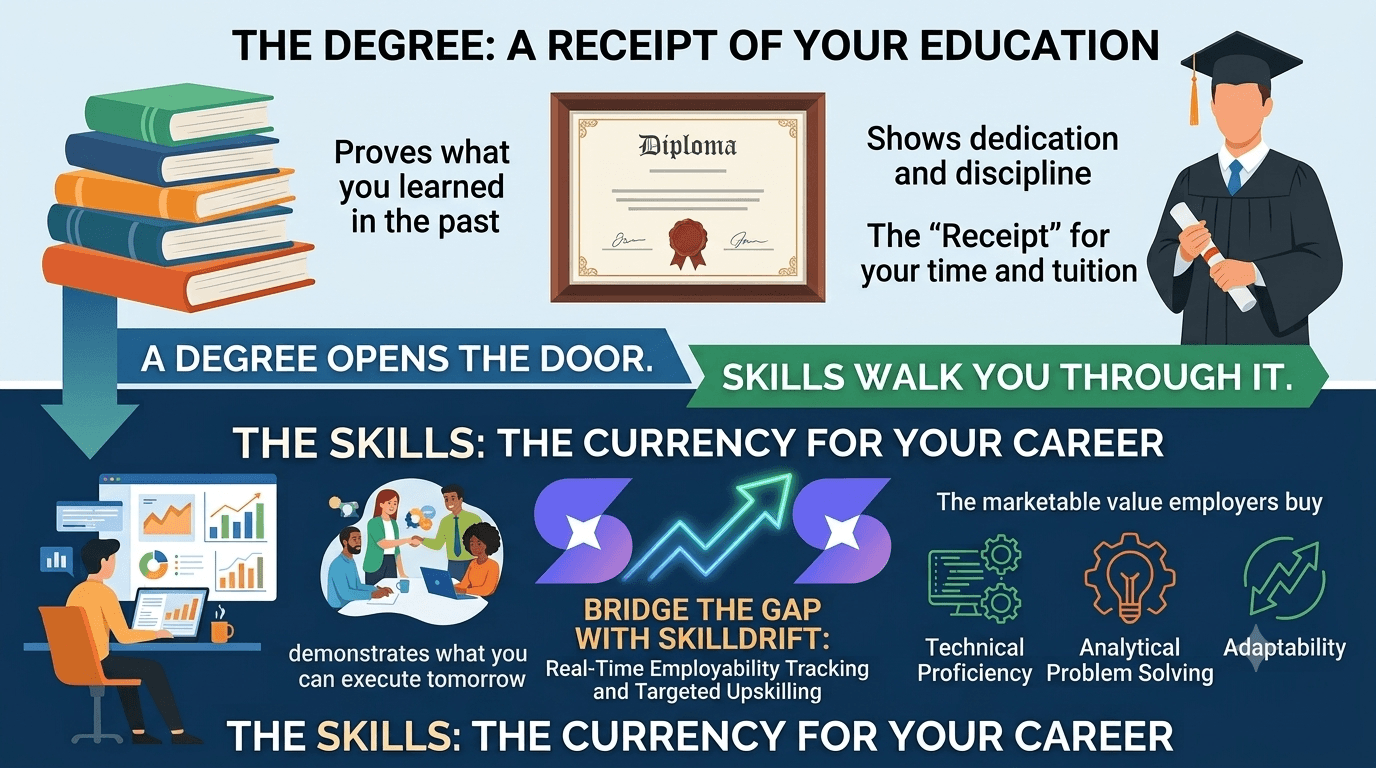
Graduation is a milestone worth celebrating. A degree represents years of focused learning, discipline, and personal growth.
But in today’s job market, it is no longer the complete story.
Employers increasingly need verifiable evidence of what a candidate can execute: how they solve problems, utilize relevant tools, communicate clearly, and adapt as workflows evolve. A degree can open the door; demonstrable, market-relevant skills help graduates walk confidently through it.
This is not an argument against higher education. It is an argument for making its inherent value more visible, actionable, and seamlessly connected to the dynamic world students are entering.
The Employability Gap is Impossible to Ignore
Skills-based hiring has rapidly moved from a niche HR practice to a mainstream talent strategy. According to TestGorilla’s 2025 survey, 85% of employers now utilize skills-based hiring in some capacity. Furthermore, McKinsey research indicates that hiring for skills is significantly more predictive of on-the-job performance than hiring based on education alone.
For students, this means a qualification alone may not clearly communicate their readiness for a specific role. For academic institutions, it means student employability can no longer be treated as a conversation reserved for the final semester.
The fundamental question has shifted. It is no longer simply, “Did this student complete the program?” It is now, “Can they clearly demonstrate how their learning translates into real-world capability?”
From a Degree to a Visible Skill Profile
Every academic program develops valuable capabilities. The core challenge is equipping students to identify, build, and demonstrate those capabilities using the exact language that employers understand.
A marketing graduate, for example, brings much more than a degree title to the table. A competitive, unbundled skill profile looks like this:
- Technical Capability: Google Analytics 4, HubSpot CRM, basic HTML/CSS.
- Analytical Capability: A/B testing methodology, customer acquisition cost (CAC) analysis, campaign reporting.
- Human Capability: Cross-functional communication, collaboration, adaptability, and sound judgment.
This specific combination - technical, analytical, and human skills - is what gives academic learning practical value in the global market. Institutions do not need to replace their rigorous curricula to support this shift. Instead, they need a clearer, continuous system to connect academic progress with evolving employer expectations.
Employability Must Become a Leading Indicator
Too often, institutions measure employability after the fact using placement rates, graduate outcomes, or alumni surveys. While these metrics matter, they are lagging indicators.
The more critical question for university leadership is: What data can students and institutions access early enough to actually improve the outcome?
Answering this requires giving students a practical, real-time view of the skills they are developing, the capabilities top employers seek, and the actionable micro-steps needed to close meaningful gaps. It also requires giving university leaders real-time visibility into cohort-level trends - identifying where students are excelling, where confidence is low, and where targeted support will make the biggest impact.
Where SkillDrift Fits In
SkillDrift is built to help institutions make employability a continuous, integrated part of the student journey, rather than a frantic final-year intervention.
Our platform creates a live translation layer between academic learning and career opportunity. We empower students to understand their current skill stacks, build job-relevant capabilities through targeted micro-learning, and develop a verifiable record of what they can execute.
At the institutional level, SkillDrift provides educators and administrators with a dynamic B2B dashboard, offering a current, granular view of skill development and potential market gaps across their entire cohort.
The goal is never to reduce higher education to a checklist of corporate keywords. The goal is to make the true depth of a student’s education easier to recognize, develop, and communicate.
When students can connect their academic experience to real capabilities, they approach the job market with confidence. When institutions can identify skill patterns early, they can support their cohorts more intentionally. And when employers can clearly understand what graduates can do, hiring becomes less about assumptions and more about potential.
A degree remains deeply valuable. But in a skills-first economy, its value is maximized when paired with clear, relevant, and demonstrable capability.
That is the future SkillDrift is helping forward-thinking institutions build.
Need to understand more? Visit us at SkillDrift or book a demo at sales@skilldrift.ai
Where to start this week
The degree opens the door. What you can demonstrate decides how far past it you get.
- Upload your resume at app.skilldrift.ai and see your gaps against the role you actually want.
- Take the highest impact gap and start the roadmap for it.
- Run one mock interview for that target role and read the report honestly.
Prefer to do it on your phone? SkillDrift is on Google Play and the Apple App Store.
If skills are what build the career, the practical question is which ones you are missing and whether anyone can see them. Build a career roadmap from the gap, check how AI analyzes your resume, and find out what a good ATS score actually means before you assume the degree is doing the work.
Nobody is going to ask what you studied for very long. They will ask what you can do.