AI and Job Losses in 2026: Entry Level Is Hit First, Mid Level Is Next, and the Herd Is Heading the Wrong Way
In late October, Microsoft offered about 60,000 of its employees, roughly a quarter of its workforce, a payout to leave voluntarily. The offer reached staff in India, the US, Canada and the UK. It was the company's second such offer this year: in April, Microsoft offered early retirement to older US staff for the first time in its history. Asked whether this means AI will cost people their jobs, chief executive Satya Nadella answered: "I wish I could just sit here and say it'll all be the same. I cannot."
Every week brings a headline like this. A company cuts thousands of roles and mentions AI in the same breath. A chief executive says a team shrank because software now does the work. If you are a student choosing a degree, or a manager ten years into your career, it is hard to know what to believe.
Here is our reading. It is built from what companies actually said, from the more careful research, and from the job postings we read every day at SkillDrift.
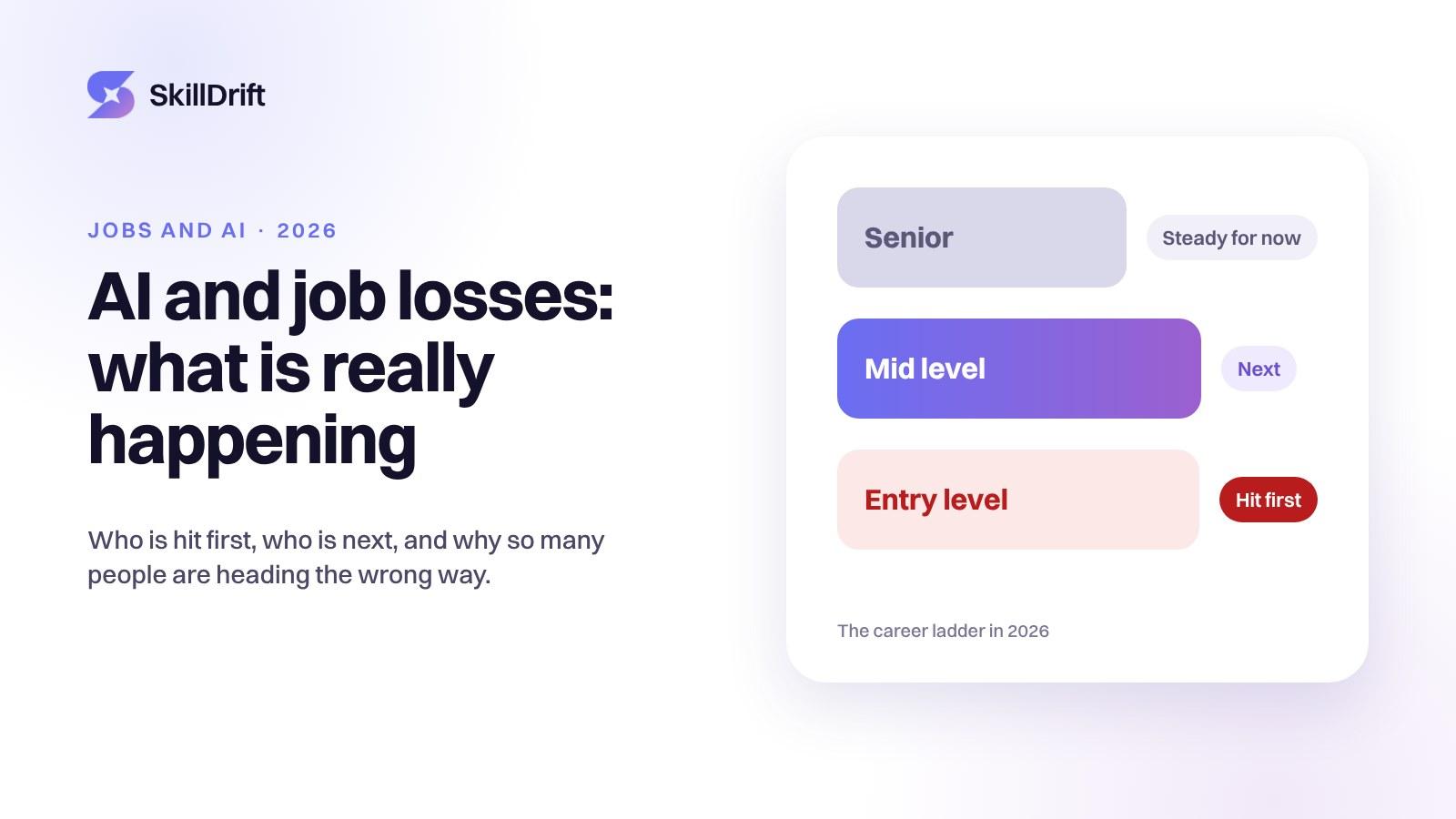
Some jobs are being lost to AI. Many layoffs blamed on AI are ordinary cost cutting with a new label. Young people looking for a first job feel it first. The bigger change over the next few years is likely to land in the middle of the career ladder. And many students are still crowding into the fields AI reaches first.
Why there is so much noise
Start with how the numbers are made. The best known tracker of US layoffs, Challenger, Gray and Christmas, records the reason each company gives. This year, AI was the reason given for about one in five announced job cuts. If a company says AI, it counts as AI.
Some companies have good reason to say it. "AI" sounds like a plan for the future. "Demand is weak" sounds like trouble. Oxford Economics suspects some firms are dressing up layoffs as good news for investors. Even Sam Altman, who runs OpenAI, said in February that there is "some AI washing": companies blaming AI for cuts they would have made anyway.
The effect is still real in some places. Salesforce chief executive Marc Benioff said he had cut support staff from 9,000 to about 5,000 "because I need less heads", as AI agents took on more customer cases. Now look at Amazon. It has cut tens of thousands of corporate jobs since October 2025, and its chief executive explained the first round plainly: "It's culture". Two big layoffs, two very different stories, and both were reported as AI news.
A few companies do say it outright. Oracle cut about 21,000 jobs in a year, and its annual report in June said AI had replaced some of those roles. Microsoft chose a softer route, with offers to leave in place of layoffs. Nadella said the offer was "mostly about let's give everybody more agency", because not every team inside Microsoft has adapted to AI yet. The company itself expects fewer than 5 per cent of those eligible to accept.
So before you believe a headline, ask one question: did the company say AI is doing the work, or did it only say the word?
Entry level is hit first
The clearest evidence comes from Stanford. Using payroll data, researchers found that employment of 22 to 25 year olds in the jobs most exposed to AI is about 19 per cent below where it would otherwise be. Experienced workers in the same jobs show no such gap. The authors are careful to say the pattern does not prove AI caused it.
How it happens matters. Most of the gap seems to come from companies hiring fewer young people. For a graduate, it shows up as fewer replies to applications.
Will it last? There is a good chance it will not, for a simple reason. Every senior engineer, manager and partner was once a junior. Stop hiring juniors for long enough, and in five years there is nobody to promote.
IBM has already acted on this. In February its chief HR officer said IBM is tripling its entry-level hiring, including for software developers. The work itself is changing: IBM expects its software engineers to spend less time on routine code and more time with customers.
One caution. A year ago the Stanford gap was 15 per cent. Now it is 19. Whether the hit proves temporary depends on more companies doing what IBM is doing.
Why mid level is next
Think about what a typical middle manager does in a week. Collect updates from the team. Turn them into a status report. Review drafts. Pass decisions up and instructions down.
AI tools now produce a decent first version of almost all of it. A weekly report that once took a team lead an afternoon can be drafted from the team's tickets and messages in minutes. The lead only checks it.
Companies have noticed. Microsoft's finance chief told investors the company was "reducing layers with fewer managers", weeks before it cut about 3 per cent of its staff in May 2025. Amazon set a goal to raise the ratio of individual contributors to managers by at least 15 per cent. And Gartner predicted that by the end of 2026, one organisation in five would use AI to flatten its structure, removing more than half of its middle management roles.
Many people in the middle of their careers have also been slow to change how they work. A 2024 survey by the nonprofit Generation found that only about 15 per cent of US workers aged 45 and over used AI tools at work.
This is not true of every manager. Gallup found that managers use AI at work more often than the people who report to them. The real risk sits with one kind of person: someone whose value is coordination, and who still does all of it by hand. Managers who hand AI the reporting and spend their time on judgment, clients and people will be fine. Those who wait for their company to decide for them may not be.
What the job postings tell us
At SkillDrift we read every posting in our jobs index for the skills it asks for, because we score every job against each user's resume. The index holds nearly a million live postings.
AI skills are growing, and they are still a small slice. In the week of 16 November, for every new posting that asked for generative AI, about six asked for Python and more than three asked for customer service. Most jobs still hire on the foundations first.
Are we training too many people for the jobs AI touches first?
Many students still pick software, accounting or office careers because they look safe and respected, and because everyone around them is doing the same. That made sense when those fields grew faster than the number of graduates. It makes less sense now. Goldman Sachs lists computer programmers, accountants, administrative assistants and customer service staff among the jobs most exposed to AI. These are exactly the first jobs many commerce, business and IT graduates aim for.
Meanwhile, other fields cannot find enough people. The World Health Organization counts a shortage of 5.8 million nurses worldwide. US builders say they need about 349,000 more workers this year, and the rush to build data centres has pushed up demand for electricians who can do precision wiring.
The herd is starting to turn. In the annual CRA survey of North American computing departments, new computer science majors fell 12.9 per cent in 2025, after peaking the year before.
One caution from India. The India Skills Report 2026 rates 80 per cent of computer science graduates as employable, against about a third of polytechnic graduates. Moving people into shortage fields only works if the training for those fields gets better too.
Should we stop following the herd?
Yes. Ask a better question than "which field looks impressive". Ask where demand is growing faster than the supply of people, and how you can get there. Some examples:
- An electrician who can wire a data centre. The AI boom is creating that job.
- A nurse or pharmacist who understands the AI tools hospitals now use. Clinical skill stays scarce, and it becomes more valuable next to the tools.
- An accountant, supply chain planner or HR professional who can check an AI forecast and catch it when it is wrong.
- A software developer who goes deep. AI engineers topped LinkedIn's 2026 list of fastest growing jobs. The crowded part of software is the generic entry route.
You can stay in a field you love. Choose your way in by demand, and add one skill to your field that AI cannot do alone.
What 2027 holds
Nobody can tell you exactly what next year will bring. But the people who are paid to forecast it agree on more than you might expect.
The layoff wave has been delayed, and it has not gone away. Goldman Sachs economists, in their outlook for 2027, expect one more year of a low-hire, low-fire job market, with AI having a bigger effect on jobs in the years after that. Their earlier research points to the reason: companies tend to automate fastest when the economy slows down. Microsoft's finance chief has already told investors that the company's headcount will keep falling through its 2027 financial year. So treat 2027 as the year to prepare.
Some of the jobs that were cut will come back, in a new form. Gartner expects that by 2027, half of the companies that cut customer service staff because of AI will hire people again to do similar work, under different job titles. AI took over the easy questions. The hard ones still need a person, and that person is now expected to know how to work alongside the AI tool.
The job title stays. The job changes. This is the real story of 2027, and it is not limited to customer service. Gartner also expects that 80 per cent of software engineers will need to learn new skills through 2027 as AI creates new roles in their field.
For India, the demand for AI skills is running ahead of the supply. Bain & Company estimated last year that AI job openings in India could pass 2.3 million by 2027, while the number of people with those skills grows to about 1.2 million. That gap is an open door for anyone willing to learn, whatever their level.
So what does 2027 ask of you? It asks you to know which parts of your own job AI can already do, and to get good at the parts it cannot. You do not need to become an AI engineer overnight. You need to know where you stand, and to start closing the gap before your employer asks you to.
What to do now
- If you are mid-career, change how you work before your company changes it for you. Hand AI the reporting and the first drafts. Spend your time on judgment, clients and people.
- If you are a student or a fresher, look at real postings before you commit. Compare what two or three fields ask for today. The software engineer skills page is one example.
- Build foundations first, then add one AI skill on top of your job. Few people are doing this yet: see almost nobody is retraining into AI.
Find out where you stand
Knowing the market is half the work. Knowing your own gap is the other half.
- Upload your resume on SkillDrift.
- Pick the role you want, in any field. SkillDrift scores every job and internship out of 100 against your resume and names each skill you are missing.
- Close each gap with a course sized to the hours you have each week, and watch your score update as you go. Practice interviews end with a report on where you are strong, where you are weak and how likely you are to be hired.
Prefer your phone? SkillDrift is on Google Play and the Apple App Store.
AI will not take every job, and it is already changing many of them. The people who do best will know what their next job needs, and close that gap first. Start with yours on SkillDrift.
How we counted
- Our job figures: the SkillDrift Jobs Index, postings from public job boards and employer sites, read for the skills they name. Pulled on 23 November 2026. The comparison counts new postings naming each skill from 16 to 22 November. No country cut is used.
- Everything else: each figure links to its source. Where a source is a prediction or a survey, the text says so.