Don’t Start with Learning. Start with the Gap.
Why Most Learning Efforts Fail Before They Even Begin
For years, the default response to career stagnation has been reflexive: learn more.
Take another course. Watch another tutorial. Earn another certification. Enroll in another program. The global professional development industry has grown into a multi-billion-dollar ecosystem built on a single, flawed assumption: more learning automatically leads to better career outcomes.
Yet, despite having unprecedented access to knowledge, professionals across industries continue to wrestle with the same frustrations:
- Why am I not progressing in my career?
- Why am I still being overlooked for critical opportunities?
- Why aren’t my new credentials translating into better roles or higher compensation?
- Why do I feel like I’m constantly learning, but moving nowhere?
The answer is uncomfortable, but necessary: Most people are starting at the wrong place.
They are starting with learning, when they should be starting with the gap.
The Hidden Problem: Learning Without Direction
Imagine deciding to drive from Bangalore to Mumbai without knowing your current starting coordinates. No matter how powerful the vehicle is, or how detailed the map may be, the journey becomes hopelessly inefficient because the point of origin is undefined.
Career development operates on the exact same principle. Many professionals consume learning content without a clear baseline, lacking an understanding of:
- The capabilities they already possess.
- The specific skills the market currently values.
- The exact competencies required for their target role.
- The actual size and shape of their capability gap.
As a result, learning becomes mere activity rather than measurable progress.
The modern professional is drowning in an overwhelming sea of educational content. Thousands of courses, bootcamps, podcasts, and AI-generated resources compete for attention daily. This abundance has created a new dilemma: learning noise. The challenge is no longer access to knowledge; the challenge is knowing what knowledge actually matters.
The Traditional Model Is Broken
For decades, career mobility followed a linear, predictable path: Education → Skills → Job.
Today, that model is obsolete. Technology evolves faster than university curricula. Job roles transform faster than enterprise training programs. AI is reshaping skill requirements faster than the workforce can adapt.
The result is a widening chasm between learning and actual employability. Individuals pour significant time and capital into programs that yield zero impact on their career trajectory - not because the content is poor, but because it solves the wrong problem.
A Better Framework for Career Growth
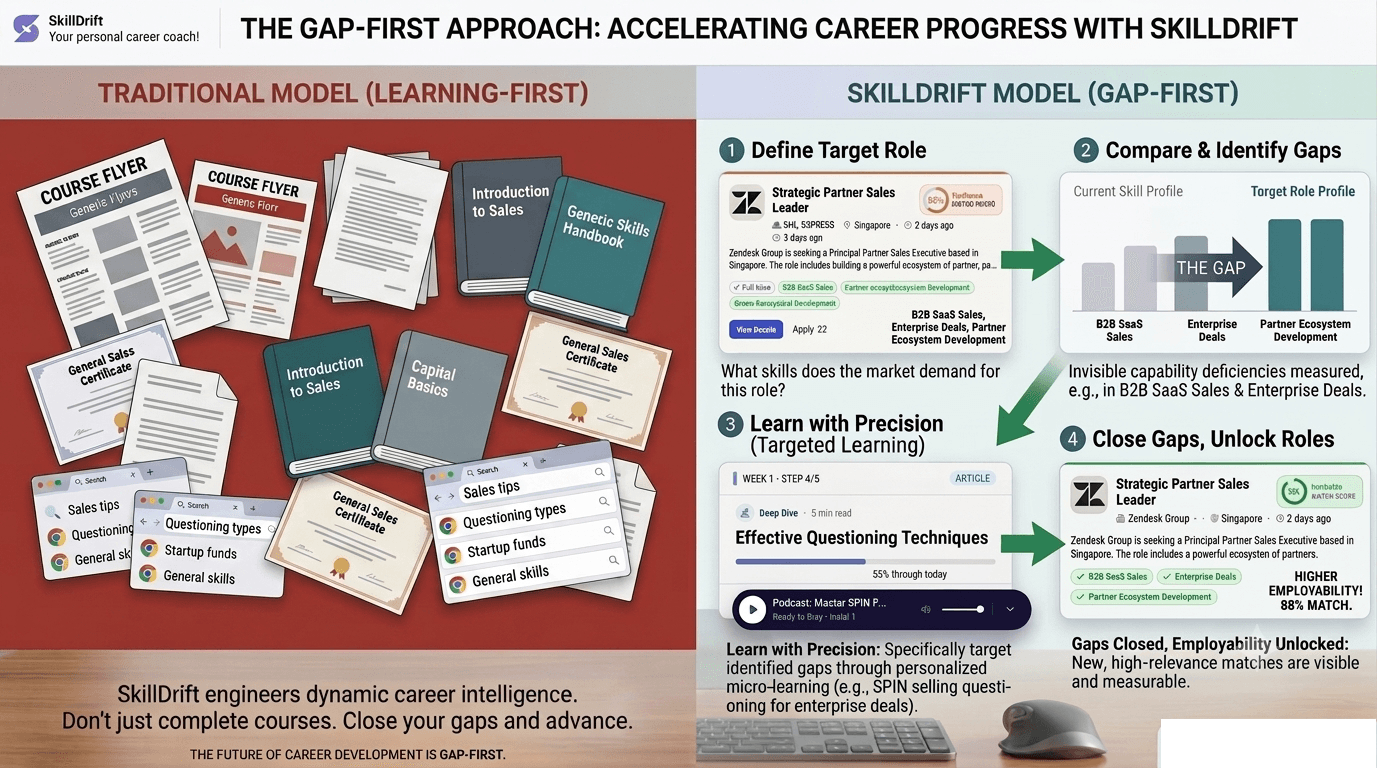
To achieve real career velocity, professionals must abandon the "learning-first" approach and adopt a precision-based sequence:
Career Goal → Skill Gap → Learning → Employability
This framework fundamentally re-engineers how professional development is executed.
Step 1: Define the Career Goal
Every meaningful development journey requires a destination. A software engineer may want to become an AI Architect. A finance professional may seek a transition into FinTech Product Management. Without a clearly defined objective, learning is random. With a target established, every potential skill can be ruthlessly evaluated for relevance.
Step 2: Identify the Skill Gap
This is the critical failure point for most professionals. They assume they know what they need to learn. In reality, career transitions are often blocked by invisible capability gaps that must be accurately measured. Running a skill gap analysis on yourself is what replaces the assumption with a named list.
For example, a data analyst aiming for a data science role might assume advanced machine learning is their missing piece. However, a proper assessment might reveal that stakeholder communication, experimental design, and business problem framing are their actual deficits. Without this visibility, they risk investing months learning the wrong skills. The gap - not the curriculum - is the true starting point.
Step 3: Learn with Precision
Once the gap is isolated, learning transforms from a guessing game into a targeted strike. The objective is no longer, "What course should I take?" It becomes, "What specific capability must I build next?" Instead of sitting through 40 hours of generic, bloated content, professionals can focus exclusively on the specific knowledge required to close high-impact gaps. Time investment becomes highly efficient. Progress becomes tangible.
Employability is the outcome of validated capability, not the outcome of learning completion. Employers do not hire candidates because they finished a broad video module; they hire candidates because they demonstrate precise, relevant skills, problem-solving acumen, and immediate role readiness.
This is where legacy learning platforms fail. They treat the completion certificate as the final destination, leaving a void between educational content and market demand. This is also where SkillDrift transforms the journey through precision-based micro-learnings.
With SkillDrift, learning is not passive consumption; it is a measurable feedback loop. Every bite-sized micro-module, simulated scenario, or targeted exercise you complete is designed to bridge a specific, measured gap. Crucially, SkillDrift doesn’t just record completions- it tracks your demonstrated proficiency during these micro-learnings. This real-time performance data is fed directly back into your personal, AI-powered capability map. You do not just finish a course; you observe your confirmed capabilities evolving.
Learning is only meaningful if it has visibility. On your unique SkillDrift dashboard, you gain a dynamic window into your employability. You observe your capability map updating in real-time, allowing you to watch as specific, red-flagged gaps between your current skill set and your dream job's requirements visibly shrink with every validated skill you acquire. SkillDrift transforms employability from a vague promise into a moving, measurable metric - a dynamic reflection of your increasing readiness to step confidently into that next role.
A Practical Example
Consider Priya, a finance professional with six years of experience whose goal is to transition into a Financial Planning & Analysis (FP&A) leadership role.
Her initial instinct is to enroll in a broad, advanced finance certification. However, a detailed gap analysis reveals a different reality: her core finance knowledge is already top-tier. Her actual deficits lie in data visualization, scenario modeling, and strategic executive communication.
Instead of spending six months on redundant finance theories, she focuses purely on developing those targeted capabilities. Within weeks, her profile is significantly aligned with the expectations of an FP&A Director.
She stopped learning for the sake of learning. She started closing gaps.
Where SkillDrift Fits In
This philosophy - Gap First, Learning Second - is the foundational architecture of SkillDrift.
Rather than starting with a catalog of courses, SkillDrift operates as an AI-native talent mobility platform that starts with career intelligence. The platform maps a user’s current skill profile against real-time market expectations and emerging demands to identify realistic career pathways.
Most importantly, it isolates the exact gaps between where a professional is and where they want to be. Only then does learning enter the equation.
SkillDrift bridges these divides through hyper-personalized micro-learning. Learning recommendations are not generated simply because content exists; they are generated to neutralize a specific capability deficit.
Instead of forcing users through cumbersome, one-size-fits-all courses, SkillDrift delivers bite-sized, highly targeted learning modules uniquely tailored to the individual's needs. This personalized micro-learning approach respects the professional's time - ensuring that they are absorbing the exact knowledge required, right when they need it, to close their specific gaps.
As users engage with these targeted micro-modules, SkillDrift continuously measures their progression. Users don't have to wait until the end of a multi-week course to see results; they watch their capabilities evolve in real-time, validating how every few minutes of learning directly enhances their career readiness.
This creates a continuous, dynamic feedback loop: Career Goal → Skill Gap → Personalized Micro-Learning → Employability → Career Growth
The objective is not to manufacture more learning hours. The objective is to engineer a more employable professional, making career progress visible, measurable, and highly actionable.
Final Thoughts
The modern learning economy has democratized access to information like never before. Yet, knowledge alone does not generate career momentum.
Momentum is created by understanding your destination, identifying the exact obstacles in your path, and deliberately closing those gaps. The next time you find yourself tempted to blindly enroll in another course, pause and ask yourself a better question:
"What exact gap am I trying to close?"
The future of career development is not learning-first. It is gap-first. The professionals who understand this distinction will hold a definitive advantage in an increasingly dynamic labor market.
Most platforms measure learning completion. SkillDrift measures employability progression.
Stop guessing what you need to learn next. Discover your exact skill gaps and start your targeted progression today. Map Your Career Path on SkillDrift. SkillDrift is built for progressive talent.
Where to start this week
The gap comes first. Everything you choose to learn is a consequence of it.
- Upload your resume at app.skilldrift.ai and see your gaps against the role you actually want.
- Take the highest impact gap and start the roadmap for it.
- Run one mock interview for that target role and read the report honestly.
Prefer to do it on your phone? SkillDrift is on Google Play and the Apple App Store.
Starting with the gap means running a skill gap analysis on yourself first, then building a career roadmap around what it returns, and checking how AI analyzes your resume so the result is visible once you have closed it.
Any course can fill an hour. Only a gap tells you which hour counts.