Hacking the Curriculum: Closing the Gap Between the Classroom and the Boardroom
Universities are no longer competing only with other universities.
They are competing with the speed of the labor market itself.
Every month that industry evolves without curriculum evolving alongside it, the value of education erodes just a little more. Employers adopt new technologies, redefine job roles, and expect new combinations of skills while academic programs continue moving through approval cycles designed for a different era.
This is the Velocity Gap - the growing disconnect between how quickly the market changes and how slowly education adapts.
The implications extend far beyond universities.
For academic institutions, it impacts graduate employability, industry partnerships, rankings, and ultimately student enrollment. For working professionals, it reduces the return on every hour and every dollar invested in continuing education. And for employers, it means spending more time and money retraining graduates who have already completed years of formal education.
The uncomfortable reality is this: A curriculum no longer becomes obsolete when students graduate. It becomes obsolete while they are still studying.
The institutions that recognize this first will define the future of higher education.
The Danger of Building Curriculum in a Vacuum
For decades, curriculum development has followed a familiar rhythm:
- Industry consultation
- Faculty committees
- Academic reviews
- Approvals
- Implementation
By the time students graduate, the market has often moved on.
This isn’t because universities lack expertise. It’s because they lack continuous visibility into what employers actually need today.
The labor market has become a moving target. Artificial Intelligence is reshaping job descriptions every quarter. New regulations create entirely new compliance requirements. Emerging technologies introduce new tools faster than textbooks can be revised.
Yet many programs still rely on annual employer surveys or advisory board meetings held once or twice a year. That delay has become expensive.
The Velocity Gap Exists Across Every Discipline
This challenge isn’t limited to technology programs. Almost every professional discipline is experiencing rapid change.
Supply Chain Management A graduate may thoroughly understand inventory optimization and ERP systems yet never gain exposure to AI-assisted demand forecasting, supplier risk intelligence, or digital twin simulations that leading manufacturers increasingly use every day. The theory remains valuable, but the workplace has simply evolved beyond it.
Human Resources Modern HR has become a strategic business function. Organizations expect HR leaders to understand workforce analytics, internal talent mobility, AI-assisted hiring, organizational design, and post-merger workforce integration. A curriculum focused primarily on payroll processing, labor law, and compliance prepares students for yesterday’s HR department & not tomorrow’s.
Civil Engineering and Urban Development Construction is increasingly driven by sustainability standards, digital project management platforms, ESG reporting, Building Information Modeling (BIM), and predictive maintenance. Graduates entering the workforce without exposure to these practices often require months of additional training before contributing effectively.
Finance Financial analysts today work with automation platforms, Python-based analytics, visualization tools, ESG reporting, alternative data, and AI-assisted forecasting. A curriculum that teaches valuation techniques without exposing students to modern analytical workflows leaves graduates technically qualified but commercially underprepared.
The issue isn’t that universities teach the wrong subjects. It’s that the market now expects an additional layer of practical, evolving capabilities that traditional curriculum structures struggle to keep pace with.
Education Should Start With the Gap, Not the Course
This is where many institutions unintentionally get the process backwards.
Curriculum discussions often begin with a simple question: What should we teach?
A more valuable question is: What capabilities are employers struggling to find, and where are our students falling short?
That shift changes everything. Instead of designing programs around assumptions, universities begin designing around measurable skill gaps. Instead of asking students to complete more courses, institutions help them close the specific gaps preventing them from becoming employable.
Learning becomes purposeful. Every module has a reason to exist. Every assessment has a measurable outcome.
Professionals Need Outcomes, Not More Content
The same principle applies to professionals investing in executive education.
The internet has made learning almost limitless. Courses, certificates, bootcamps, masterclasses, videos, articles - the challenge is no longer access to learning. The challenge is knowing what actually matters.
Professionals don’t need another 40-hour course just because it’s popular. They need to know:
- Which skills are employers requesting today?
- Which of those skills are missing from their profile?
- Which learning resources will close those gaps fastest?
- How will those improvements affect their career opportunities?
Career growth doesn’t begin with learning. It begins with identifying the gap. Learning is simply the shortest path to closing it.
From Static Curriculum to Living Curriculum
The universities that thrive over the next decade will treat curriculum as a living system rather than a static document.
Imagine two different approaches:
The Traditional Curriculum Model
- Industry evolves
- Annual employer survey
- Committee discussions
- Curriculum approval
- Program launched
- Students graduate
- Market changes again
By the time graduates enter the workforce, employers are already asking for something different.
Continuous Curriculum Intelligence
- Industry demand changes
- Skill gaps identified automatically
- Faculty notified immediately
- Micro-learning and curriculum updates deployed
- Students build missing capabilities
- Employability improves continuously
Instead of reacting to the market every few years, institutions evolve alongside it.
Turning Labor Market Intelligence into Curriculum Decisions
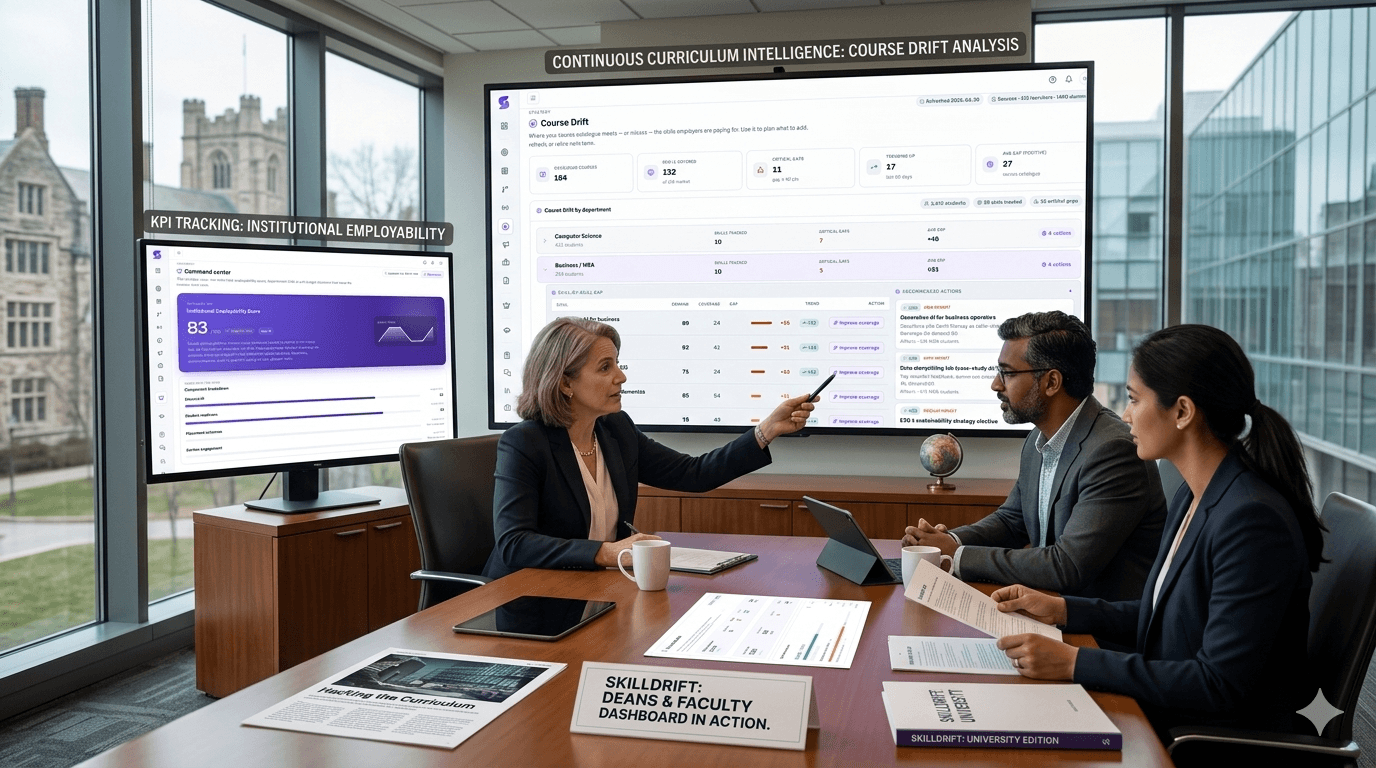
This is the philosophy behind the SkillDrift Deans & Faculty Dashboard.
Rather than asking universities to predict the future, SkillDrift continuously analyzes the relationship between three constantly evolving ecosystems:
- Enterprise hiring demand
- Workforce skills
- Learning resources
The platform doesn’t begin with courses. It begins with identifying the precise gap between what employers require and what students currently possess.
Once those gaps become visible, curriculum decisions become evidence-based rather than assumption-based. Faculty can understand not only what is changing but also why, where, and how quickly.
From Insight to Action
Visibility alone doesn’t improve employability. Action does.
SkillDrift helps institutions move from observation to execution. When new enterprise demand begins emerging, universities can:
- Introduce targeted micro-credentials before the next academic year.
- Recommend personalized learning pathways for specific student groups.
- Monitor employability trends continuously rather than waiting until graduation.
- Compare programs against regional, national, or international hiring markets.
- Measure how curriculum updates improve placement readiness over time.
This transforms curriculum development from an annual planning exercise into an ongoing improvement cycle.
One Connected Employability Ecosystem
Perhaps the biggest shift is not technological. It’s philosophical.
Historically, education, recruitment, learning platforms, and career services have operated independently. SkillDrift connects them into a single ecosystem:
The Employability Loop
- Enterprise Hiring Trends
- Emerging Skills Identified
- Curriculum & Skill Gap Analysis
- Faculty Recommendations
- Personalized Learning
- Skills Verified
- Student Resume Updated
- Improved Job Matching
- Higher Employability Outcomes
Instead of simply helping universities understand the labor market, the platform enables them to respond to it. The result is a continuous feedback loop connecting employers, educators, learners, and careers.
The Monday-to-Tuesday Promise
The future of higher education will not be defined by who offers the largest catalog of courses. It will be defined by who produces graduates ready for the realities of modern work.
The universities that succeed won’t redesign their curriculum every five years. They’ll continuously refine it every week.
Education should never become a race to keep up with the labor market. It should evolve alongside it. When institutions build around measurable skill gaps rather than assumptions, learning becomes more relevant, graduates become more employable, employers gain work-ready talent, and professionals see immediate value from every new capability they acquire.
The classroom and the boardroom no longer have to exist months or years apart.
With the right market intelligence, what is learned on Monday can genuinely create value in the boardroom on Tuesday.
Where to start this week
Whether you are the institution or the student, the first move is the same: measure the gap.
- Upload your resume at app.skilldrift.ai and see your gaps against the role you actually want.
- Take the highest impact gap and start the roadmap for it.
- Run one mock interview for that target role and read the report honestly.
Prefer to do it on your phone? SkillDrift is on Google Play and the Apple App Store.
The same logic works at the level of one person. Run a skill gap analysis on yourself, then build a career roadmap from what it returns, which is the opposite of taking random online courses and hoping.
The distance between the classroom and the boardroom closes one measured skill at a time.