How to Switch Careers When You Do Not Have the Skills Yet
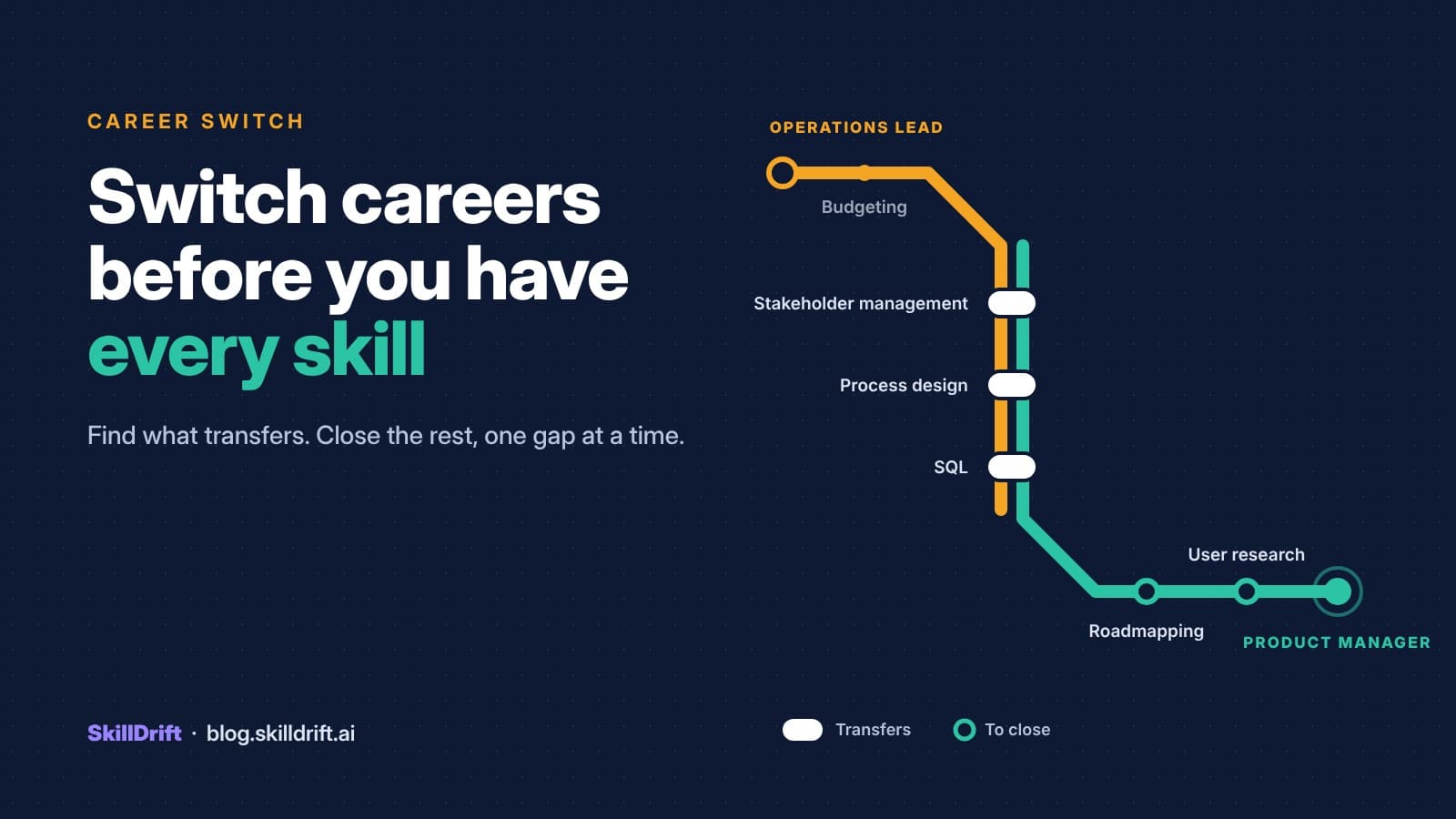
To switch careers when you do not have the skills yet, start from one target role. Compare what real job postings for that role ask for with what you can already show. Most people find that more of their skills transfer than they expected. Close the gaps that remain one at a time, and put the proof on your resume as you go.
Can you switch careers without the skills yet?
Yes. Almost nobody who switches careers has every skill on day one. Employers hiring someone from another field look for two things: skills that carry over from the past work, and evidence that the rest is being closed. A plan built around a single target role gives you both.
The common mistake is to start with learning. A course picked before you know the gap can take months and still miss what employers ask for. Learning comes after the gap is clear.
How do you pick the target role?
Pick one job title you could apply for within a year. "Something in data" or "a job in tech" is too wide to plan against. Read ten postings for two or three candidate titles. Choose the one where you already meet a fair share of the asks, and where the work interests you enough to learn the rest.
Roles close to your current domain are the shortest switches. An accountant moving into financial analysis keeps the domain and learns the tools. A teacher moving into instructional design keeps the craft of explaining and learns the authoring tools.
Which of your skills transfer to a new career?
Transferable skills are the ones a new employer counts even though you used them in another field. They fall into three groups:
- Domain knowledge: the industry, its customers and its rules. A nurse moving into health technology keeps this.
- Ways of working: managing stakeholders, running a project, writing clearly, presenting a result, handling a budget.
- Tools: spreadsheets, a CRM, SQL, a design tool, a programming language.
A skill transfers when a posting for the new role asks for it and you can point to work that shows it. Write that work next to the skill, in the employer's words. This part of a switch needs no new learning, which makes it the fastest win.
How do you find the gap between your old career and the new one?
Open five postings for your target role and list every skill they ask for. Count how many of the five ask for each one. Then put each skill in one of three groups:
- On my resume.
- I have it, but my resume does not show it.
- I do not have it yet.
A skill named in four or five postings belongs to the role. A skill in one posting belongs to one company. Work from the top of the list. How to run a skill gap analysis on yourself covers the three groups in more depth.
How do you close the gap without starting from zero?
Close one gap at a time, starting with the one most postings ask for, and finish it before you start the next. Several half learned skills do not show on a resume or in an interview.
Size the learning to the hours you can keep every week. Four steady hours a week finish more than ten hours in the first week and none after. End each gap with something you can show: a project, a piece of work you can describe without notes, or a certificate tied to the skill.
Then measure again against new postings, because the skills a role asks for change from one quarter to the next. This is what we call closed loop career development: measure the gap against the role, learn for that gap, prove it, then measure again.
How do you show a career switch on your resume?
Put the target role at the top. A two line summary can say where you are going and what you bring, for example: "Operations lead moving into product management. Brings stakeholder management, process design and SQL."
Under each past role, rewrite the bullets in the new field's words. Give new skills and projects their own section near the top, with the proof attached. Cut detail the new field does not need.
How long does a career switch take?
It depends on how many gaps stand between you and the role, and how many hours a week you can give them. Count the skills in group 3. Plan the next six to twelve months in detail and review the plan every two weeks. Apply as soon as most of the frequent asks are covered. Waiting for every skill means waiting too long. The personal development plan template gives the plan a place to live.
What does SkillDrift do for a career switch?
SkillDrift runs this plan from your resume. You add a career path for the role you want. It shows your role transition readiness as a percentage, compares your current level with the level the role requires, skill by skill, and lists your strengths and your critical gaps. For a gap you choose, it builds a learning roadmap in sprints, and the certificate you earn can go on your resume. Each career path also brings matching jobs scored out of 100, interview practice, and a resume tailored to each application.
To see what postings ask for in the field you are moving into, start with skills in demand, by role and industry.
Frequently asked questions
Is it too late to switch careers at 30 or 40? No. Employers hire people from other fields at every age. More experience usually means more skills that transfer.
Should I go back to school to switch careers? Only when the target role requires a degree or a licence, as nursing and law do. For most roles, closing the frequent gaps and showing proof is faster.
Do I need to take a pay cut? Sometimes, for the first role. A target that keeps your domain knowledge usually reduces the drop, because more of your experience counts.
What if I have less than a year of experience? Use internships and entry level postings for the gap list. The method is the same.
Where to start this week
- Write down one target role.
- Open five postings for that title and sort the skills into the three groups.
- Or upload your resume to SkillDrift and add a career path for the role you want.
Prefer your phone? SkillDrift is on Google Play and the Apple App Store.
A career switch is a gap you can measure. Measure it first, then close it one skill at a time.