Personalised Learning Platforms for Your Career: Which Ones Actually Personalise, Compared
Checked 10 October 2026. Each platform is described from its own pages on that date. No prices are included, because they change often and vary by country.
Most personalised learning platforms personalise what you see next: a course recommendation, or a tutor that explains a lesson at your level. Far fewer start from the job you want, build the learning around what you are missing for it, and then show you the result on your resume and your job matches. If your goal is a career move, that last kind is the one to look for.
What does personalised learning mean for your career?
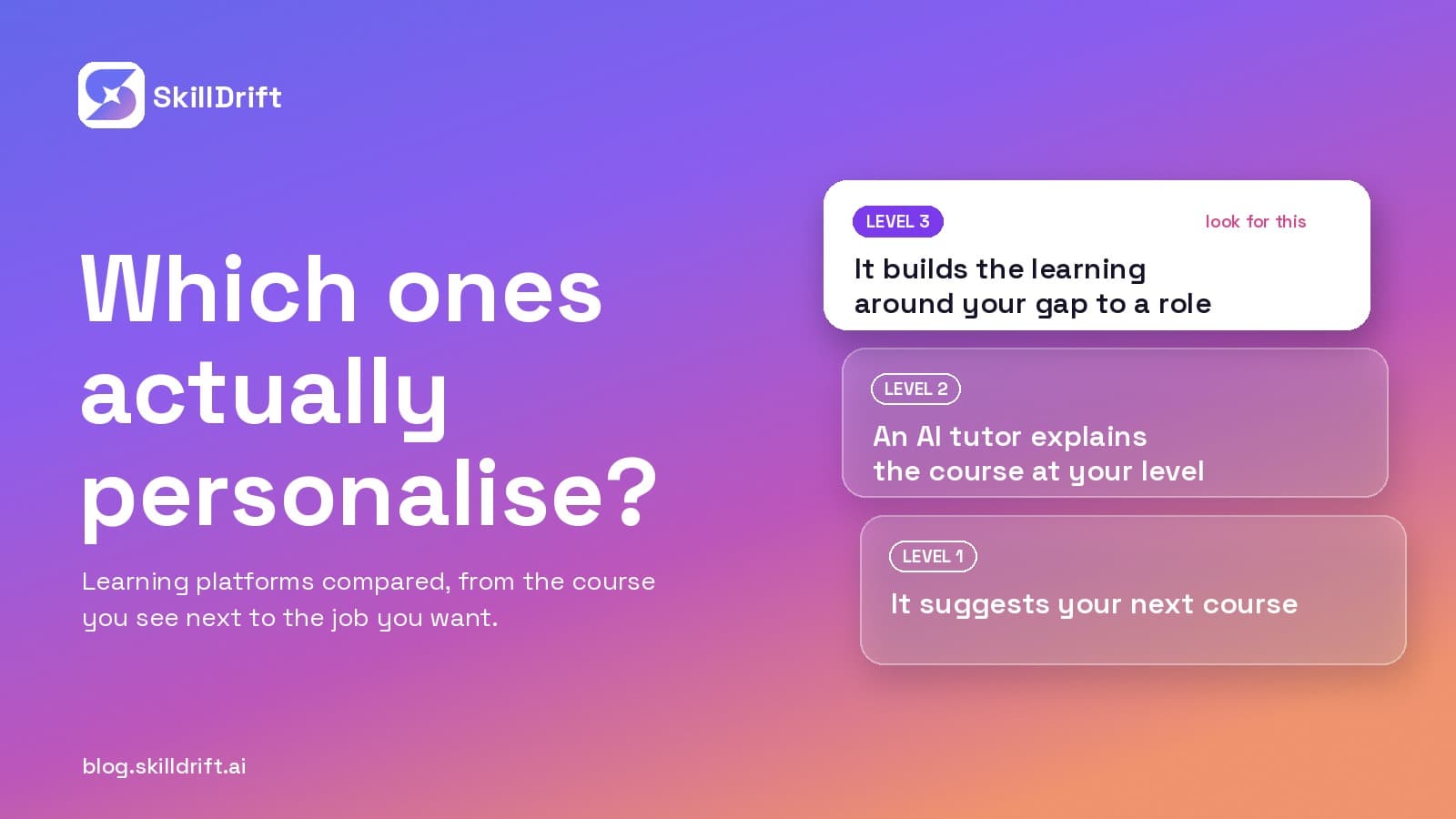
Personalised learning means the learning changes because of who you are. In practice there are three levels.
- The recommendation changes. The platform suggests courses from its library based on your profile, your role or what you watched before.
- The help inside the course changes. An AI tutor explains a concept again, at your level, inside a course you already chose.
- The learning itself is built around you. It starts from a measured gap between you and a named role, the lessons are framed for that role, and finishing them changes your resume and the jobs you match.
Levels one and two are useful. The third is the one tied to a specific next job, which is what most people mean when they search for personalised learning for their career.
How do the main platforms personalise?
Each entry says what the platform personalises, in its own words, what it draws on, and who it suits best.
- LinkedIn Learning. An AI coaching chatbot looks at your job title, asks follow up questions, then gives insights and course recommendations. It draws on the LinkedIn Learning course library, with links to the courses. Best suited to professionals who want expert courses and quick answers on a topic.
- Coursera Coach. "Tailored guidance and support" inside courses: it explains concepts and offers practice. It draws on the Coursera course you are taking. Best suited to learners who have already picked a course and want help finishing it well.
- Udemy. An AI Assistant that helps you find content for your goals and gives guidance grounded in its courses; AI learning paths matched to a skills framework. It draws on courses in the Udemy Business collection, matched to an organisation's skills. Best suited to employees whose company buys Udemy Business.
- Khanmigo. A tutor that guides you to answers instead of giving them, plus coaching on college admissions and careers. It draws on academic subjects such as math, science, coding and humanities. Best suited to students from elementary school through college.
- ChatGPT study mode. Step by step lessons "tailored to the right level for the user", using questions and memory from previous chats. It draws on whatever topic you bring to it. Best suited to a quick study plan on a topic you have already chosen.
- SkillDrift. Learning built around the gap between you and the role you want, framed for that role, tailored to your experience, and sized to the hours you can give it each week. It draws on your resume, a job description or a mock interview, and your target role. Best suited to anyone working toward a specific next role.
A note on chatbots: other assistants can be asked for a study plan in the same way. OpenAI itself says study mode can show "some inconsistent behavior and mistakes across conversations", so treat any chatbot plan as a starting point.
Which personalised learning platform should you choose?
Choose by what you already know about your next step.
- You know the subject and want a good course. LinkedIn Learning, Coursera or Udemy will serve you well. Their personalisation helps you find and finish the right course.
- You are a student working through school subjects. Khanmigo is built for you.
- You want a plan for a topic today. A chatbot will give you one in a minute.
- You know the role you want, but not exactly what you are missing for it. Start from the gap. This is where SkillDrift fits: it measures the gap against that role, builds the learning around it at the level you choose and for the hours you have each week, ends each week with a skill check, and adds the certificate to your resume when you claim it. Each finished roadmap adds the skill to your resume.
How can you test whether a platform really personalises?
Ask four questions of any learning product before you commit time to it.
- Does it start from a gap that was measured against a named role or a real job posting, rather than a topic you picked?
- Is the learning framed for that role? The same subject should read differently for a sales leader and for an engineer.
- Does it check that you learned it, with more than a completion tick?
- When you finish, does anything else change, such as your resume, your remaining gaps or the jobs you match?
Most platforms pass one or two. The full explanation of these tests is in what hyper-personalised learning is.
What is closed loop career development?
Closed loop career development measures the gap between a person and the role they want, closes it with learning built around that gap and that role, and updates their resume, gaps and job matches as they go. SkillDrift works this way. You can read how the loop works, step by step.
If you have not measured your gap yet, how to run a skill gap analysis on yourself takes about forty minutes with a job description and your resume.
To see what employers ask for in the role you want, start with skills needed for a job, role by role.
Where to start this week
Personalisation is easiest to judge on your own resume.
- Upload your resume to SkillDrift and choose the role you want.
- Pick the gap that matters most for that role and start the learning roadmap for it.
- At the end of the week, take the skill check and see what you have actually learned.
Prefer your phone? SkillDrift is on Google Play and the Apple App Store.
Learning that starts from your gap ends somewhere you can see.
Sources, all opened 10 Oct 2026: LinkedIn Learning AI-powered coaching · Coursera Coach · Udemy AI capabilities, 22 Oct 2024 · Khanmigo for learners · ChatGPT study mode, 29 Jul 2025 · SkillDrift closed loop page