What Is Hyper-Personalised Learning? Closed Loop Career Development, Explained
Most learning is written for a topic. You pick the topic, the course explains it the same way to everyone who picks it, and when you finish, a certificate goes into a folder.
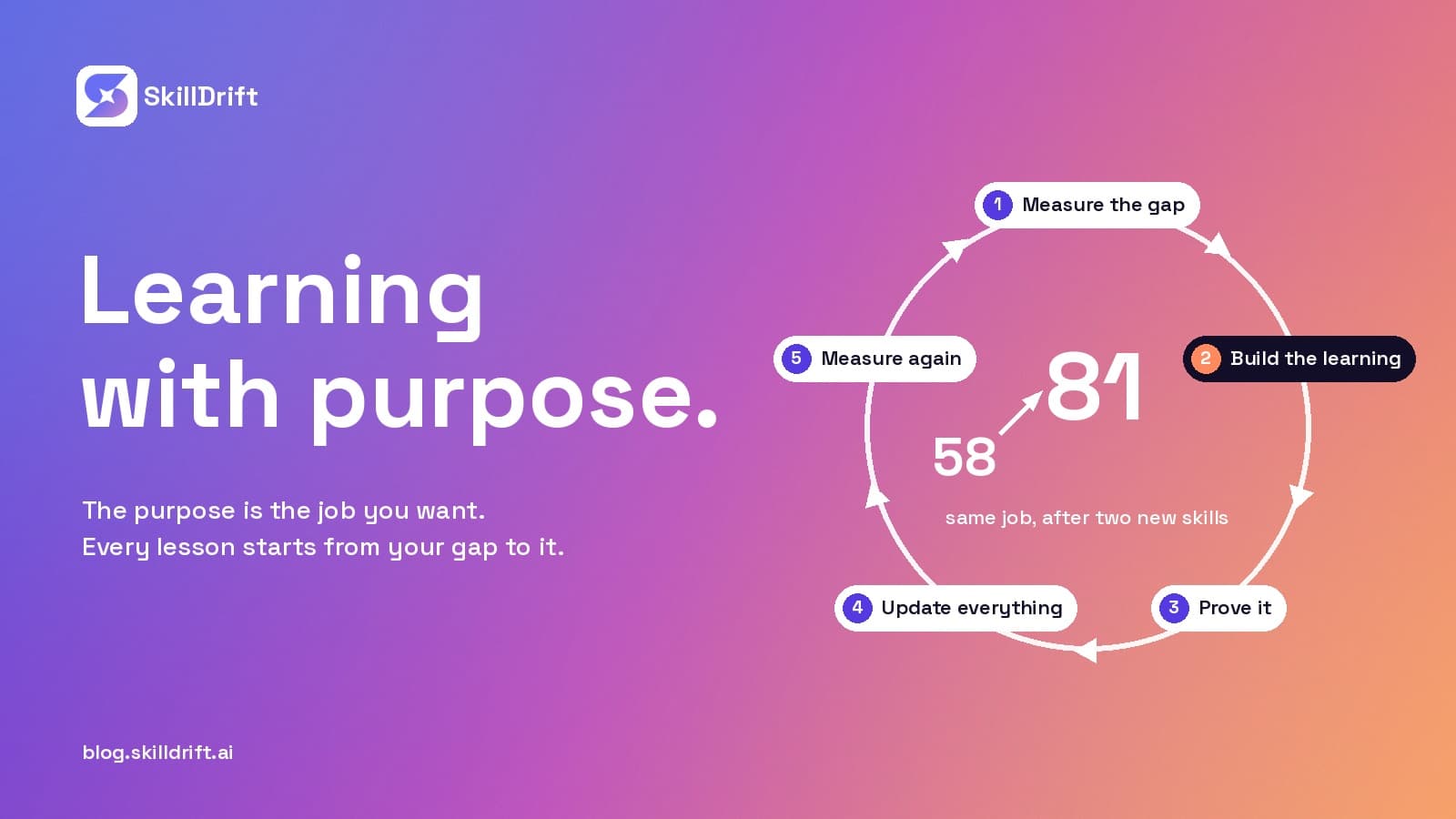
Hyper-personalised learning is built for a person. It starts from what that person is missing for the role they want, it is written in the terms of that role, and when it is finished, something about their career visibly changes. It only pays off inside a loop, and the loop has five steps.
What is hyper-personalised learning?
Hyper-personalised learning is learning built around one person's measured gap between their current skills and a specific role, and framed in the language of that role. It starts from what the person is missing, not from a topic they picked, and it changes as their skills change.
Personalised is not the same as recommended
The word personalised is used for three very different things.
The first is a sorted catalogue. Everyone gets the same courses, and a recommendation engine puts different ones at the top. The course is still written for everyone.
The second is adaptive delivery. The course is the same, but the pace, the order or the difficulty adjusts to how you answer. Useful, and common in school learning.
The third is built for you. The learning is matched to the gap you actually have, and the lesson names your target role, draws its examples from it, and skips what you already know. That is the hyper-personalised version, and until recently it was too expensive to do for one person at a time. Generative AI changed that. SkillDrift uses it for one job: matching the learning to the gap your resume shows, for the role you want, at the moment the gap is measured.
What closed loop career development means
Hyper-personalised learning on its own is a better course. It becomes a career tool when it sits inside a loop.
- Measure the gap between a person and the role they want, from their resume, a job posting or an interview.
- Build the learning around that gap and that role.
- Prove it: every week of learning ends with a skill check, and the certificate unlocks once the skills are verified. A mock interview can show it too.
- Update everything automatically: the new skills and the certificate are added to the resume, the remaining gaps shrink, and every job match is rescored. The person does not have to edit or track any of it.
- Measure again, and start the next gap.
We call this closed loop career development. Closed means the end of one step feeds the start of the next. Most learning is open loop: it ends at a certificate that nothing else reads, so the learner has to work out alone what it changed.
The definition, the loop and a worked example are also on one page: what is closed loop career development.
Parts of this loop already exist
Most of the pieces are familiar. Job boards match you to roles. Course platforms teach from a catalogue, and some now add an AI tutor inside the course. Company learning platforms personalise training for their own employees. A chatbot will write you a study plan in a minute, and some now remember you. But it only knows what you tell it. It does not score you against real job postings, check that you actually learned the skill, or change your resume and the jobs you match when you do.
What is missing is the connection. Each tool does its part and hands the person the job of joining them up. A closed loop does the joining: the gap decides the learning, the learning is built around the learner's gap, and finishing it changes the resume and the jobs they match without anyone editing anything.
Four tests for hyper-personalised learning
A simple way to check any learning product, including ours.
- Does it start from a gap that was measured, against a named role or a real posting, rather than from a topic you chose?
- Is it framed for that role? The same subject should read differently for a sales leader and for a software engineer.
- Is it small enough to finish? One named gap at a time, in short sprints.
- Does finishing it move something you can see: your resume, your remaining gaps, the jobs you match?
The first two tests make learning personal. The fourth makes it closed loop.
What it looks like in practice
On SkillDrift, one sales leader's track on design systems, a subject usually taught to designers and engineers, opens like this: "As a senior sales leader, your advantage is that you can connect design-system decisions directly to revenue outcomes." The same person's track on channel partner programmes is framed for the regional sales director role on their career path, down to the kinds of partners that role manages.
Neither reads like a course written for everyone. Each is framed for one role and one target.
Here is what that looks like for one job. A resume scores 58 out of 100 against it, which is a stretch, because two skills the job asks for are missing. After the person learns both, the same job scores 81, which is a good fit. The two new skills and the certificate were added to the resume along the way, without the person editing it.
Why this matters now
The skills employers ask for are moving faster than catalogues are rewritten. In the SkillDrift Jobs Index, Python passed communication as the most requested skill in job postings on 13 September 2026, a change covered in the third reading of the Jobs Index. A course written last year for everyone cannot track that. Learning matched to this week's gap, for this person, can.
It also answers the most common reason people give up on learning: they cannot see what it changed. For more on that, read why random online courses rarely move a career and why you should start with the gap, not the learning.
Where to start this week
- Upload your resume at app.skilldrift.ai and see your gaps against the role you want.
- Start the learning for the gap with the most impact and read the first lesson. Notice whether it speaks to your role. At the end of the week, take the skill check and see what you have actually learned.
- Run one mock interview for that role, and turn what it finds into the next sprint.
Prefer to do it on your phone? SkillDrift is on Google Play and the Apple App Store.
Learning built for everyone ends at a certificate. Learning built for you ends at the next role.