The “Loyalty Tax”: Why Staying Put Without Internal Mobility Can Cost You
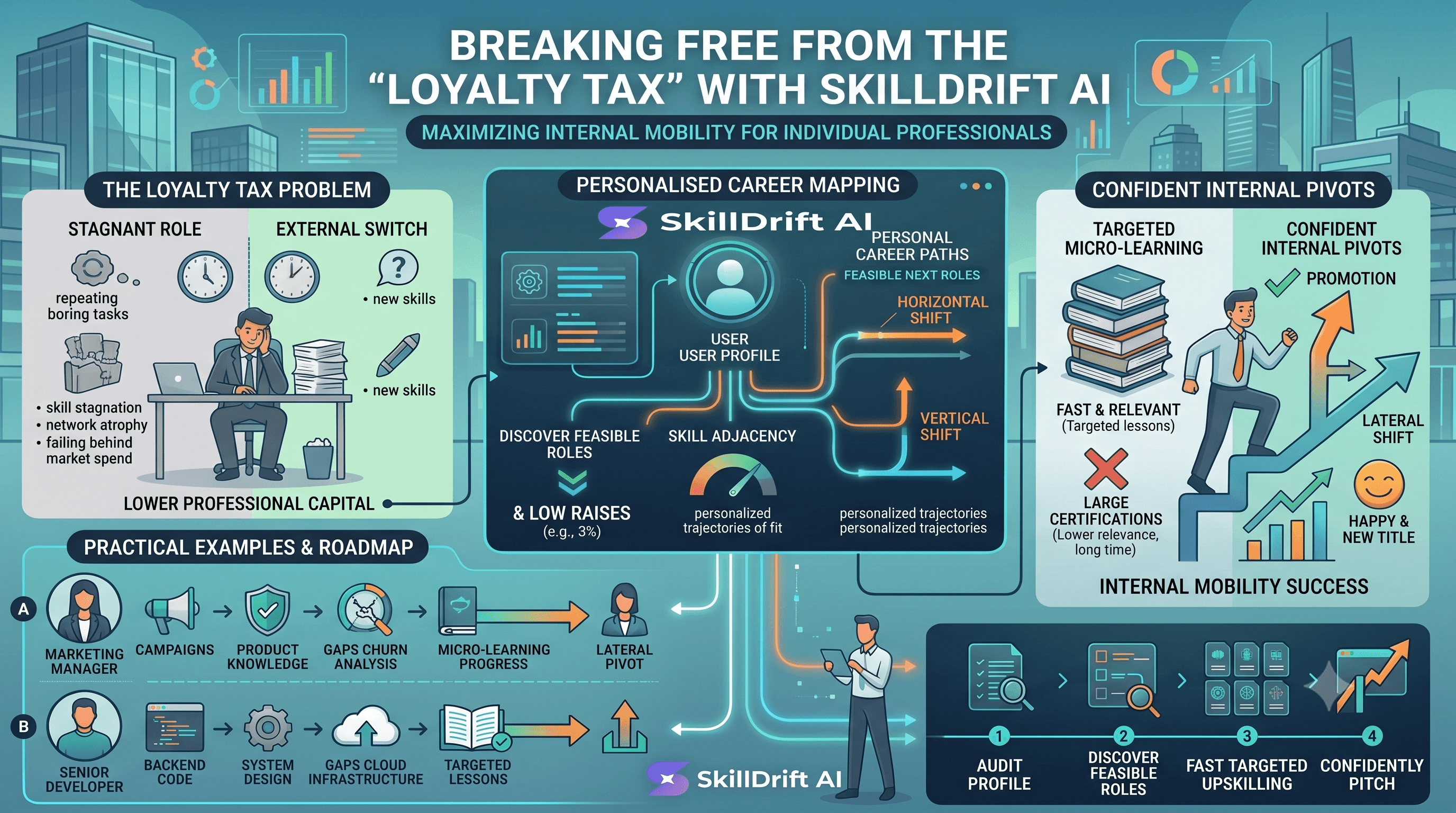
Changing employers has long been one of the most reliable ways to accelerate pay and broaden experience. But the real cost of staying in one role for too long goes beyond a missed salary increase.
When your responsibilities, tools, network, and learning curve remain unchanged, your professional value can quietly plateau. The risk is not loyalty to a company; it is loyalty to a job description that no longer stretches you.
For professionals in organisations with room to move internally, there is a better path than standing still or immediately looking elsewhere: deliberately building toward an adjacent role.
The hidden cost of a static role
Stability can be valuable. It gives you institutional knowledge, trusted relationships, and a deeper understanding of how the business works. But when stability turns into repetition, it can become a career risk.
If you have spent years performing the same tasks, using the same tools, and solving the same problems, you may be becoming more valuable to your current team while becoming less prepared for what comes next.
That “loyalty tax” can show up in three ways:
- Skill stagnation: You become highly capable in legacy processes or a narrow set of responsibilities while industry expectations keep evolving.
- Network atrophy: You work with the same stakeholders and miss opportunities to learn from new teams, leaders, customers, and ways of working.
- Perception boxing: Leaders begin to see you primarily as the person for your current role, rather than as someone who could contribute in a broader, more strategic capacity.
The issue is not that you stayed. It is whether you kept growing while you stayed.
Build momentum through adjacent career moves
Career growth does not always mean a promotion within the same function. Often, the strongest next move is an adjacent role: one that builds on much of what you already do while stretching you in meaningful new ways.
For example*, a content marketer might move into customer success, product marketing, or community. A senior developer might grow into solutions architecture, technical product management, or engineering leadership. These roles are not identical, but they share enough capabilities to make the transition realistic.*
The key is to identify three things:
- The skills you already bring.
- The capabilities the next role requires.
- The specific gaps worth closing before you make your case.
That is where SkillDrift can help. By mapping your existing experience against potential career paths, SkillDrift helps you identify feasible next roles and understand the skills that would make you a stronger candidate for them.
Instead of asking, “What job should I pursue next?” you can ask a more useful question: “What is the most achievable role that expands my career from where I am today?”
Avoid the certification trap
Once professionals identify a direction, many make the same mistake: they try to learn everything.
They enrol in broad certification programmes, spend months working through general courses, and hope the qualification will eventually create an opportunity. There is value in deep learning, but it is not always the fastest or most practical route to an internal move.
A more effective approach is just-in-time learning: focus on the skills that are directly relevant to the role you want next.
If your target role requires CRM reporting, stakeholder presentations, cloud-infrastructure knowledge, or churn analysis, start there. Build enough competence to contribute, demonstrate initiative, and take on relevant work.
SkillDrift’s micro-learning approach is designed around this principle. Rather than asking you to complete a large, generic curriculum, it helps direct your attention to the skills most relevant to the career path you are exploring.
This makes learning more manageable in a busy workweek and easier to connect to real opportunities at work.
What this looks like in practice
Example 1: A horizontal move from marketing to customer success
Imagine a mid-level content marketing manager who has spent several years creating campaigns and developing strong product knowledge. The conventional next step may be a more senior marketing position, but those opportunities may be limited.
Through career-path mapping, she identifies customer success as a potential adjacent move.
She already has transferable strengths:
- Clear communication
- Audience empathy
- Product knowledge
- The ability to translate complex ideas into useful content
The gaps are more specific: customer-health metrics, churn analysis, onboarding processes, and CRM workflow.
Rather than pursuing a broad sales or marketing qualification, she focuses her learning on those areas. She also looks for opportunities to work more closely with the customer-success team, join customer calls, or help improve onboarding content.
Over time, she is not simply saying she is interested in customer success. She is building evidence that she can contribute to it.
Example 2: A vertical move from senior developer to solutions architect
Consider a senior software engineer who enjoys technical problem-solving but does not want to move into pure people management.
A solutions architect role may be a strong next step. The developer already understands system design, technical troubleshooting, and software delivery. The growth areas may include cloud architecture, business requirements, and communicating technical choices to non-technical stakeholders.
A focused plan could include learning relevant architecture frameworks, developing stronger presentation skills, and volunteering for cross-functional technical discussions.
The learning matters, but so does the application. By taking on opportunities to translate technical requirements for business teams, the engineer begins demonstrating the core behaviour of the role before formally moving into it.
Your internal-mobility roadmap
If you want to stop standing still and start building career momentum, begin here:
- Audit your professional capital. List the tools, methods, domain knowledge, relationships, and strengths you use in your current role. Look beyond your formal job description.
- Identify adjacent roles. Explore roles that use a meaningful portion of your current skill set while giving you new exposure and responsibility. SkillDrift can help map those potential paths.
- Target the gaps that matter. Avoid learning at random. Focus on the few skills that would most strengthen your readiness for the role you want.
- Create proof through action. Look for projects, conversations, shadowing opportunities, or stretch assignments that let you practise those skills in a real business context.
- Pitch the pivot thoughtfully. Do not wait passively for a job listing. Speak with relevant leaders about the problems their team is solving, the value you can bring, and the capabilities you are actively building.
Keep your role growing with you
Loyalty to a great company can be a real advantage. You understand the culture, the business, and the people. But loyalty to a static job description can limit your options over time.
The goal is not to leave at the first sign of slower growth. It is to make sure your career keeps expanding with you.
By identifying adjacent opportunities, focusing your learning, and creating evidence of your readiness, you can turn your current experience into a clearer next move—without having to start from scratch somewhere else.
Turn your next move into a plan
You do not have to guess which role comes next or spend months learning skills you may never use. SkillDrift helps you understand where your current experience can take you, identify the most relevant skill gaps, and build a focused plan for closing them.
Whether you are aiming for a promotion, a lateral move, or a completely new direction within your company, SkillDrift gives you a clearer way to move forward - one practical step at a time.
Explore your next feasible career move with SkillDrift.
SkillDrift is built for progressive talent.
Where to start this week
If you are staying put, make it a decision rather than a default.
- Upload your resume at app.skilldrift.ai and see your gaps against the role you actually want.
- Take the highest impact gap and start the roadmap for it.
- Run one mock interview for that internal role and read the report honestly.
Prefer to do it on your phone? SkillDrift is on Google Play and the Apple App Store.
Staying put costs less if you are still compounding. The size of the prize is in the 62% AI wage premium, the route to it is a career roadmap built on a real gap, and the thing that usually blocks the move is a resume the ATS rejects before a person reads it.
Loyalty is not the problem. Staying inside the same job description is.