The Resume Is Dead. Your Digital Twin Is Getting Hired.
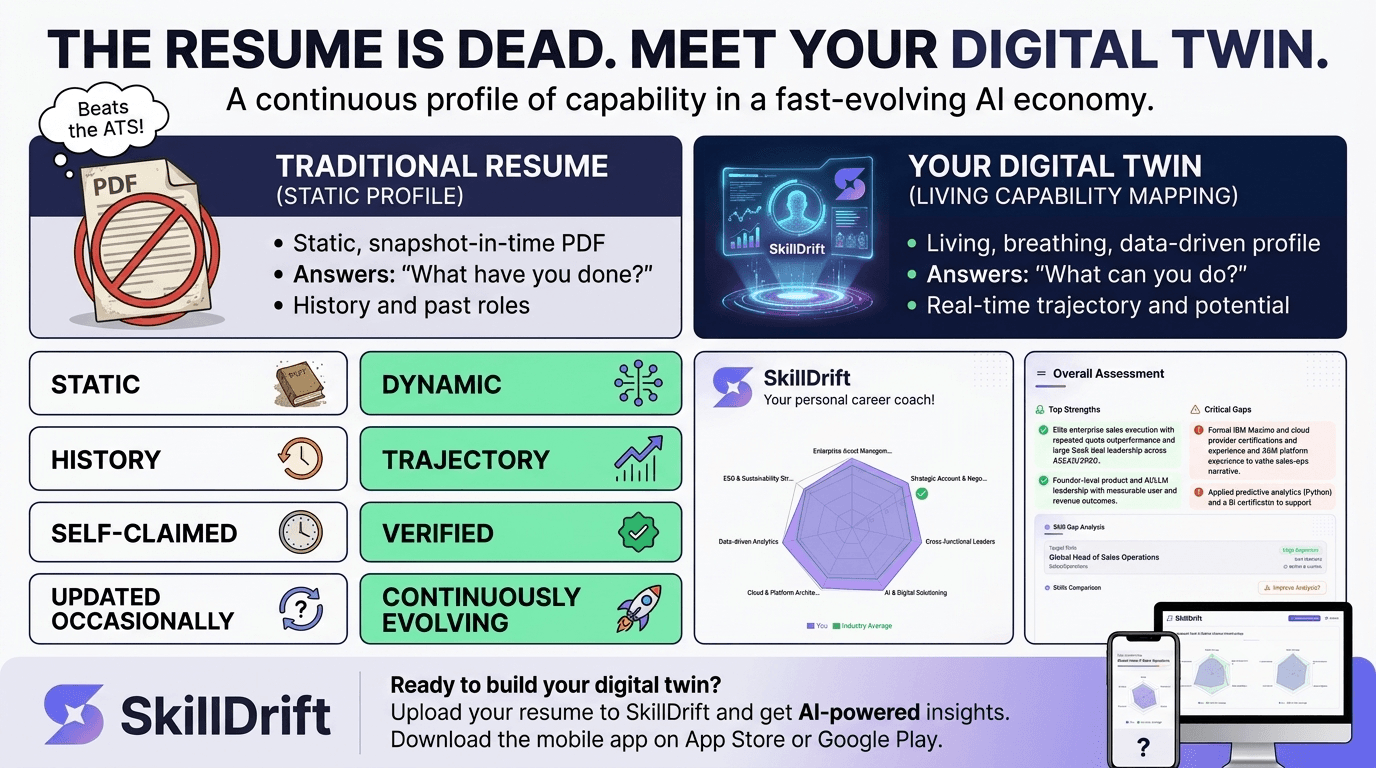
For decades, the resume has been the currency of the job market. It’s typically a one or two-page PDF - a carefully crafted list of jobs, degrees, certifications, and achievements. Every few months, we tweak a few bullet points, export another PDF, and hope it survives the Applicant Tracking System (ATS) before a human ever lays eyes on it.
This system worked reasonably well in a world where careers changed slowly. But that world no longer exists.
Today, technologies evolve every quarter, and new roles emerge before universities can even teach them. AI is rewriting job descriptions almost weekly. Yet, we are still trying to represent dynamic careers with static documents. It’s a bit like trying to understand someone’s fitness journey by looking at a single photograph taken three years ago. The picture might be accurate, but it just isn’t current.
Designed for a Different Era
The traditional resume answers only one question: “What have you done?”
But today's employers increasingly care about a completely different set of questions:
- What can you do today?
- What can you learn tomorrow?
- How quickly do you adapt?
- Which adjacent skills do you already possess?
- How close are you to becoming productive in this role?
Those answers rarely fit inside two pages. A software engineer who learned Generative AI over the last six months may still have a resume dominated by five years of Java development. A marketing professional experimenting daily with AI-driven campaign automation often looks identical on paper to someone who hasn’t updated their workflow since 2022.
The resume captures history. Companies need visibility into potential.
AI Didn’t Kill the Resume. It Exposed Its Weakness.
There is endless debate about AI writing resumes. Candidates use AI, recruiters use AI, and ATS platforms run on AI. Ironically, everyone is optimizing the wrong thing.
People spend hours trying to “beat the ATS,” but the ATS isn’t actually the problem. The problem is that we are asking intelligent systems to make decisions using outdated, incomplete data. Imagine asking Netflix to recommend movies after seeing only the last five films you’ve watched in your entire life, or Spotify creating playlists from songs you listened to five years ago. The recommendations wouldn’t necessarily be wrong; they’d simply be based on stale information.
Hiring works exactly the same way.
Real Careers Don’t Stand Still
Consider two data analysts who both graduated in 2022 and currently work with SQL, Excel, and basic dashboards. On paper, their resumes are nearly identical.
But let's look at what happened over the last year:
Candidate A:
- Learned Python for advanced analytics.
- Built dynamic dashboards using Power BI.
- Completed practical projects utilizing AI-assisted analytics.
- Practices case interviews every week.
- Regularly studies emerging data tools.
Candidate B:
- Continues performing the exact same tasks as when they joined.
A static PDF resume barely reveals this difference. Yet, one candidate has significantly higher future potential and learning velocity. Static resumes struggle to communicate momentum, and momentum increasingly matters more than history.
The Rise of the Professional Digital Twin
Manufacturing has used digital twins for years. Before building an aircraft engine or a wind turbine, engineers create a digital version that continuously reflects the real object as new data flows in. The digital twin evolves, predicts, and identifies weaknesses before they become failures.
Careers deserve the exact same treatment.
Imagine having a digital representation of your professional capabilities that evolves right alongside you. Not a document, but a living profile that actually understands:
- Your verified skills and core competencies.
- Your current strengths and skill gaps.
- Your learning velocity and job readiness for future roles.
- How your capabilities compare against real-time market expectations.
- Which specific skills will create the biggest impact on your trajectory.
Instead of asking, “What job did you have?” it starts answering, “What are you becoming?”
Forward-thinking educational institutions are already realizing this, moving away from static degrees to tracking real-time student job readiness and employability metrics. The broader market demands proof of continuous evolution.
The Future is Capability Mapping
The World Economic Forum has repeatedly highlighted that a massive share of today’s workforce will require significant reskilling as technology reshapes industries. Yet, employers consistently report difficulty finding people with the right mix of technical, business, and human skills.
It’s a paradox*: Millions are looking for jobs, while millions of jobs struggle to find qualified people.*
This gap isn’t always about a lack of talent; it’s about a lack of visibility. People possess capabilities that never make it onto a resume, and employers search for signals that candidates never communicate. The next generation of hiring won’t be about writing better resumes; it will be about maintaining better career data. At an individual level, a skill gap analysis is how you see which of those gaps are yours.
Instead of constantly editing your story to guess what recruiters want, your career story should write itself through verified evidence.
A Digital Twin Doesn’t Stand Still. Neither Should You.
Most career platforms stop after analyzing your resume. They identify your skills, highlight a few gaps, recommend some courses, and consider the job done. But careers don’t evolve through one-time assessments; they evolve through continuous feedback.
Every new technology you learn, every project you complete, every interview you practice, and every micro-skill you acquire changes your value in the job market. Your professional identity shouldn’t wait until the next time you edit your resume. It should evolve every time you do.
That’s the exact philosophy behind SkillDrift.
You begin by uploading your resume. In minutes, SkillDrift creates your digital twin - a living representation of your professional capabilities, not just your work history. From there, the journey becomes continuous. SkillDrift benchmarks your skills against real-world market demand, identifies the capability gaps standing between you and your target role, and then delivers hyper-personalized, just-in-time learning designed specifically for you. Not generic learning. Not endless course catalogs. Just the right skill, at the right time, because it’s the next capability that will have the greatest impact on your career.
Think of it like GPS navigation. A GPS doesn’t hand you every possible route before you start driving; it gives you the next turn exactly when you need it. Career growth should work the same way.
As you complete SkillSprints, strengthen your knowledge, practice interviews, and build new capabilities, your digital twin updates automatically. Your capability gaps shrink, your career readiness improves, and your job fit scores are recalculated in real time. New opportunities begin appearing that weren’t available just days earlier. You’re no longer relying on a resume that describes who you were when you last updated it. You’re presenting an always-current picture of who you’ve become.
That’s where the real shift happens. Every verified skill, completed learning sprint, and improvement you make sends a stronger signal to the market. Not because you’ve simply claimed a new skill on a PDF, but because you’ve continuously demonstrated your ability to learn, adapt, and grow.
In a world where technology is transforming jobs faster than ever before, your ability to keep evolving is your greatest competitive advantage. The future of hiring won’t belong to people with the most perfectly formatted resumes. It will belong to people whose capabilities continuously evolve alongside the market. That’s the difference between simply documenting your career and actively optimizing it.
The resume isn’t disappearing tomorrow. But it is becoming the starting point - not the destination. Your digital twin carries the journey forward.
Ready to Build Yours?
Every career starts somewhere, and yours can start with the resume you already have.
Upload it to SkillDrift and discover how your skills compare with today’s job market, where your biggest opportunities lie, and the fastest path to your next role. From there, SkillDrift continuously helps you close capability gaps through hyper-personalized learning, automatically updates your digital twin as you grow, and recalculates your job readiness and matches in real time.
Because your career shouldn’t stand still while the market keeps moving.
Start building your digital twin today at SkillDrift. Or, make career growth part of your daily routine by downloading the SkillDrift app on the Apple App Store or Google Play.
Your resume tells employers where you’ve been. Your digital twin shows them where you’re going.
Where to start this week
If your resume is still the only thing representing you, start by finding out what it actually says about your skills.
- Upload your resume at app.skilldrift.ai and see your gaps against the role you actually want.
- Take the highest impact gap and start the roadmap for it.
- Finish one course and watch the certificate attach itself to your resume automatically.
Prefer to do it on your phone? SkillDrift is on Google Play and the Apple App Store.
Until the twin is everywhere, the document still has to clear the filter. That is what a good ATS score actually means and how to check whether yours is ATS friendly. Then build a career roadmap so the twin has something new to show.
A resume is a record of the past. A digital twin is evidence of the present.