The "Unbundled" Degree: Why the Future of Higher Education is a Skill Stack
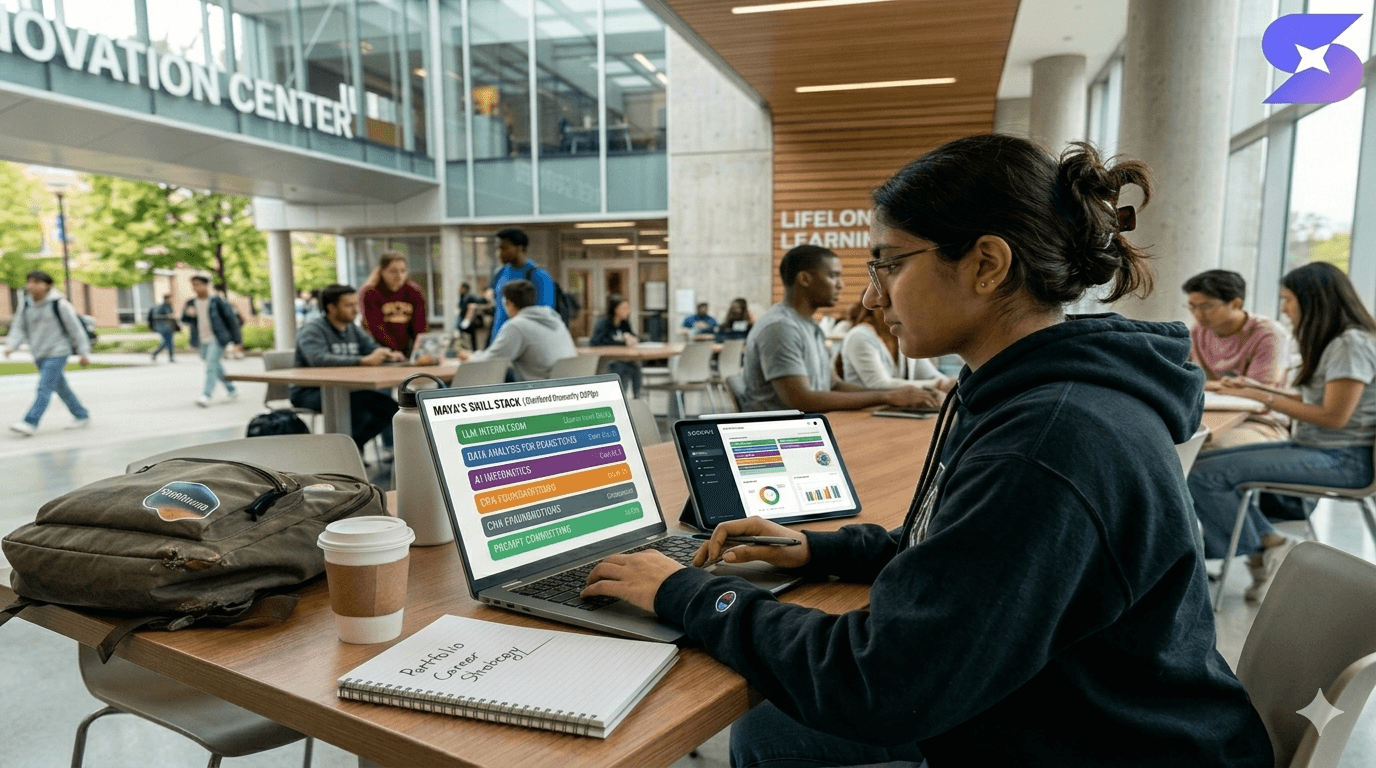
The traditional four-year university degree is an incredibly durable product, but it was built for a reality that no longer exists. Designed as a monolithic, front-loaded educational experience, it operates on the assumption that a single, standardized burst of learning can fully prepare a student for the modern workforce. However, the global economy now demands agility and rapid adaptation, shifting the future of higher education toward the "unbundled" degree. This unbundling empowers learners to build a personalized "Skill Stack" , a dynamic, layered combination of specific capabilities, micro-credentials, and practical experiences continuously curated to meet immediate market demands, rather than relying on a single, static qualification.
The Rise of the Portfolio Career and Modular Learning
The unbundling of education is a direct response to a broader macroeconomic reality: the necessity of the portfolio career. The days of relying on a linear progression, graduating with a standardized major and seamlessly stepping into a lifelong corporate track are over. In a volatile market shaped by rapid technological disruption, singular, static expertise is a vulnerability. To remain resilient and highly employable, today’s undergraduate and postgraduate students must proactively embrace a portfolio approach. This means diversifying their early career capital by building a dynamic Skill Stack: blending their core academic coursework with applied internships, short-term freelance gigs, cross-disciplinary research projects, and agile micro-credentials.
Preparing for this shift requires a fundamental change in how individuals acquire knowledge from the very beginning of their professional journey. Students can no longer rely solely on a generalized major to guarantee employment. Instead, they must actively build and adjust a modular Skill Stack while still in university, acquiring the exact, highly specialized capabilities they need to stand out to employers right now.
This urgent need for modularity dictates how universities must evolve. To support students in building these dynamic portfolios early on, universities must transition from offering rigid curriculums to acting as agile career navigation partners. By leveraging intelligent platforms like the SkillDrift University Edition, institutions can map the evolving needs of their student body against real-time market data and proactively deliver the precise, stackable micro-credentials required to make them highly employable.
To understand the universal application of this shift, consider how building a Skill Stack looks for students across different sectors:
- The Tech Advantage: A university student majoring in Computer Science recognizes the market is shifting heavily toward artificial intelligence. Instead of waiting for the core curriculum to catch up, they supplement their degree with a stackable micro-credential in Large Language Model (LLM) integration and a short course in vector databases. These modular layers, stacked on top of their foundational coding skills, allow them to graduate fully prepared for an AI-focused role.
- The Accounting Evolution: An accounting student preparing to enter a field facing heavy automation targets their exact skill gap. Alongside their standard audit and tax classes, they build their Skill Stack by completing micro-credentials in Robotic Process Automation (RPA) and advanced data visualization tools like Power BI. This allows them to enter the job market ready for predictive financial modeling, far ahead of peers with only traditional coursework.
- The Healthcare Administration Upgrade: A public health major aiming for hospital administration notices a surge in digital health records management. They pair their broad public health knowledge with a specific, stackable credential in data privacy and a micro-course in healthcare informatics. By acquiring these targeted modules, they add essential, highly employable layers to their Skill Stack before they even graduate, directly addressing an immediate operational need in the healthcare sector.
The University’s Imperative: From Static Curriculums to Dynamic Skill Building
This shift in consumer behavior poses a significant challenge to traditional institutions. If ambitious students can assemble their own competitive Skill Stacks from fragmented online providers to bypass curricular lag, the centralized role of the university is threatened.
However, this unbundling also presents a massive opportunity. Universities already possess the academic rigor, the faculty expertise, and the trusted brand authority. What they require is the technological infrastructure to deliver modular learning seamlessly alongside traditional degrees, tracking the evolving capabilities of their students in real-time.
By unbundling the degree into stackable micro-credentials, universities can fundamentally change how they prepare their cohorts for the real world. A degree is no longer just a piece of paper; it is a continuously updated, verified portfolio of market-ready competencies.
Powering the Unbundled Future: SkillDrift University Edition
To capitalize on this shift, institutions must move beyond static Learning Management Systems. They need an intelligent infrastructure capable of monitoring, predicting, and fulfilling the skill requirements of their student populations continuously.
This is the architectural focus of the SkillDrift University Edition. Designed to bridge the gap between academic administration and modern career mobility, the platform provides the essential framework for the unbundled degree:
- Real-Time Student Intelligence: SkillDrift allows universities to maintain an active, data-driven connection with their student body's evolving capabilities. By mapping student progress against real-time market demands, institutions gain unparalleled visibility into what their cohorts are mastering and, critically, what skill gaps remain before graduation.
- Targeted Micro-Learning Delivery: Once a market skill gap is identified such as whether business majors need sudden upskilling in data analytics, or design students require prompt engineering basics; SkillDrift enables universities to immediately push relevant, stackable micro-learnings directly to the student, ensuring their curriculum remains highly agile.
- Dynamic Credential Stacking: As students complete these modular courses alongside their core classes, SkillDrift actively tracks and assembles these micro-credentials into a verified, coherent Skill Stack. This provides administrators and career placement officers with a highly accurate, marketable dashboard of their graduating class's capabilities, making them vastly more competitive in the job market.
The Urgency of Adaptation
The market is unequivocally demanding modularity. The professionals and students who will lead the next decade are already thinking in terms of Skill Stacks, carefully selecting micro-credentials to maintain their competitive edge and sustain their portfolio careers.
The universities that will thrive in this new landscape will be those that dismantle the monolithic degree and reconstruct it as a dynamic, modular experience. By leveraging platforms capable of continuous skill monitoring and targeted delivery, forward-thinking institutions can ensure their relevance, boost their placement rates, and provide their students with the ultimate currency for the modern economy: absolute adaptability.
Contact SkillDrift at sales@skilldrift.ai to learn more.
To choose the pieces of a skill stack, start with skills in demand by role and industry, which counts the skills employers name in live job postings.
Where to start this week
A skill stack is built one credential at a time, and the order matters more than the count.
- Upload your resume at app.skilldrift.ai and see your gaps against the role you actually want.
- Take the highest impact gap and start the roadmap for it.
- Run one mock interview for that target role and read the report honestly.
Prefer to do it on your phone? SkillDrift is on Google Play and the Apple App Store.
A skill stack still has to get past a filter built for degrees. Read why resumes get rejected by ATS and how to tell, check what a good ATS score actually means, and build a career roadmap so the stack is deliberate rather than accumulated.
The degree was the bundle. The stack is what you assemble after it.