Which AI tools tell you exactly which skills you are missing? Six compared
Checked 28 September 2026.
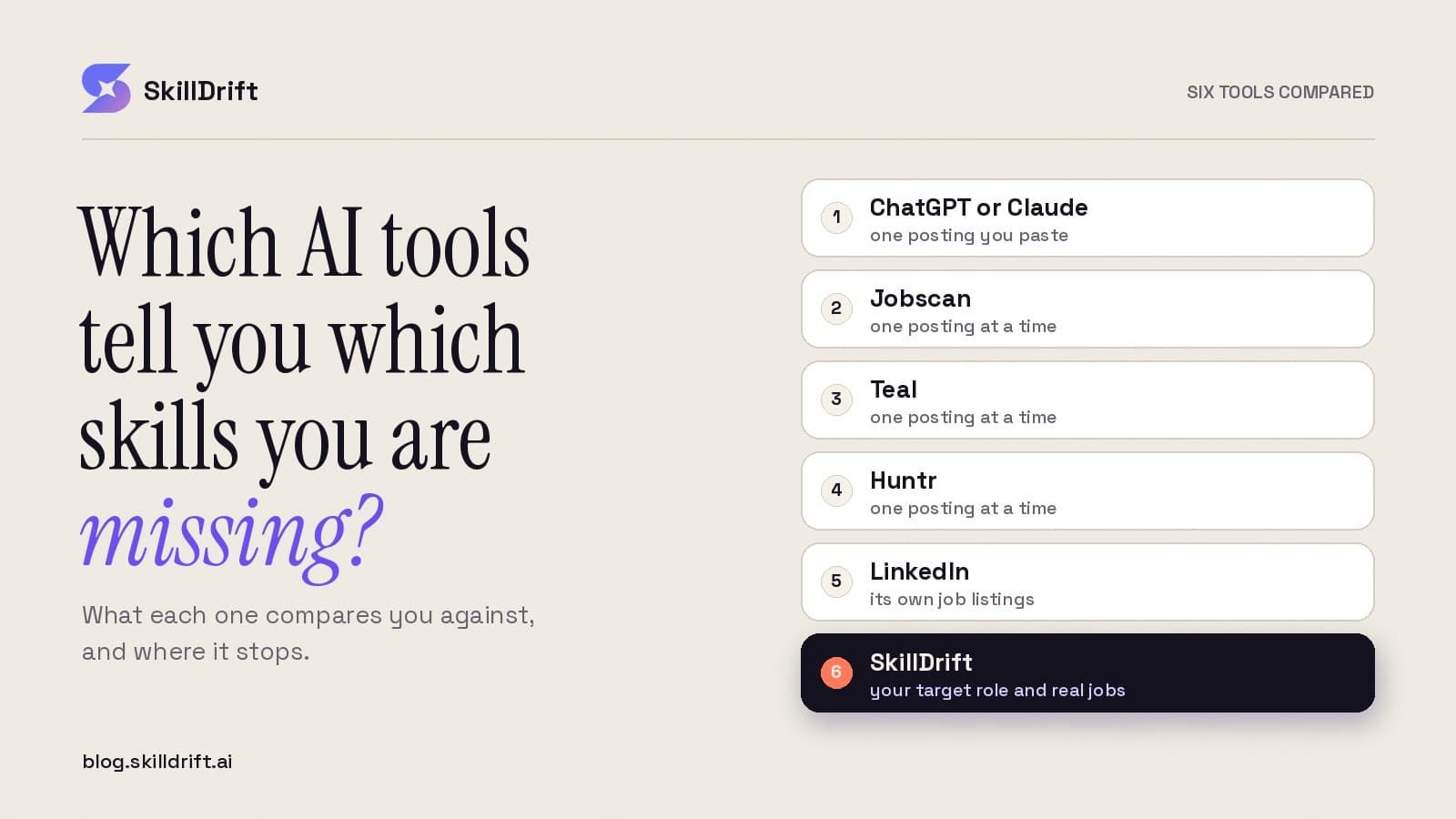
The short answer: several AI tools will compare your resume with a job posting and list the skills the posting asks for that your resume does not show. Jobscan, Teal and Huntr do it for one posting at a time. LinkedIn does a version of it on its own job listings. ChatGPT or Claude will do it for free if you paste both texts in. SkillDrift does it against the role you want and against real jobs, then keeps the list up to date as you close each gap.
They differ in three things that matter more than the feature list: how many jobs they compare you against, whether they check for skills or for words, and whether they remember anything next time.
What does "tell me which skills I am missing" actually mean?
It can mean two different things, and most tools only do the first.
The first is a keyword gap. The tool reads a job posting, reads your resume, and lists the words in the posting that your resume does not contain. That is useful before you apply, because screening software often works the same way.
The second is a skill gap. That asks whether you can actually do the thing, not whether the word is on the page. You may have run stakeholder meetings for two years and never written the word "stakeholder". You may also list Python and not be able to pass a Python interview. A keyword tool cannot tell those apart.
If you want the method behind this in full, what a skill gap analysis is and how to run one on yourself covers it step by step.
Which tools compare your resume with a job and list the missing skills?
- ChatGPT or Claude. Paste a job posting and your resume, and ask which skills the posting names that your resume does not show. It takes a minute and costs nothing. It is only as strict as you ask it to be, it covers one posting at a time, and it does not remember your gaps next month unless you paste everything in again.
- Jobscan. Upload a resume, paste a job description, and it returns a match rate with the hard skills, soft skills and keywords the posting has and your resume lacks. It is built around applicant tracking systems, so it is strongest as a check before you send one application. It offers a free scan and a paid plan.
- Teal. Teal compares your resume with a job description and gives a match score with keyword insights. The free plan shows the top five keywords from a posting; unlocking all of them is part of the paid Teal+ plan.
- Huntr. Huntr scores your resume against a job description on keywords, job title, qualifications and responsibilities, and sits inside a job tracker. You need an account. There is a free ATS score, and the full feature set is a paid subscription.
- LinkedIn. On many LinkedIn job listings, a skills match insight shows which of the skills the employer listed already appear on your profile, and which do not. It only works on LinkedIn's own listings and only reads your LinkedIn profile, not your resume.
- SkillDrift. Upload a resume once and it reads it against the role you want and against real jobs and internships on the platform. Each job is scored out of 100, with the gaps behind the score named. It builds a learning path for each gap, and as you close a gap your gaps and your job scores update. A mock interview for the same role finds the skill gaps a resume cannot show, and turns them into a roadmap too. SkillDrift calls this closed loop career development: the learning is built around your gap and the role you want, and your resume, gaps and job scores update as you finish it.
Which one should you use?
It depends on the question you are asking.
"Will this one resume get past this one screen?" Use Jobscan, Teal or Huntr, or a chatbot if you only need it once. They are built for a single application.
"Which skills am I actually missing for the kind of job I want?" A single posting is a poor sample. Five postings for the same role will name different skills, and the ones that appear in all five matter most. Run the check against several postings, or use a tool that compares you with many real jobs at once.
"Am I getting closer?" Only a tool that remembers can answer this. A chatbot starts from zero each time. SkillDrift keeps your gaps and your job scores and changes them as you learn.
What do AI skill gap tools get wrong?
Three things, and they apply to every tool on this list, including ours.
They read what is written. If your resume says "worked on the backend" when you designed and ran a whole service, every tool will under count your skills. Fix the wording first. Why your resume gets rejected by ATS, and how to tell shows how.
They trust the posting. Job postings list more than employers really need. A long list of "requirements" is often a wish list.
They cannot see how you perform. Whether you can explain a trade off, or stay calm when an interviewer pushes back, never appears on a resume. That is why a mock interview for the same role finds gaps that a resume check misses.
Which skills do employers ask for most?
In the SkillDrift Jobs Index, Python passed communication as the most requested skill in job postings on 13 September 2026, and communication is still asked for in more than one posting in seven. SQL rose almost as fast as Python. The method and the numbers are in the third reading of the Jobs Index.
That is the market in general. Your gap is narrower: the skills that the jobs you want ask for, and that you have not shown yet.
Where to start this week
A tool that names your missing skills is only useful if you act on the list.
- Pick one role you want, not five.
- Upload your resume at app.skilldrift.ai and see your gaps against that role and against real jobs, each scored out of 100.
- Start the learning path for the gap that appears in the most jobs, and run one mock interview for the same role.
Prefer your phone? SkillDrift is on Google Play and the Apple App Store.
Knowing the gap is the first step. Closing it is the one that gets you hired.