Python has passed communication as the most requested skill in job postings
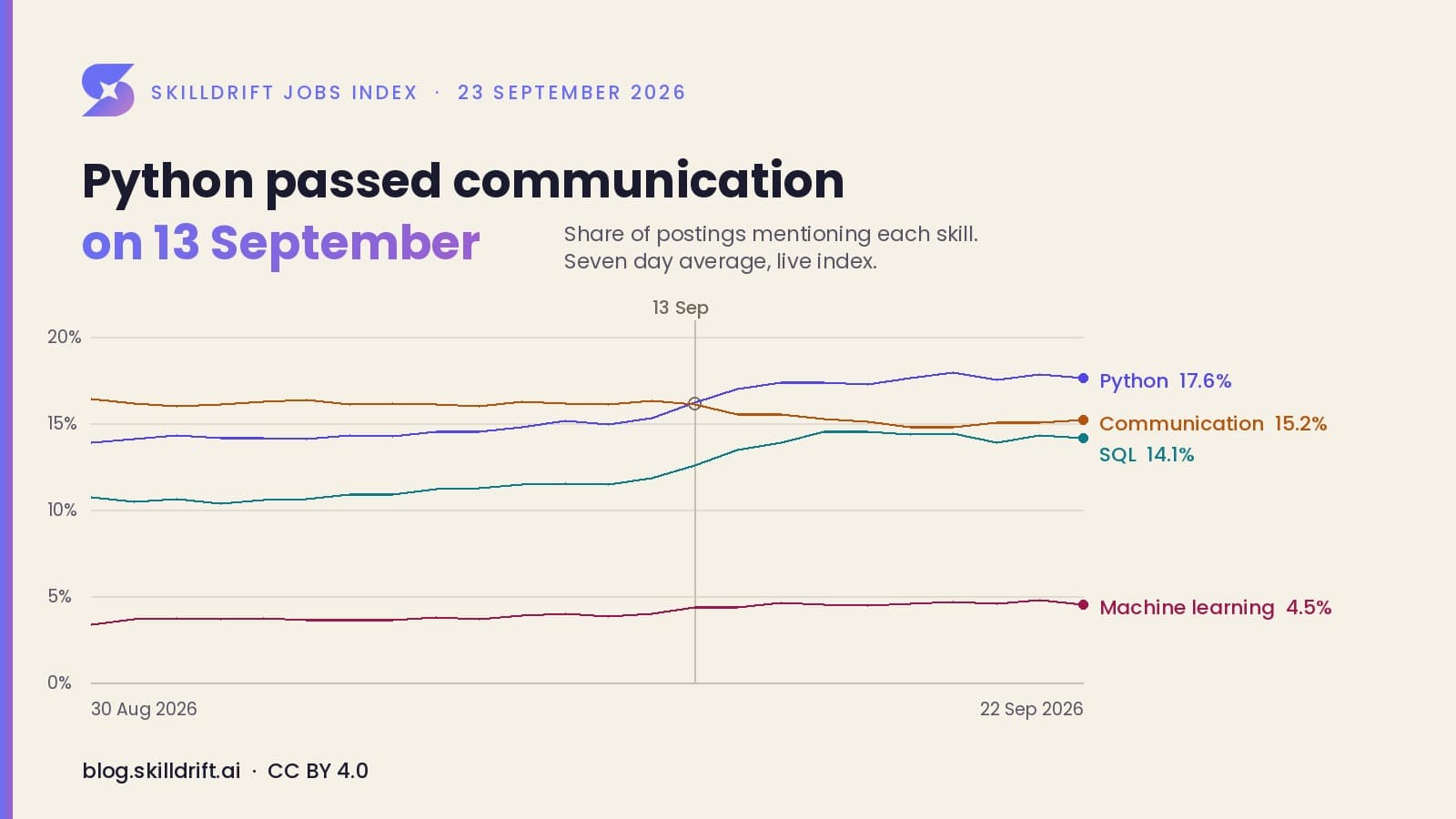
Third reading from the SkillDrift Jobs Index. Reading of 23 September 2026. Licensed CC BY 4.0.
On 13 September 2026, Python passed communication as the most requested skill in the job postings we index. It is the first time since we began counting that a technical skill has held the top place.
The two earlier readings set this up. The first reading, on 11 September, answered the level question and found communication ahead. The second, on 14 September, answered the direction question and found communication still first, with Python having closed nearly two thirds of the gap in a quarter.
The gap closed completely on the last day of that second reading's measurement window. We did not see it at the time because the window ended there.
Where the two skills sit now
Share of postings mentioning each skill. Seven day rolling average.
Python, 13.9 to 17.6 per cent, up 3.7 points
Communication, 16.4 to 15.2 per cent, down 1.2 points
SQL, 10.7 to 14.1 per cent, up 3.4 points
Problem solving, 9.0 to 9.3 per cent, up 0.3 points
Machine learning, 3.4 to 4.5 per cent, up 1.1 points
Communication did not collapse. It is still asked for in more than one posting in seven, and it fell by just over a point. Python rose underneath it, and SQL rose almost as fast from further back.
The most striking number here is not Python. SQL, designed in the early 1970s, added 3.4 points of share in three weeks. That is more than three times what machine learning added over the same window.
The thing everyone expects to be the story
AI is rising on every term we track. It is also small.
Machine learning, 3.4 to 4.5 per cent
TensorFlow, 1.4 to 2.0 per cent
Generative AI, 0.9 to 1.5 per cent
Deep learning, 1.2 to 1.4 per cent
Artificial intelligence, 0.6 to 0.7 per cent
LLM, 0.5 to 0.6 per cent
AI, 0.5 to 0.6 per cent
Machine learning is the largest of them at 4.5 percent of postings. The literal term "AI" appears in fewer than one posting in a hundred and fifty. Generative AI peaked at 1.9 percent in mid September and has come off since.
So the honest reading is that employers are hiring for the data stack rather than for AI itself. The skills that grew fastest in absolute terms are the ones an AI system is built on top of, not the ones named after it.
What is in the index
As at 23 September 2026:
Live postings in the index, 412,223
Postings parsed for requirements, 412,147
Added in the last 24 hours, 2,316
Added in the last 7 days, 31,718
Added in the last 30 days, 127,984
Every posting is live at the time of reading. Closed and filled postings are not counted.
Seventy six postings, which is 0.02 percent, had not finished parsing when this reading was taken. Forty were queued and thirty six failed. They are excluded from the breakdowns below, which is why those breakdowns sum to 412,147 rather than 412,223.
Thirty one percent of the index was posted in the last thirty days. It is a live corpus, not an archive.
How much experience employers actually ask for
141,514 postings, which is 34.3 percent of the index, state no experience requirement at all.
That share has held at 34.3 percent across three readings taken on 17 and 23 September while the index itself grew by more than 6 percent. A share that stays put while its denominator moves is more reliable than any single reading.
Of the 270,633 postings that do state a number:
0 to 1 years, 72,759 postings, 26.9 per cent
2 to 3 years, 77,068 postings, 28.5 per cent
4 to 6 years, 71,769 postings, 26.5 per cent
7 to 9 years, 26,759 postings, 9.9 per cent
10 to 14 years, 16,582 postings, 6.1 per cent
15 years and above, 5,696 postings, 2.1 per cent
Almost 82 percent of postings that state a requirement ask for six years or less. Only 8.2 percent ask for ten years or more.
The requirement is read from the posting text as the employer wrote it. Where a posting gives a range, the lower bound places it. Postings that state nothing are counted separately and are never treated as entry level. A posting with no stated requirement may be genuinely open, or the employer may expect the reader to infer it. We cannot tell which from the text, so we do not guess.
How we counted this
Shares, not counts. Postings do not arrive at a steady rate. In the window above, daily intake ranged from 232 to 8,840. A raw count of postings mentioning a skill is therefore mostly a measurement of how much the index took in that day. The denominator here is the number of postings that entered the index on each day, summed across every industry. The seven day rolling window exists to smooth the batching, not to smooth the trend.
Spelling variants are aggregated, and here is the list that matters. Employers write the same skill several ways, and counting only one spelling understates it. Communication is the sum of "communication" and "communication skills". Problem solving is the sum of "problem solving" and "problem-solving". We found this by reconciling this reading against the published second reading: twelve of fourteen skills matched to the second decimal place, and the two that did not were both two word phrases where a variant had been dropped. Verbal communication and written communication are counted as their own separate skills and are not folded into communication.
The denominator limit. We hold daily intake for thirty days, so a share can only be calculated over that window. Longer comparisons in this index are counts, and counts are not a trend.
What this does not say
Four limits, stated plainly, because a source that only lists its strengths is not a source.
It counts postings, not jobs and not hires. One role advertised on three boards is a duplicate we try to collapse and do not always catch. A posting is not evidence anyone was hired.
It reads stated requirements, not real ones. Employers hire people who do not meet the stated bar and reject people who do.
It is not a labour force. The index reflects what employers advertise, weighted towards roles and sectors that advertise online at all. Work filled by referral or agency does not appear.
Skill mentions are text matches on the posting body. A posting saying "no Python required" counts as a mention of Python. At this volume that noise is small and it is not zero.
Suggested citation
SkillDrift Jobs Index, third reading, 23 September 2026. blog.skilldrift.ai
Licensed under Creative Commons Attribution 4.0. You may use these figures, including commercially, with attribution.
If you want a cut that is not on this page, by role, by industry or by experience band within a role, ask and we will pull it. We would rather the number in your piece be the right one.
What to do with this if you are planning a move
The useful reading is not that communication stopped mattering. It plainly has not. The useful reading is that the ground moves faster than most people check, and the specific skills that moved are worth naming rather than guessing. Running a skill gap analysis on yourself is how you turn a reading like this into a list you can act on.
- Upload your resume at app.skilldrift.ai. No account needed to see your first result.
- Every job and internship in the index is matched against your resume and scored out of 100, so you can see which postings you are actually close to.
- Where a posting asks for something your resume does not show, that gap becomes a learning roadmap, and the gap closes as you work through it.
The app is also on Google Play and the Apple App Store.
The next reading publishes in October.