Career Goals Examples for Every Stage, and How to Turn One Into a Plan
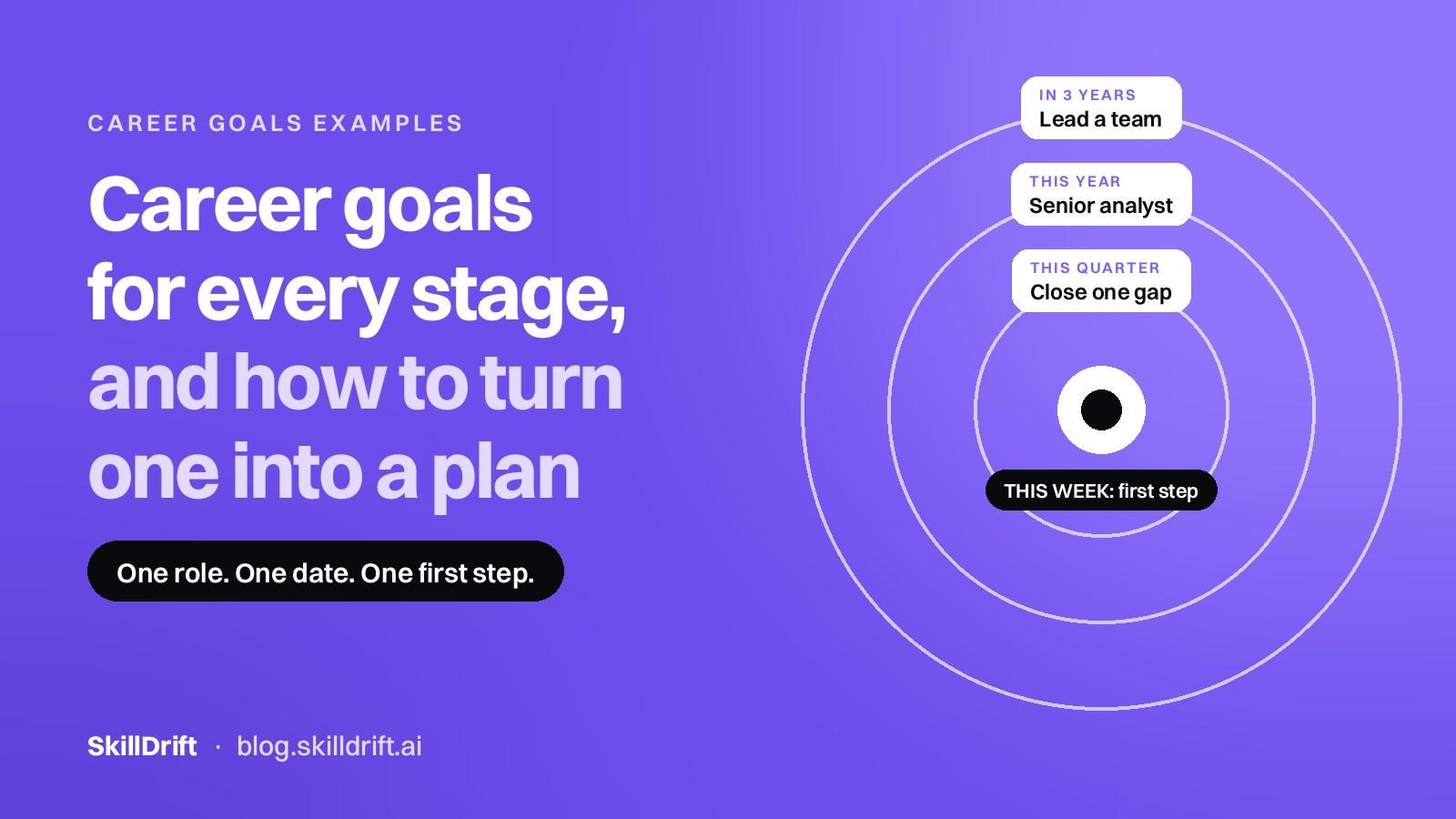
A good career goal names a role or a result, a date, and the skills it needs. Below are career goals examples for students, freshers, early career professionals, mid career professionals, career changers and people returning to work, each with a short term and a long term version. After the examples, there are five steps to turn one goal into a plan you can start this week.
What makes a good career goal?
A career goal is useful when someone else could check whether you reached it. Four things make that possible:
- A role or a result. "Become a data analyst" can be checked. "Grow in my career" cannot.
- A date. Six months, one year or three years. Without a date, the goal never becomes urgent.
- The skills it needs. Read them from real job postings for the role.
- A first step for this week. If you cannot name one, the goal is still too vague.
What is the difference between short term and long term career goals?
A short term career goal is something you can reach in six to twelve months, such as finishing a certification, getting an internship or moving into a bigger project. A long term career goal takes three to five years, such as leading a team or moving into a new field.
The two should connect. Each short term goal is one step toward the long term one. If a short term goal does not move you closer to the long term goal, ask why it is on the list.
Career goals examples for students
- Short term: Get one internship in the field I am studying before my final year.
- Short term: Build two projects that use the skills most often named in internship postings for my field.
- Short term: Clear my campus placement interviews by practising answers out loud every week.
- Long term: Get my first full-time role in the field within six months of graduating.
Career goals examples for freshers
- Short term: Land my first full-time job as a junior marketing executive within six months.
- Short term: Add one proof of a skill to my resume every month, such as a project, a certificate or a result from my internship.
- Short term: Get more interview calls by matching my resume to each job I apply for.
- Long term: Become a specialist in one area of my field within three years, with work I can show.
Career goals examples for early career professionals
- Short term: Learn the one skill that most of the roles one level above mine ask for, and use it on a real project this quarter.
- Short term: Lead one piece of work from start to finish, with a result I can put in numbers.
- Long term: Move from analyst to senior analyst within two years.
- Long term: Become the person my team asks about one subject.
Career goals examples for mid career professionals
- Short term: Get promoted where I am by my next review, with a written list of the results I delivered this year.
- Short term: Close the two skill gaps that stand between me and a team lead role.
- Long term: Lead a team of five within three years.
- Long term: Move from managing projects to owning a product or a budget.
Career goals examples for career changers
- Short term: Pick one target role in the new field and list the skills five postings ask for.
- Short term: Find the skills I already have that transfer, and show them on my resume in the new field's words.
- Long term: Work in the new field within eighteen months, starting from a role that uses what I already know.
If you are changing fields, how to switch careers when you do not have the skills yet walks through this in more detail.
Career goals examples for people returning to work
- Short term: Update one skill that changed while I was away, and show it with a small project.
- Short term: Explain the gap on my resume in one sentence and move on to what I can do now.
- Long term: Return to my previous level within two years.
What are good professional goals examples for a performance review?
In a review, a professional goal should tie to a result your manager can see. Some examples:
- Cut the time a monthly report takes from three days to one by the end of the quarter.
- Train two new joiners on our main process by June.
- Learn the analytics tool the team is moving to and run the first three reports with it.
- Present one project update to senior leadership this year.
Is a career goal the same as a career objective?
No. A career objective is one or two lines at the top of a resume that tell an employer what role you want and what you bring to it. A career goal is for you: where you want to be and how you plan to get there. A clear goal makes the objective easy to write. For example: "Junior data analyst with SQL and Excel project work, looking for a first full-time analyst role."
How do you turn a career goal into a plan?
- Write the goal as one role and one date. For example, "Data analyst by next June."
- Read five real job postings for that role. List every skill they name, and count how often each one appears. Postings for the same title often ask for different things, so five gives a fair picture. For a quick view by field, see skills in demand, by role and industry.
- Sort each skill into three groups: on my resume; I have it but my resume does not show it; I do not have it yet. The middle group needs no new learning. Fix those lines on your resume first.
- Pick one gap and give it fixed hours each week. Work in weekly steps and finish each skill with proof: a project, a result at work or a certificate.
- Measure again every month. Compare your resume with new postings for the role. If the gap is closing, keep going. If the goal no longer fits, change it.
This is what we call closed loop career development: measure the gap, close it, prove it, then measure again. For a fuller version of steps 4 and 5, see how to build a career roadmap step by step.
How does SkillDrift help you reach a career goal?
SkillDrift starts with your goal. You choose what you want now, such as landing your first full-time job, getting an internship, finding a new job in your field or getting better at your current job, and you can name the role you want next.
Upload your resume once, and SkillDrift:
- Scores every job and internship out of 100 against your resume, and shows what matches and what to close for each one.
- Shows how ready you are for your next role as a percentage, and how much finishing each roadmap would add.
- Builds a learning roadmap for each skill gap, in weekly sprints sized to the hours you can give each week.
- Adds the certificate to your resume once you finish a roadmap and claim it, and the jobs that ask for that skill score higher.
- Lets you practise the interview for a job you want, with a report on what to fix next.
If your goal is a promotion, it also keeps track of your review month and helps you write your self-review from the wins you log each week.
Frequently asked questions
How many career goals should I have? One long term goal and two or three short term goals that lead to it. More than that splits your time.
What is a SMART career goal? A goal that is specific, measurable, achievable, relevant and time bound. "Become a data analyst by next June, with three SQL projects on my resume" is a SMART goal. "Get better at data" is not.
What if my career goal changes? That is normal. Check it every few months against real job postings. If the role has changed or you want something else, write a new goal and start from step 1.
Should I put my career goal on my resume? Put a short career objective instead, written for the job you are applying for.
Where to start this week
- Write your goal as one role and one date.
- Open five job postings for that role and list the skills they name.
- Or check your resume against real jobs on SkillDrift and see your gaps for the role you want next.
Prefer your phone? SkillDrift is on Google Play and the Apple App Store.
Know someone setting goals for the year ahead? Send them these examples.
A goal you can check is a goal you can reach. Write one down today.