Closing the Loop: How Higher Education Can Conquer the "Velocity Gap" and Empower the Future Workforce!
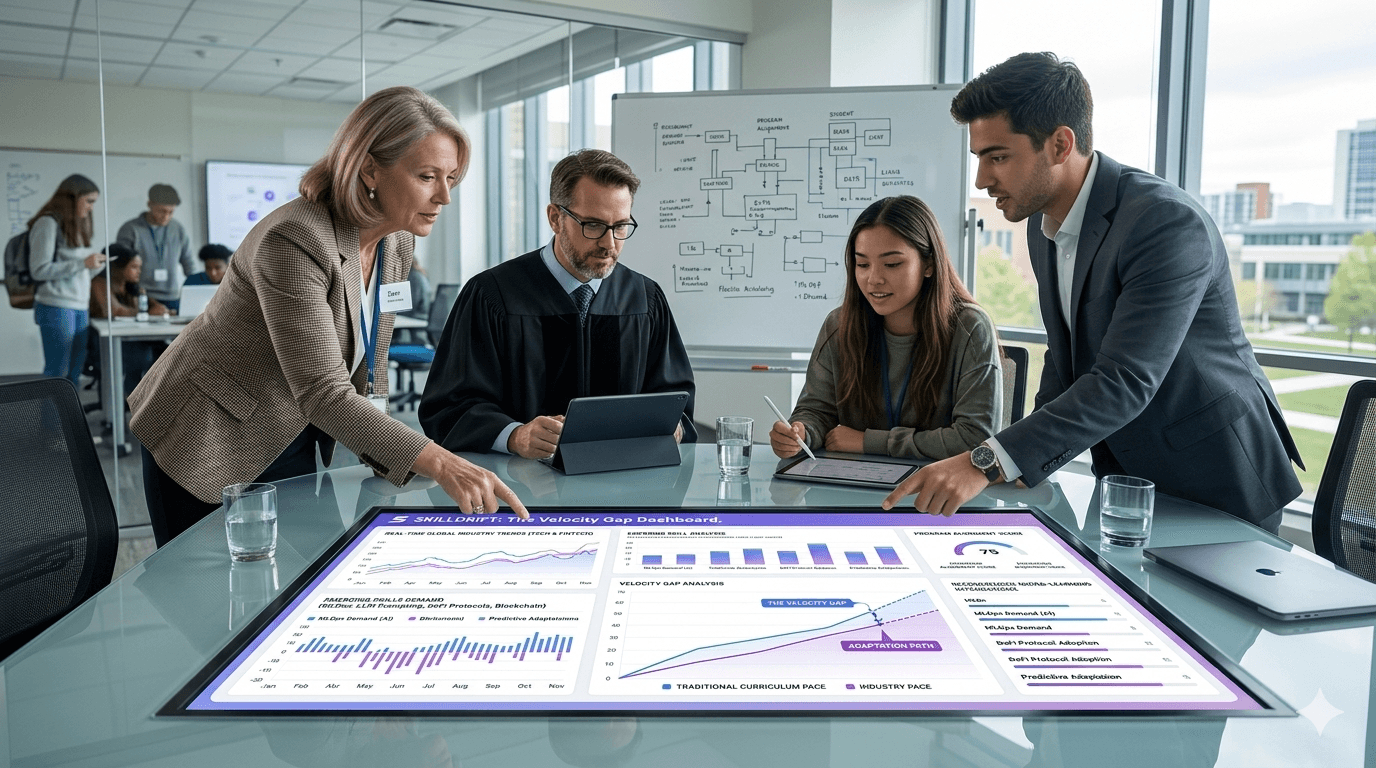
Universities have always been the bedrock of innovation and societal progress. They are the crucibles where critical thinking is forged, where foundational theories are tested, and where the next generation of leaders develops the intellectual stamina required to tackle complex global challenges. The intrinsic value of a traditional university degree - the cultivation of a disciplined mind, the exposure to diverse perspectives, and the power of a vibrant alumni community remains absolutely irreplaceable.
However, as the pace of technological advancement accelerates, higher education faces a unique structural challenge. The half-life of a learned technical skill is shrinking. In fast-moving sectors like technology and financial technology (fintech), that half-life is now measured in mere months.
This creates the "Velocity Gap" , the natural divergence between the necessarily deliberate, multi-year curriculum cycles of traditional degree programs and the dynamic, real-time demands of the global workforce.
Traditional degrees are not losing their relevance; rather, their application needs an upgrade. Universities do not have to choose between foundational academic rigor and modern employability. By bridging the gap between stable core curricula and dynamic industry demands using real-time data and micro-learning, academic institutions can evolve to become the ultimate launchpads for the modern economy.
Here is how the academic ecosystem from Deans and faculty to career counselors and students can close the loop.
The Challenge of Pacing: Where Core Academics Meet Moving Targets
To understand the Velocity Gap, we must recognize that universities are actually succeeding at their primary mission: teaching students how to think. The friction occurs in the "last mile" of job readiness, where the specific tools and platforms demanded by employers change faster than any syllabus can reasonably adapt.
The disconnect is most visible in rapid-growth sectors like tech and fintech, where innovation outstrips standard institutional pacing.
The Tech Landscape
Consider a foundational computer science program. Universities excel at teaching the underlying mathematics, algorithmic logic, and structural theories of computing. These are the timeless building blocks of a great software engineer.
- The Pacing Challenge: While the foundation remains strong, the specific tools the industry uses are moving targets. A student might master the theory of databases, but employers today are looking for immediate fluency in MLOps (Machine Learning Operations), Large Language Model (LLM) prompt engineering, and cloud-native serverless architectures. When the core curriculum cannot easily swap out specific coding languages mid-semester, graduates may possess a brilliant theoretical mind but require months of on the job training to navigate a modern enterprise tech stack.
The Fintech Evolution
Similarly, traditional finance programs are unparalleled in teaching deep economic principles, monetary theory, and market psychology.
- The Pacing Challenge: The financial sector is undergoing a massive transformation. Modern financial institutions and disruptive startups demand professionals who can overlay traditional financial knowledge with an understanding of decentralized finance (DeFi) protocols, algorithmic trading, smart contracts, and AI-driven risk modeling.
The goal is not for universities to abandon their rich, theoretical foundations to become corporate training centers. The goal is to seamlessly layer these fast-moving, high-demand skills on top of that robust academic foundation.
Empowering Leadership: The Role of Macro-Level Dashboards
If the challenge is the speed of market change, the solution is actionable intelligence. To conquer the Velocity Gap, university leadership must be equipped with the right tools to predict industry trends rather than react to them.
University Deans and academic strategists need access to macro-level dashboards that aggregate real-time labor market data, skill gaps, and emerging toolsets. Imagine academic leadership having a real-time pulse on employer demand within their geographic or industry placement radius.
With this data, universities can:
- Predict and Prepare: Identify when a new technology is moving from a niche trend to an industry standard, allowing institutions to prepare supplementary materials before the market peaks.
- Guide Strategic Partnerships: Make informed decisions about which industry software providers or enterprise tools to bring onto campus.
- Protect the Core Curriculum: By utilizing dashboards to track the volatile "surface skills," Deans can protect the core curriculum from constant, disruptive overhauls, knowing that the dynamic skills are being addressed elsewhere in the student experience.
Closing the Gap: Contextualized Micro-Learnings and SkillDrift
Data tells institutions what the market needs, but the delivery mechanism must be agile. Integrating highly contextualized micro-credentials directly into the university experience is the most effective way to create graduates who are "industry-ready" from day one.
This is where collaborative platforms are changing the landscape of higher education. For example, the SkillDrift University version is designed specifically to partner with academic institutions to solve the problem of curriculum drift without burdening the faculty.
Instead of requiring a multi-year syllabus rewrite, platforms like SkillDrift seamlessly integrate highly contextualized micro-learnings alongside the traditional curriculum.
- For the Institution: It acts as a dynamic overlay. A professor can continue teaching foundational financial theory, while the platform simultaneously provides students with bite-sized modules on current fintech regulations or blockchain applications.
- Measuring Job Readiness: Moving beyond traditional GPAs, the platform provides tangible "job readiness" scores. It tracks a student's acquisition of dynamic skills and maps them directly against real-time employer demands, giving both the university and the student a clear view of their market competitiveness.
- Career Counseling at Scale: University career centers are often overwhelmed, struggling to provide personalized guidance to thousands of students. SkillDrift empowers career counselors by automating skill-gap analysis and providing AI-driven, scalable counseling, ensuring every student has a personalized roadmap to bridge their specific skills to their target career.
By weaving these dynamic micro-learnings into the fabric of the degree, the university preserves its academic integrity while ensuring its students' immediate employability.
A Collaborative Evolution for the Academic Ecosystem
Conquering the Velocity Gap is a collaborative effort that honors the legacy of higher education while embracing the tools of the future.
To University Deans and Leadership
You are the stewards of your institution's legacy and its future. By embracing macro-level dashboards and integrating agile learning platforms, you can alleviate the pressure of constant curriculum redesign. You have the power to offer an educational experience that provides both timeless wisdom and immediate market value.
To Academic Faculty
Your expertise and mentorship are the heartbeat of the university. You do not need to constantly chase every fleeting tech trend. By leveraging supplementary micro-learning platforms, you can focus on what you do best - teaching critical thinking, complex problem-solving, and foundational theory knowing that your students are also receiving the latest contextualized industry skills.
To Career Counselors
You are the critical bridge between campus and the corporate world. By utilizing platforms that measure real-time job readiness and provide career guidance at scale, you can multiply your impact. You can shift from generic resume reviews to targeted, data-backed career strategy sessions for every individual student.
To the Students
Your university years are an incredible investment in your intellectual and personal growth. Cherish the deep, foundational learning your institution provides. At the same time, take advantage of the micro-credentials and dynamic learning platforms your university offers to build a robust, immediately deployable toolkit.
The Future is Collaborative
Traditional degrees are far from obsolete; they are the strongest possible foundation for a successful career. By partnering with agile platforms to integrate real-time data and contextualized micro-learnings, higher education can easily close the loop. Together, we can build an ecosystem where universities continue to shape brilliant minds, and modern tools ensure those minds are perfectly primed to lead the industries of tomorrow.
For more information, contact us at sales@skilldrift.ai
Career centres can use skills in demand by role and industry to see which skills live job postings ask for in each role group and industry.
Where to start this week
Whichever side of the loop you sit on, the first move is the same measurement.
- Upload your resume at app.skilldrift.ai and see your gaps against the role you actually want.
- Take the highest impact gap and start the roadmap for it.
- Run one mock interview for that target role and read the report honestly.
Prefer to do it on your phone? SkillDrift is on Google Play and the Apple App Store.
For more on the gap between study and work, read closing the gap between the classroom and the boardroom and why proof of competence now matters more than a GPA.
The loop closes when what is taught and what is hired stop being two separate conversations.