Skills for Your Resume in 2026: The Ones Employers Name in Job Postings, Role by Role
The short answer. Put the skills on your resume that the jobs you want actually name, and show each one with proof. Across all new job postings, communication is the most named skill: about one posting in four in the last 30 days. After that, the list depends on the role. A data role asks for Python and SQL in about half of its postings. A sales role asks for negotiation. A design role asks for Figma. Below are the skills employers name most for eleven role families, from the job postings we read at SkillDrift, and a simple way to show them.
What skills should I put on my resume?
Use three rules.
1. Start from the role, not from a generic list. A list of "top 20 skills" mixes roles that have little in common. Read what postings for your target role ask for first.
Example: Generic lists often lead with leadership and teamwork, but each is named in fewer than 4% of new postings. If you want a data analyst role, Python and SQL are each named in about half of data and AI postings. Those two belong at the top of your skills section.
2. Name the skill the way employers name it. If postings say "financial reporting", write "financial reporting", not "handled numbers".
More examples of the same work, written the way postings name it. Each of these is in the top eight for that role in the lists below:
- "Ran paid campaigns" becomes "Google Ads" and "Meta Ads" (marketing).
- "Made app screens" becomes "Figma" and "prototyping" (design).
- "Helped customers with problems" becomes "customer service" and "troubleshooting" (customer support).
- "Managed the team's tasks" becomes "Agile" and "Jira" (product).
3. Prove each skill once. A skill with a result next to it is believed. A skill in a list of twenty is skipped.
Example: "Skills: Excel" tells the reader little. "Built an Excel tracker for 40 vendor orders that cut late deliveries by half" proves Excel and vendor management in one line. Both are on the operations list below.
The sections below give you the first two. The third is in the section on how to show these skills, further down.
Which soft skills do employers name most?
Share of new job postings that named each skill, 12 October to 10 November 2026 (378,627 postings):
- Communication: 25.9%
- Problem solving: 12.1%
- Stakeholder management: 6.5%
- Leadership: 3.5%
- Teamwork: 3.4%
Communication is named more than twice as often as any other soft skill. But a resume that only says "excellent communication skills" proves nothing. Example: "Presented weekly sales numbers to a team of 12 and cut the meeting from 60 to 30 minutes" shows communication without using the word.
Which skills do employers name for each role?
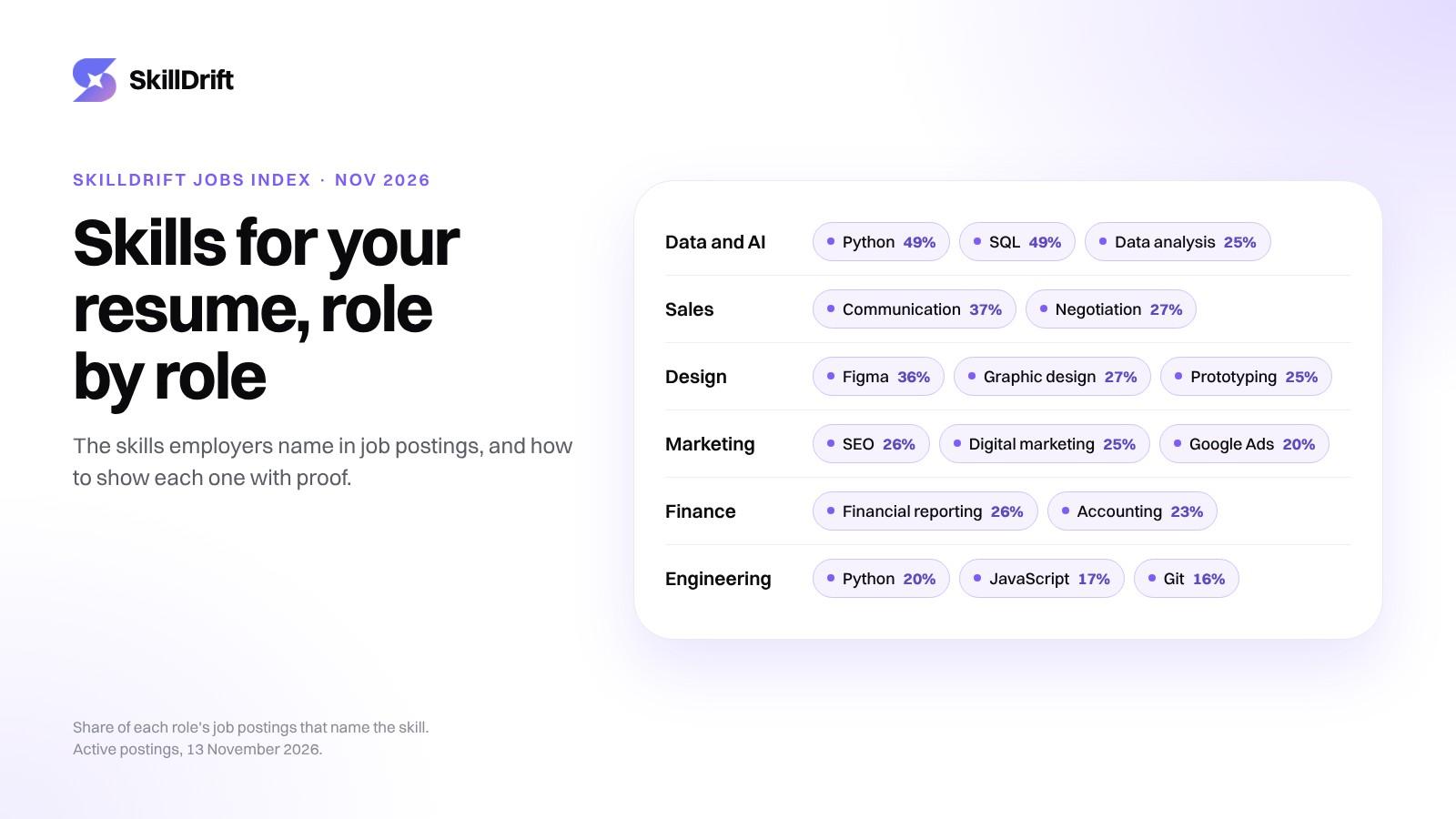
Each list shows the skills named most often in active postings for that role family on 13 November 2026, with the share of that role's postings that named each one. Each role links to its full skills page.
Software and engineering
Of 285,807 engineering postings: Python 20%, JavaScript 17%, Git 16%, CI/CD 16%, Java 14%, SQL 13%, React 12%, AWS 11%. Git and CI/CD are on almost as many postings as the languages, so list the tools you have used to ship code, not only the languages. Full list: engineering skills and the software engineer page.
Data and AI
Of 62,496 data and AI postings: Python 49%, SQL 49%, data analysis 25%, machine learning 23%, Power BI 19%, data visualisation 19%, data modelling 14%, Tableau 13%. Python and SQL each appear in about half of all data postings. If your resume has one and not the other, that is the first gap to close. Full list: data and AI skills and the data analyst page.
Sales
Of 75,072 sales postings: communication 37%, sales 32%, negotiation 27%, business development 21%, lead generation 18%, CRM 11%, B2B sales 9%, account management 9%. Sales is where soft skills lead. Negotiation and lead generation are easy to prove with numbers: deals closed, leads booked, conversion rate. Full list: sales skills.
Marketing
Of 39,051 marketing postings: SEO 26%, digital marketing 25%, Google Ads 20%, social media marketing 17%, Meta Ads 13%, Google Analytics 13%, keyword research 13%, content creation 12%. Marketing postings name tools by brand. Write "Google Ads" and "Meta Ads", not "paid campaigns". Full list: marketing skills.
Finance and accounting
Of 65,814 finance postings: financial reporting 26%, accounting 23%, Excel 16%, accounts payable 16%, tax compliance (GST 15%, TDS 12%), accounts receivable 14%, financial analysis 14%. Local tax rules appear in many finance postings, so name the tax systems you have worked with. Full list: finance skills.
Human resources
Of 32,842 HR postings: employee relations 24%, recruitment 24%, performance management 21%, talent acquisition 18%, HR operations 18%, employee engagement 17%, onboarding 16%, candidate sourcing 14%. HR postings split between hiring skills and people skills. Show at least one of each. Full list: HR skills.
Customer support
Of 36,578 customer support postings: customer service 34%, customer support 21%, troubleshooting 11%, technical support 8%, customer success 7%, Windows 5%, documentation 5%, CRM 5%. Troubleshooting and technical support are the skills that separate a support resume from the rest. Full list: customer support skills.
Design
Of 27,660 design postings: Figma 36%, graphic design 27%, prototyping 25%, typography 25%, design systems 21%, wireframing 21%, Adobe Photoshop 20%, Adobe Illustrator 19%. Figma is named more than any other design skill. A portfolio link does more here than a skills list. Full list: design skills.
Product management
Of 12,711 product postings: product management 38%, product strategy 17%, Agile 15%, project management 14%, business analysis 14%, user stories 12%, data analysis 12%, Jira 11%. Data analysis is on one product posting in eight. A product manager who can pull their own numbers stands out. Full list: product skills.
Operations
Of 163,334 operations postings: stakeholder management 11%, inventory management 9%, Excel 8%, project management 8%, data entry 7%, Microsoft Office 6%, vendor management 6%, risk management 5%. Operations is the widest family, so no single skill dominates. Pick the three that match your target posting. Full list: operations skills.
Education
Of 18,667 education postings: communication 31%, teaching 21%, lesson planning 15%, classroom management 15%, student assessment 9%, curriculum development 5%. Full list: education skills and the teacher page.
Where is AI on these lists?
AI skills are in the postings, but outside data roles none is named often enough to reach a top eight yet. The one exception is machine learning, named in 23% of data and AI postings.
Across all new postings in the week of 4 to 10 November 2026 (77,066), generative AI was named in 1.6%, about one posting in 63. Machine learning was named in 2.4%, prompt engineering in 0.9% and large language models in 0.9%. Each is rising week by week, but the eighth skill on most role lists above is named in 5% to 13% of that role's postings.
Where generative AI is named, it comes with Python and machine learning far more often than with anything else. So for now, AI skills sit on top of the foundations each role already asks for. If you add an AI skill to your resume, add it next to the core skills of your role, with proof, and not instead of them.
How should I show these skills on my resume?
Show each important skill in three places:
- In the skills section, using the posting's own words.
- In one bullet under a job or project, with a result. Example for SQL: "Wrote SQL queries that cut the monthly sales report from two days to two hours."
- In your summary, for the two or three skills the target role names most.
Hard skills (Python, Figma, financial reporting) are proved with a tool, a task and a result. Soft skills (communication, problem solving) are proved by what happened because of them, without naming the skill.
For more on this, see skills needed for a job: five roles side by side.
How do I find which skills I am missing?
Compare your resume with the postings you want, skill by skill. You can do it by hand with five postings, or let SkillDrift do it.
SkillDrift reads your resume, scores every job and internship out of 100 against it, and names each skill you are missing for the role you want. Every gap gets a course built for it, sized to the hours you have each week. When you finish, the certificate is added to your resume and your scores update. That cycle of measure, learn, prove and measure again is what we call closed loop career development.
How we counted
- Role lists: the SkillDrift Jobs Index, job postings from public job boards and employer sites, each read for the skills it names. Active postings on 13 November 2026, grouped into role families. A percentage is the share of that family's postings that named the skill.
- Soft skills: new postings that entered the index from 12 October to 10 November 2026 (378,627). "Communication" includes "communication skills", and "problem solving" includes "problem-solving", after checking that no posting is counted twice.
- Limits: postings name skills in different ways, and some skills are implied rather than named. No country cut is used.
Prefer your phone? SkillDrift is on Google Play and the Apple App Store.
The best skills section matches the job you want and shows proof next to each skill. See which skills your resume is missing on SkillDrift.