Skills Needed for a Job: Five Roles Side by Side, and a Simple Template to Find Your Gap
Search for the skills needed for a job and you will find long lists. Communication, teamwork, problem solving, time management, a few technical tools. The lists are accurate. They are also the same for almost every job, which is why they rarely help anyone decide what to do next.
The useful question is narrower. Which skills does the job you want ask for, and which of those does your resume not show yet? That is a skill gap, and it is something you can measure. This post shows how, with a simple template, and links to the full skill lists for five common roles.
Prefer to listen? This post is also an episode of Future-Proof Careers with SkillDrift: Skills needed for a job in 2026: five roles compared.
What skills are needed for a job?
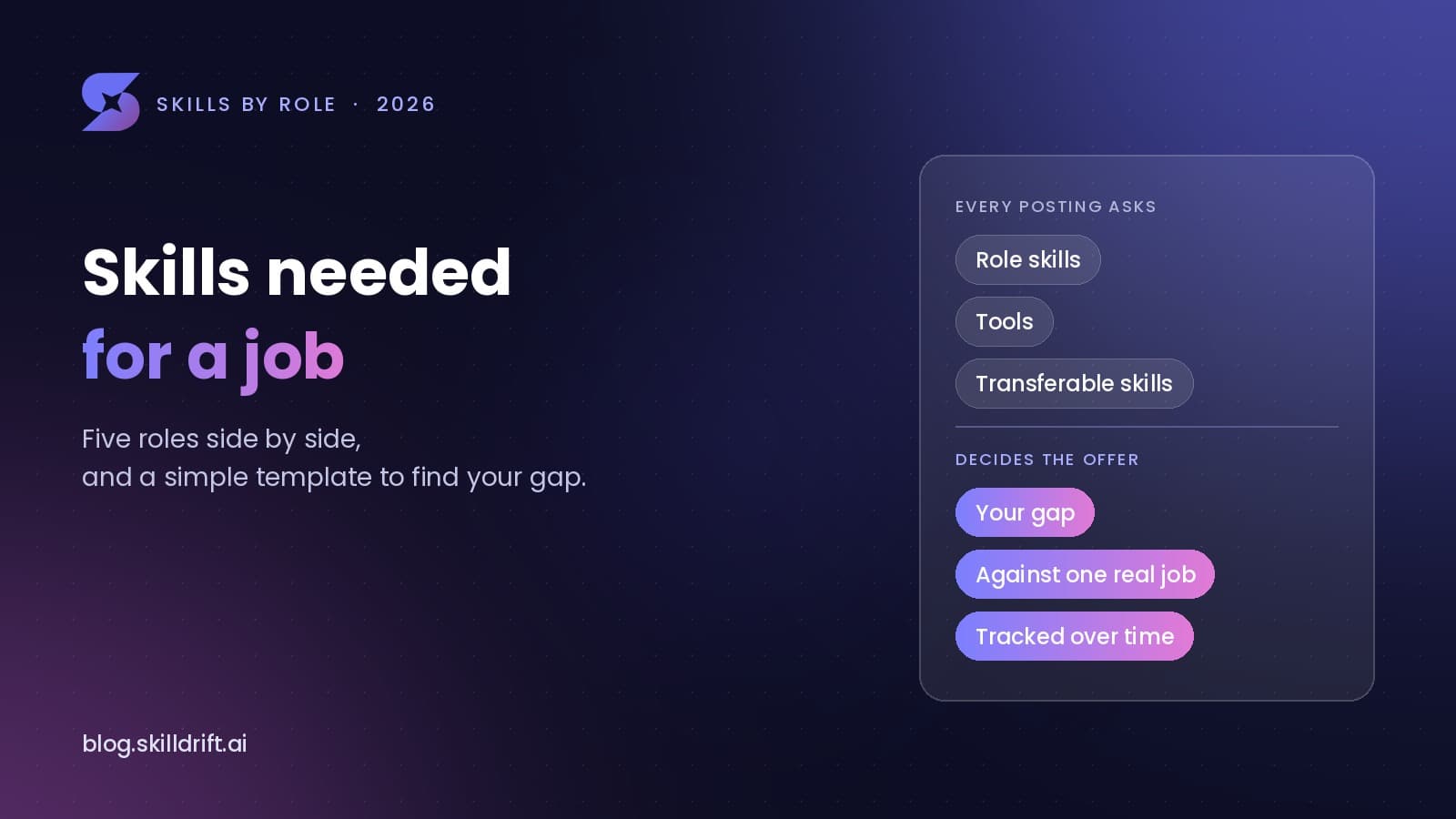
Every job needs three kinds of skills: role skills, which are specific to the work (SQL for an analyst, prospecting for a salesperson, employment law for HR); tools, which are the software and systems the role runs on; and transferable skills, such as communication, problem solving and working with others, which every role asks for. Most job postings list all three. The mix changes by role and seniority, and the transferable skills are usually the ones that decide the offer.
Communication is the clearest example. In the SkillDrift Jobs Index it is asked for in more than one posting in seven, and until 13 September 2026 it was the single most requested skill of all. Python has just passed it. The method and the numbers are in the third reading of the Jobs Index.
Skills by role: five common jobs
The general list only goes so far. Here is where the skills differ, role by role. Each links to the full list for that role.
- Software engineer. One language to a professional standard, testing, cloud and deployment, and system design as seniority grows. What decides the offer is often ownership and written communication.
- Sales executive. Prospecting, discovery, objection handling, CRM discipline and forecasting. What decides the offer is usually discovery: asking before pitching.
- Human resources. Employment law, recruitment, performance and employee relations, HR systems and people data. What decides the offer is judgment in a difficult conversation.
- Product manager. Customer discovery, prioritisation, roadmapping, working with engineering and reading data. What decides the offer is how you choose between good ideas.
- Data analyst. SQL, spreadsheets, a visualisation tool, basic statistics and one programming language. What decides the offer is turning a number into a decision. We cover this role in more depth in skills needed for a data analyst in 2026.
Each role also has its own full post: software engineer skills, sales executive skills, HR skills and product manager skills.
For every other role, the method below works the same way.
A skills gap analysis template, and the fastest way to fill it
The template is four columns.
Skill the posting names. Shown clearly on my resume. Shown weakly. Not shown.
A filled in version looks like this.
SQL: shown clearly.
Stakeholder management: shown weakly.
Forecasting: not shown.
Nobody should be filling this in by hand in 2026. Paste one real posting and your resume into ChatGPT, Claude or any other assistant, and ask it to return exactly those four columns, using the posting's own words for each skill. It takes about a minute.
Read the result this way. The "shown weakly" column is usually the longest, and it is the fastest to fix: those are skills you already have and have not described. The "not shown" column is your real gap, and each item in it needs a plan, not a rewrite.
For a fuller version, including how to rate your level on each skill, read what a skill gap analysis is and how to run one on yourself.
Where that one minute answer runs out
Three things happen after the chatbot hands the table back.
First, it covers one posting. The next job you look at names a different mix, and you start again from an empty table.
Second, it does not update. You finish a course, lead a project or earn a certificate, and nothing you did last month is in the next answer unless you paste it in again.
Third, it cannot see the skills a resume never shows. How you handle a scenario question, how you explain a trade off, how you answer when a panel pushes back. Those only appear when somebody asks you.
How SkillDrift tracks the gap over time
SkillDrift is built for the part that comes after the first table. Upload a resume once and it reads it against the role you want and against real jobs on the platform. Each job is scored out of 100, so you can see which roles are within reach and which are a stretch. It builds a learning path for each gap. As you close a gap, your gaps and your job scores update. When you finish a course, the SkillDrift certificate is added to your resume, and you can share it on LinkedIn. A mock interview for the same role finds the gaps a resume cannot show, and turns them into a roadmap too.
An example of how that plays out. A job scores 58 out of 100 against a resume. Stretch. Two skills are missing. Both are closed through the learning path. The same job now scores 81, Good fit.
If your resume is also going through a screening system, what a good ATS score actually means explains what that score measures. To turn the gap into a plan with dates, read how to build a career roadmap step by step.
Where to start this week
A skills list tells you what the market wants. Your gap tells you what to do next.
- Pick one role you want and have a chatbot fill in the four column table above against one real posting.
- Upload your resume at app.skilldrift.ai to see the same gap scored against real jobs, and start the roadmap for the highest impact one.
- Run one mock interview for that role and read the report honestly.
Prefer to do it on your phone? SkillDrift is on Google Play and the Apple App Store.
Every job has a list. The one that matters is the list of what you have not shown yet.