What Should I Learn Next for My Career? A Ten Minute Method
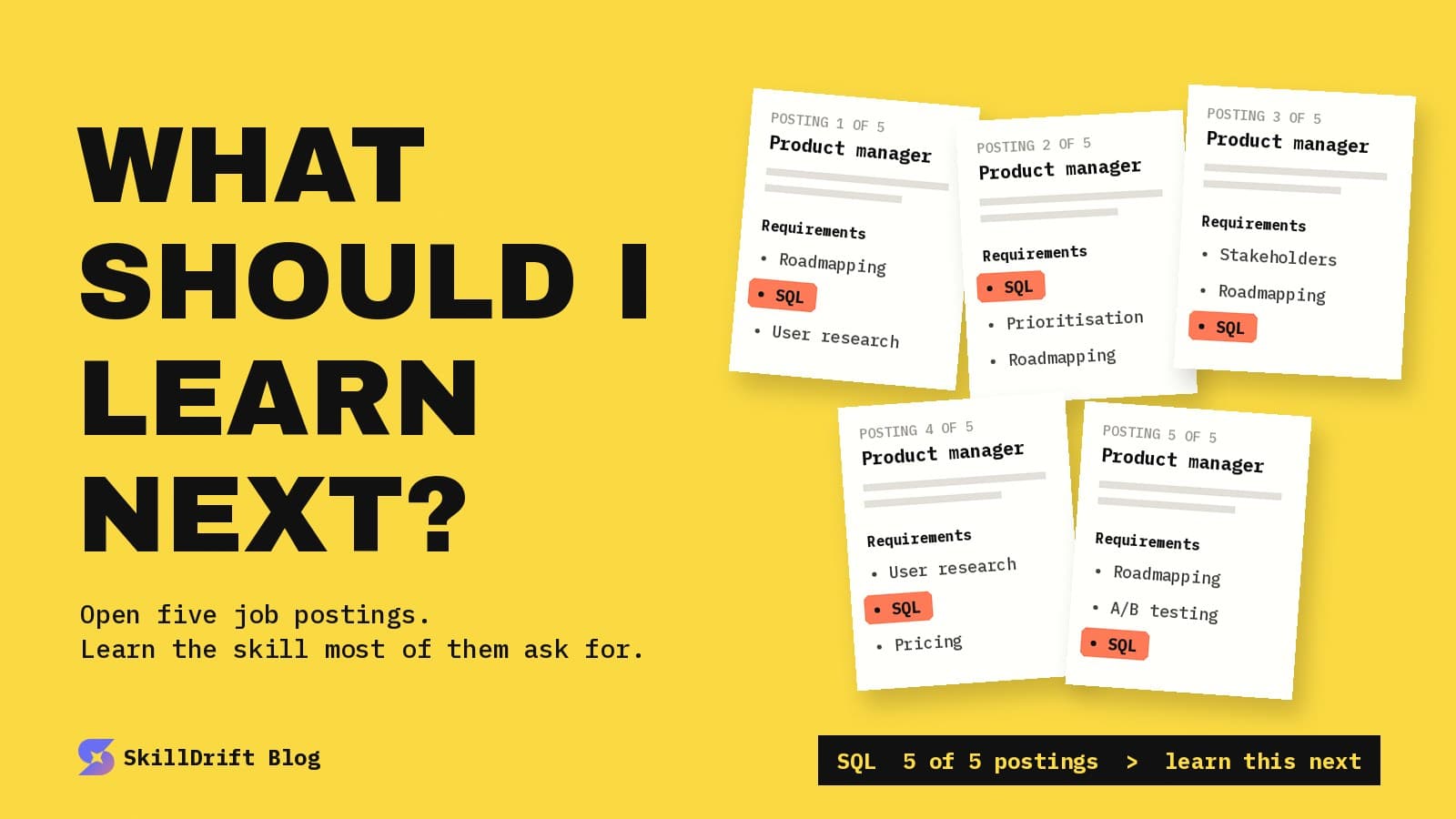
Learn the skill that stands between you and the next role you want, and that shows up in most job postings for that role. That is the whole answer. Lists of the best skills to learn and a platform's next course suggestion are weaker guides, because neither knows which role you are aiming at or what your resume already shows.
The method below takes about ten minutes for a quick pass, with five job postings open.
How do I decide what to learn next?
- Name one target role. A job title you could apply for in the next year, such as product manager or sales executive. A direction such as "something in tech" is too wide to measure against.
- Open five real postings for that title. One posting is one company's opinion. Five show which requirements belong to the role.
- Sort every skill they ask for into three columns. On my resume. I have it, but my resume does not show it. I do not have it.
- Rank the third column. Put at the top the skills that appear in most of the five postings and that you could use in a real project within weeks.
- Pick the top one and learn it for that role. Then prove it with something you can show, add it to your resume, and run the method again.
The second column is often bigger than people expect. That part is a writing fix, and it takes an afternoon. How to run a skill gap analysis on yourself covers the three columns in more depth.
What if I do not know which role I want next?
Choose the next realistic step. The final destination can wait. Look at the titles held by people one step ahead of you in your field, and pick the one whose postings you already half match. How to build a career roadmap helps with the longer path once the next step is clear.
Are lists of the best skills to learn useful?
They are useful as a check on the market, and weak as a plan. A list tells you what is common across many jobs. It cannot tell you what you are missing for yours. Our own Jobs Index shows the market shifts: Python has passed communication as the most requested skill in job postings. A shift like that matters to you if your target role asks for either skill. For role by role lists, see skills needed for a job, five roles side by side.
Why do finished courses often lead to no interviews?
Usually because the course was chosen by topic, and nothing on the resume changed when it ended. An employer reads the resume, and a course that changed nothing on it stays invisible. Stop taking random online courses explains what works better.
What does closed loop career development mean?
Closed loop career development measures the gap between a person and the role they want, closes it with learning built around that gap and that role, and updates their resume, gaps and job matches as they go. It is the method above, run continuously. SkillDrift works this way: it measures your gap from your resume, a job description or a mock interview, builds the learning around that gap and your target role, fits it to the hours you can give it each week, ends each week with a skill check, and rescores your jobs out of 100 as your gaps close. Read how the loop works.
Frequently asked questions
How long should I spend on one skill? Until you can describe a real piece of work you did with it, without notes. For most skills that takes a few weeks.
Should I learn several skills at once? One, or two at most. Several half learned skills do not show on a resume or in an interview.
What should I learn next if I have less than a year of experience? Use the same method on entry level postings and internships for your target role. The skills that appear in most of them go to the top of the list.
How do I show a new skill on my resume? Name the skill in the employer's words and attach it to something you did with it. A verified certificate helps when it sits next to that evidence.
Where to start this week
The method works on paper. It works faster against your own resume.
- Upload your resume to SkillDrift and choose the role you want next.
- Take the gap that matters most for that role and start the learning roadmap for it.
- At the end of the week, take the skill check and see what you have actually learned.
Prefer your phone? SkillDrift is on Google Play and the Apple App Store.
The next skill to learn is the one your next role is waiting for.