Product Manager Skills in 2026: What Every Posting Asks For, and the Judgment a Resume Hides
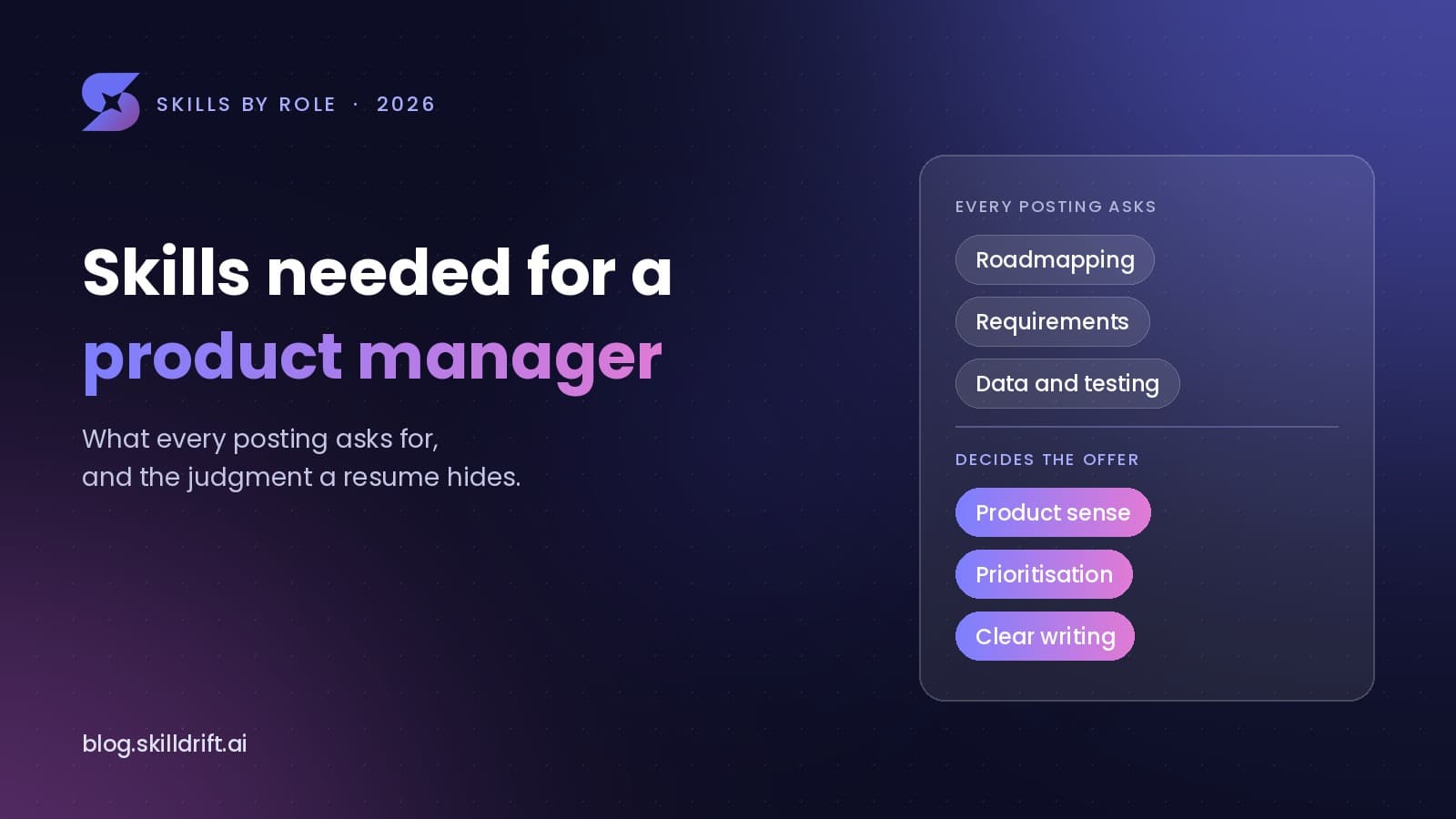
Ask ten product managers what the job is and you will get ten answers. Ask ten job postings what skills it needs and you will get almost the same list every time: roadmaps, stakeholder management, data, "a strong sense of the customer".
That gap between the answers and the list is the reason product management is hard to hire for, and hard to get into. Most of the skills that decide the job are judgment skills, and a resume is a poor place to show judgment. This post covers the full list, the skills that decide the offer, and how to show them.
What skills does a product manager need?
A product manager needs five groups of skills: understanding customers and their problems, deciding what to build and in what order, working with engineering and design to ship it, using data to see whether it worked, and communicating all of this to people who do not report to them. Technical depth helps, and the amount needed depends on the product. The common thread is judgment: choosing what not to do is as much of the job as choosing what to do.
Here is the list in plain terms.
- Customer discovery. Interviewing users, reading support tickets and finding the problem behind the request.
- Prioritisation. Choosing between good ideas with limited time, and explaining the choice.
- Roadmapping. Turning priorities into a plan that engineering can build and leadership can follow.
- Writing requirements. A clear problem statement, success measures and scope, short enough to be read.
- Working with engineering and design. Enough technical understanding to discuss trade offs honestly.
- Data and experimentation. Defining a metric, reading a dashboard and running a simple test.
- Stakeholder management. Keeping sales, support, marketing and leadership aligned without surprising anyone.
- Launch and go to market. A feature is done when people use it. Shipping is only the start.
- Working with AI. Using AI tools for research and analysis, and knowing where their answers need checking.
Skills needed for product management by level
The list stays the same. The weight moves.
An associate or junior product manager is judged mostly on execution. Clear requirements, clean handovers to engineering, and follow through after launch.
A product manager is judged on outcomes. Did the metric move? Did the team build the right thing?
A senior or group product manager is judged on strategy and people. Which problems the whole team takes on this year, and whether the product managers under them are getting better.
This matters when you read a posting. Two roles both called "product manager" can sit at very different points on that scale. Read the verbs. "Execute", "own delivery" and "write specs" point one way. "Define vision", "set strategy" and "mentor" point the other.
Skills required for a product manager that resumes rarely show
Most product resumes describe what shipped. "Launched a new onboarding flow." "Led the mobile app redesign." These lines are true, and they hide almost everything a hiring panel wants to know.
Take the onboarding line. Behind it there was probably customer research, a decision to cut three features to hit a date, an argument with sales about a promised integration, and a metric that moved or did not. That is discovery, prioritisation, stakeholder management and data. None of it is on the page.
A stronger version names the decision and the result:
"Rebuilt onboarding after 20 user interviews showed setup took too long; cut scope to hit the quarter, raised week one activation from 31 to 44 percent."
Same project. Four skills visible instead of one.
If you are not sure how a screening system reads your resume before a person does, start with what a good ATS score actually means.
The skills that decide the offer
Most candidates who reach a product interview can describe a framework. What separates them is usually one of three things.
Product sense. Interviewers often ask candidates to improve a product they use every day. The strongest answers start with who the user is and what problem they have, before any feature is named.
Prioritisation under constraint. A common question: you have one engineer for a quarter and five requests from leadership. What do you do? The panel is listening for a clear principle, an honest trade off and a way to explain the decision to the people who lose.
Communication. In the SkillDrift Jobs Index, communication is asked for in more than one posting in seven. Until 13 September 2026 it was the most requested skill of all, and it is now second only to Python. The method and the numbers are in the third reading of the Jobs Index. For a product manager, much of it is written. A one page brief that an engineer, a designer and a sales lead all read the same way is a rare and valued skill.
Many people moving into product come from engineering, design, analytics or marketing. Each brings some of these skills and misses others. That is why the best next role is often one you are not fully qualified for yet.
How to find your own gap against a real role
The quickest way to start today is an AI chatbot. Paste a product manager posting and your resume into ChatGPT, Claude or any other assistant, and ask which skills the posting names that your resume does not show. You will get a useful answer in a minute. Ask it to rewrite your weakest lines in the words the posting uses, and it will do that too.
A chatbot answers the question you ask, once, about the posting you paste. That is where it stops. It does not know which other jobs you would fit. It does not remember your gaps next month. It cannot tell you whether you have closed one.
SkillDrift is built for what comes after that first answer. Upload a resume once and it reads it against the role you want and against real jobs on the platform. Each job is scored out of 100, so you can see which roles are within reach and which are a stretch. It builds a learning path for each gap. As you close a gap, your gaps and your job scores update. When you finish a course, the SkillDrift certificate is added to your resume. And a mock interview for the same role finds the gaps a resume cannot show, such as how you prioritise under pressure, and turns them into a roadmap too.
For the full product manager skill list, grouped by what every posting asks for and what decides the offer, see the skills needed for a product manager in 2026 page. For a plan with dates, read how to build a career roadmap step by step.
This post is part of our series on skills by role. For five roles side by side, and a template to find your own gap, see skills needed for a job.
Where to start this week
A skills list tells you what the market wants. Your gap tells you what to do next.
- Upload your resume at app.skilldrift.ai and see your gaps against the product role you actually want.
- Take the highest impact gap and start the roadmap for it.
- Run one mock interview for that target role and read the report honestly.
Prefer to do it on your phone? SkillDrift is on Google Play and the Apple App Store.
A product manager decides what gets built. Your resume should show how you decide.