Sales Executive Skills in 2026: What the Job Asks For, and What Your Resume Leaves Out
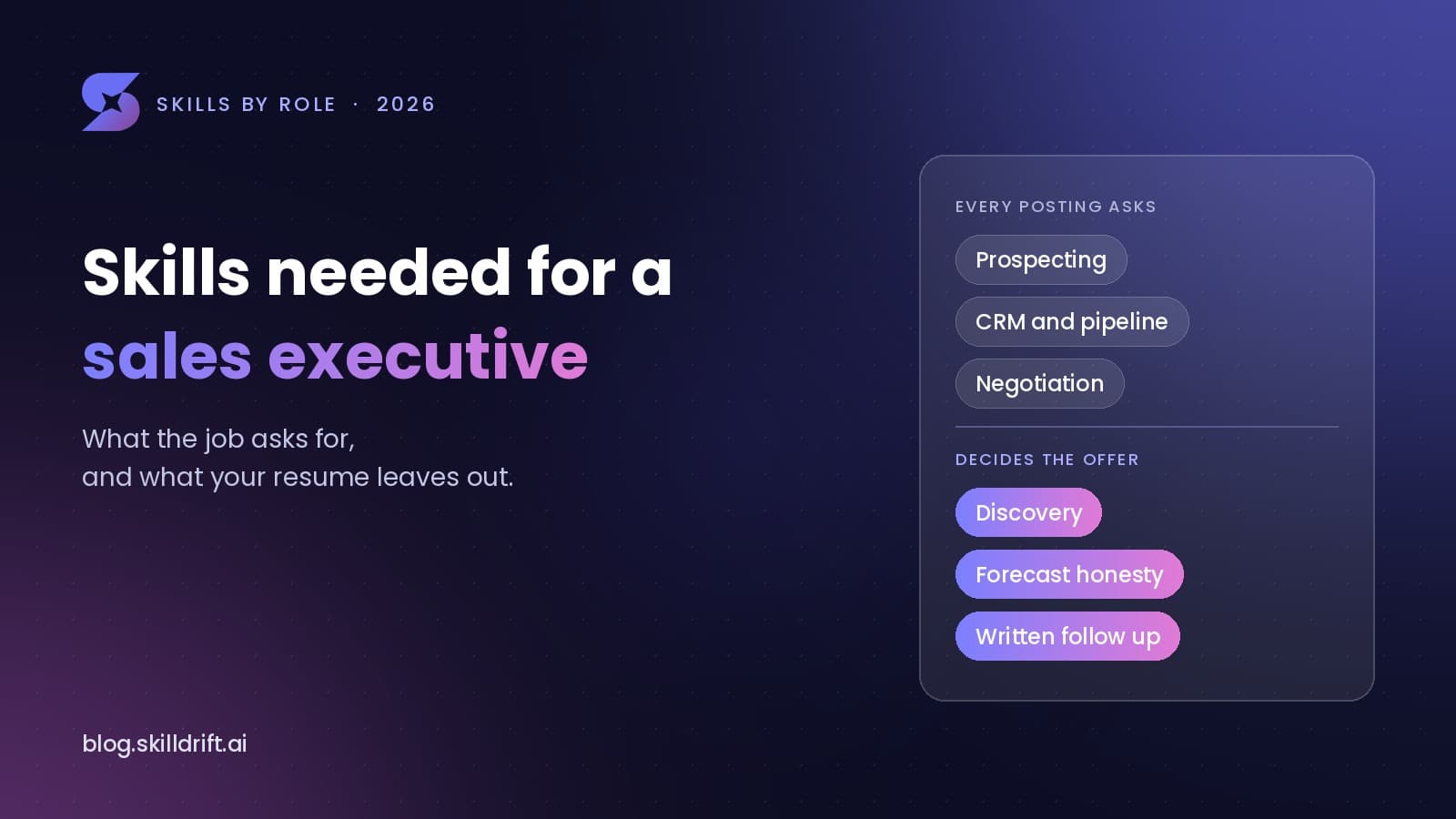
Sales is one of the few jobs where results are counted every month. So it is strange how many sales resumes say almost nothing about how those results were made.
"Exceeded targets" and "strong communication skills" appear on nearly every one. They do not tell a hiring manager whether you can find a buyer, run a discovery call or forecast honestly. This post covers the skills a sales role asks for, which of them decide the offer, and how to show them.
What skills does a sales executive need?
A sales executive needs five groups of skills: finding and qualifying buyers, running a conversation that uncovers a real need, handling objections and negotiating, managing a pipeline with a CRM, and the discipline to follow up and forecast accurately. On top of that sits product knowledge, which every employer expects you to learn fast.
In more detail:
- Prospecting. Finding the right accounts and people, by phone, email, social channels and referrals.
- Qualification. Deciding quickly whether a lead has a real need, a budget and a timeline.
- Discovery. Asking questions that get to the actual problem, then listening to the answer.
- Presentation and demonstration. Showing how the product solves that specific problem, not every problem.
- Objection handling. Treating an objection as information rather than a rejection.
- Negotiation and closing. Agreeing terms that both sides will keep.
- CRM and pipeline management. Keeping records current so the team can trust the numbers.
- Forecasting. Saying what will close this month, and being right.
- Communication in writing. Clear follow up emails, proposals and handover notes.
- Resilience. Recovering from a lost deal the same afternoon.
Sales associate, sales executive, sales manager: how the skills shift
The titles overlap, but the weight moves.
A sales associate role, often in retail or inside sales, leans on product knowledge, customer service, handling a high volume of conversations and basic CRM use.
A sales executive role leans on the full cycle: prospecting, discovery, negotiation and closing, usually with a personal target.
A sales manager role adds coaching, hiring, territory planning and forecasting for a whole team. The skill that most often separates a strong executive from a strong manager is coaching. Many top sellers are promoted and then struggle, because the job has changed from doing to teaching.
So before you work on your skills, decide which of these jobs you want next. It is the same point we make in why the best next role is often one you are not fully qualified for yet.
The skills that decide the offer
Most candidates who reach a sales interview can talk about targets. What separates them is usually one of three things.
Discovery. Interviewers often run a short role play. Candidates who pitch in the first minute tend to lose. Candidates who ask three good questions first tend to win.
Forecast honesty. A manager has been let down by optimistic pipelines before. A candidate who can explain how they decided what would close, and what they did when a deal slipped, is rare.
Written communication. In the SkillDrift Jobs Index, communication is asked for in more than one posting in seven. Until 13 September 2026 it was the most requested skill of all, and it is now second only to Python. The method and the numbers are in the third reading of the Jobs Index. In sales, a large part of that is written: the follow up that moves a deal forward, and the proposal a buyer forwards to their own boss.
These are rarely the skills people worry about before an interview. They are often the ones that cost the offer. We see the same pattern in the silent skill gap.
Why a sales resume hides the skills that matter
A typical line reads: "Achieved 120 percent of annual quota." It is a good result. But it shows one skill, closing, and hides the rest.
The same year might have included building a new territory from zero, a discovery process that raised the win rate, and a CRM clean up the whole team now uses. That is prospecting, discovery and pipeline management. None of it is on the page.
A recruiter reading fast will not guess it. An applicant tracking system will not either, because it matches the words a posting uses. If you are not sure how that works, read what a good ATS score actually means.
The fix is to write what you did in the language of the role. "Built a new mid market territory from zero to a full pipeline in two quarters, then reached 120 percent of quota" shows three skills and a result.
How to find your own gap against a real role
The quickest way to start today is an AI chatbot. Paste a sales posting and your resume into ChatGPT, Claude or any other assistant, and ask which skills the posting names that your resume does not show. You will get a useful answer in a minute. Ask it to rewrite your weakest lines in the words the posting uses, and it will do that too.
A chatbot answers the question you ask, once, about the posting you paste. That is where it stops. It does not know which other jobs you would fit. It does not remember your gaps next month. It cannot tell you whether you have closed one.
SkillDrift is built for what comes after that first answer. Upload a resume once and it reads it against the role you want and against real jobs on the platform. Each job is scored out of 100, so you can see which roles are within reach and which are a stretch. It builds a learning path for each gap. As you close a gap, your gaps and your job scores update. When you finish a course, the SkillDrift certificate is added to your resume. And a realtime or voice mock interview for the same role ends with a report that names the weak skill, gives a hire verdict out of 10 and turns the gap into a roadmap.
For the full sales skill list, grouped by what every posting asks for and what decides the offer, see the skills needed for a sales executive in 2026 page. For a plan with dates, see how to build a career roadmap step by step.
This post is part of our series on skills by role. For five roles side by side, and a template to find your own gap, see skills needed for a job.
Where to start this week
A skills list tells you what the market wants. Your gap tells you what to do next.
- Upload your resume at app.skilldrift.ai and see your gaps against the sales role you actually want.
- Take the highest impact gap and start the roadmap for it.
- Run one mock interview for that target role and read the report honestly.
Prefer to do it on your phone? SkillDrift is on Google Play and the Apple App Store.
Targets show what you closed. Your resume should show how.