Skills Needed for HR Professionals in 2026, and How to Show Them on a Resume
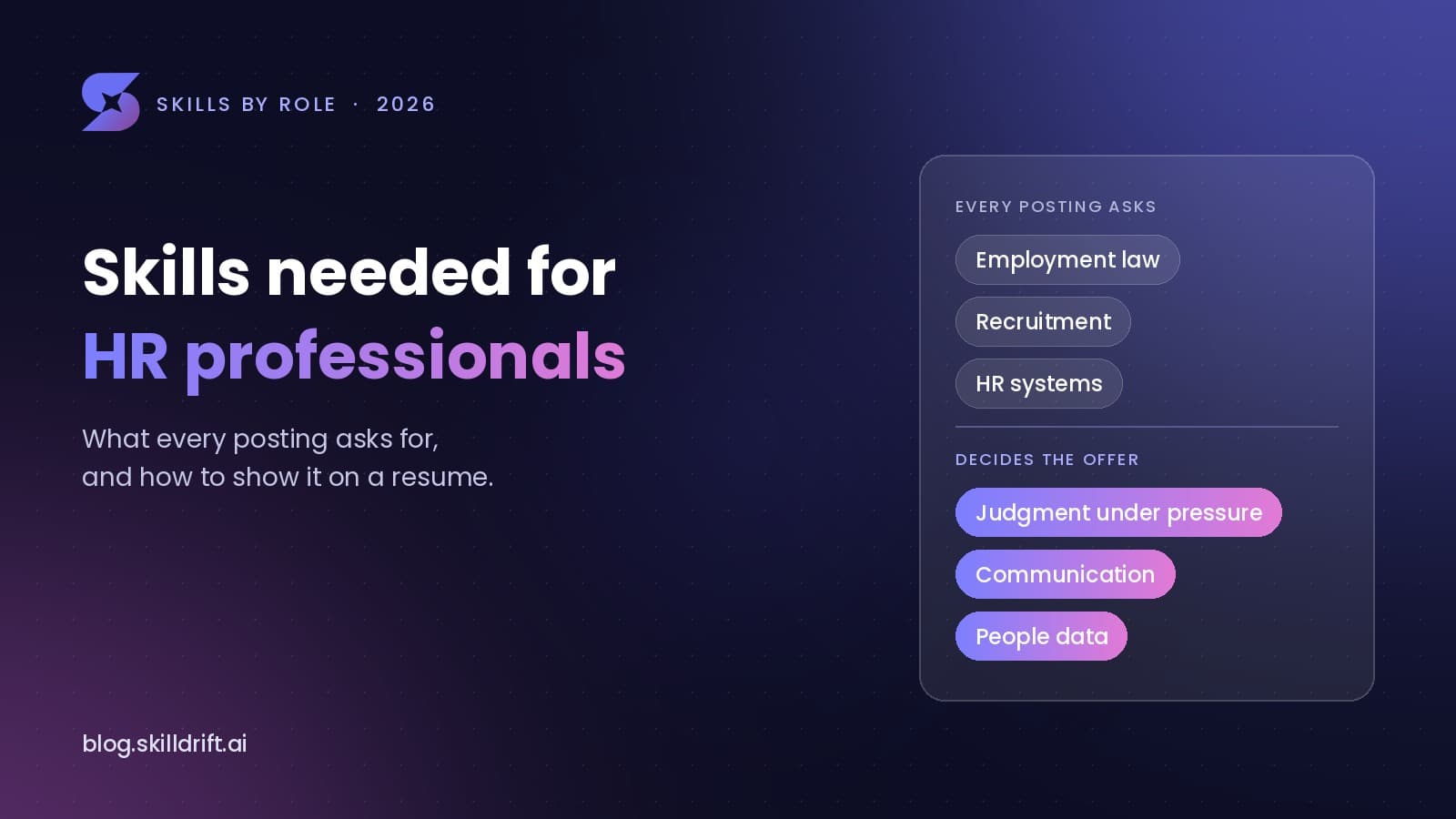
Most HR job descriptions ask for the same things. Knowledge of employment law, experience with an HR system, "excellent interpersonal skills". A resume can tick every one of those boxes and still not get the call.
The reason is usually the same. The skills that decide an HR hire are the ones that are hardest to put on a page: judgment in a difficult conversation, the ability to read workforce data, and the trust of managers who do not report to you. This post covers the full list, the skills that decide the offer, and how to show them.
What skills does an HR professional need?
An HR professional needs five groups of skills: knowledge of employment law and policy, the core people processes (recruitment, onboarding, performance and employee relations), working with HR systems and people data, communication and conflict handling, and the business sense to connect all of it to what the organisation is trying to do. The weight of each group changes with the role. A recruiter, an HR generalist and an HR manager use the same list in very different proportions.
Here is the list in plain terms.
- Employment law and policy. Knowing the rules that apply where you work, and knowing when to ask for legal advice.
- Recruitment and selection. Writing a fair job description, screening, interviewing and closing an offer.
- Onboarding. Getting a new joiner productive and settled in the first ninety days.
- Performance management. Setting goals, running reviews and handling underperformance fairly.
- Employee relations. Grievances, investigations, disciplinary cases and the notes that go with them.
- HR systems. At least one HRIS or applicant tracking system, and the discipline to keep its records clean.
- People data. Turnover, time to hire, absence and engagement numbers, read well enough to spot a problem early.
- Communication. Clear policy writing, clear emails to staff and calm conversations when emotions are high.
- Business sense. Knowing how the organisation makes money and what each team needs from HR to do its job.
HR skills for a resume: what to put on the page
This is where most HR resumes lose ground. They list duties. "Responsible for onboarding." "Handled employee relations." A hiring manager reads those lines and learns what the job was, not what the candidate did with it.
The stronger version names the skill, the scale and the result. Compare these two lines.
"Managed recruitment for the sales team."
"Ran end to end hiring for a 40 person sales team, cut time to hire from 52 to 31 days and rebuilt the interview scorecard the managers now use."
The second line shows recruitment, process design, data and stakeholder management. It is the same job. It is simply described in the words a posting uses.
A few more that work well on an HR resume:
- A number next to every process you owned: hires made, cases closed, people onboarded.
- The system you used, by name, because many postings screen for it.
- One line on a difficult case handled well, described without names or detail that breaks confidentiality.
If you are not sure how a screening system reads those lines, start with what a good ATS score actually means.
HR manager skills: what changes with seniority
An HR manager needs everything above, plus three things that are rarely taught.
The first is coaching managers. Most people problems are solved by the line manager, not by HR. A good HR manager spends much of the week helping managers have the conversation themselves.
The second is workforce planning. Deciding, with finance and team leads, how many people the business needs next year, with which skills, and where they will come from.
The third is influence without authority. An HR manager rarely owns the decision. They shape it. That means building enough trust with senior leaders that the advice is taken before a problem becomes a case.
Human resources manager qualifications often list a degree and a professional certification. Those help. But most interview panels spend their time on the three skills above, because they are the ones that are hard to verify on paper.
The skills that decide the offer
Most people who reach an HR interview can describe the processes. What separates them is usually one of three things.
Judgment under pressure. Many HR interviews include a scenario: a manager wants someone gone by Friday, or a complaint lands about a senior leader. The strongest candidates slow the situation down, ask what the facts are and name the risk before they name the answer.
Communication. In the SkillDrift Jobs Index, communication is asked for in more than one posting in seven. Until 13 September 2026 it was the most requested skill of all, and it is now second only to Python. The method and the numbers are in the third reading of the Jobs Index. In HR, much of that is written: a policy people actually read, and a hard message that stays kind.
Comfort with data. HR is increasingly asked to explain its numbers. A candidate who can say why attrition rose in one team, and what they did about it, stands out from one who can only describe the survey.
These are often the skills that cost the offer, and they are rarely the ones people prepare for. We see the same pattern in the silent skill gap.
How to find your own gap against a real role
The quickest way to start today is an AI chatbot. Paste an HR job posting and your resume into ChatGPT, Claude or any other assistant, and ask which skills the posting names that your resume does not show. You will get a useful answer in a minute. Ask it to rewrite your weakest lines in the words the posting uses, and it will do that too.
A chatbot answers the question you ask, once, about the posting you paste. That is where it stops. It does not know which other jobs you would fit. It does not remember your gaps next month. It cannot tell you whether you have closed one.
SkillDrift is built for what comes after that first answer. Upload a resume once and it reads it against the role you want and against real jobs on the platform. Each job is scored out of 100, so you can see which roles are within reach and which are a stretch. It builds a learning path for each gap. As you close a gap, your gaps and your job scores update. When you finish a course, the SkillDrift certificate is added to your resume. And a mock interview for the same role finds the gaps a resume cannot show, such as how you handle a difficult scenario, and turns them into a roadmap too.
For the full HR skill list, grouped by what every posting asks for and what decides the offer, see the skills needed for an HR role in 2026 page. If you are weighing a move inside your current organisation, internal mobility versus job hopping is worth reading first. For a plan with dates, see how to build a career roadmap step by step.
This post is part of our series on skills by role. For five roles side by side, and a template to find your own gap, see skills needed for a job.
Where to start this week
A skills list tells you what the market wants. Your gap tells you what to do next.
- Upload your resume at app.skilldrift.ai and see your gaps against the HR role you actually want.
- Take the highest impact gap and start the roadmap for it.
- Run one mock interview for that target role and read the report honestly.
Prefer to do it on your phone? SkillDrift is on Google Play and the Apple App Store.
HR is the job of helping other people grow. Your own resume should show that you have done it.