The Agentic AI Era: Coding the Developer's Digital Twin
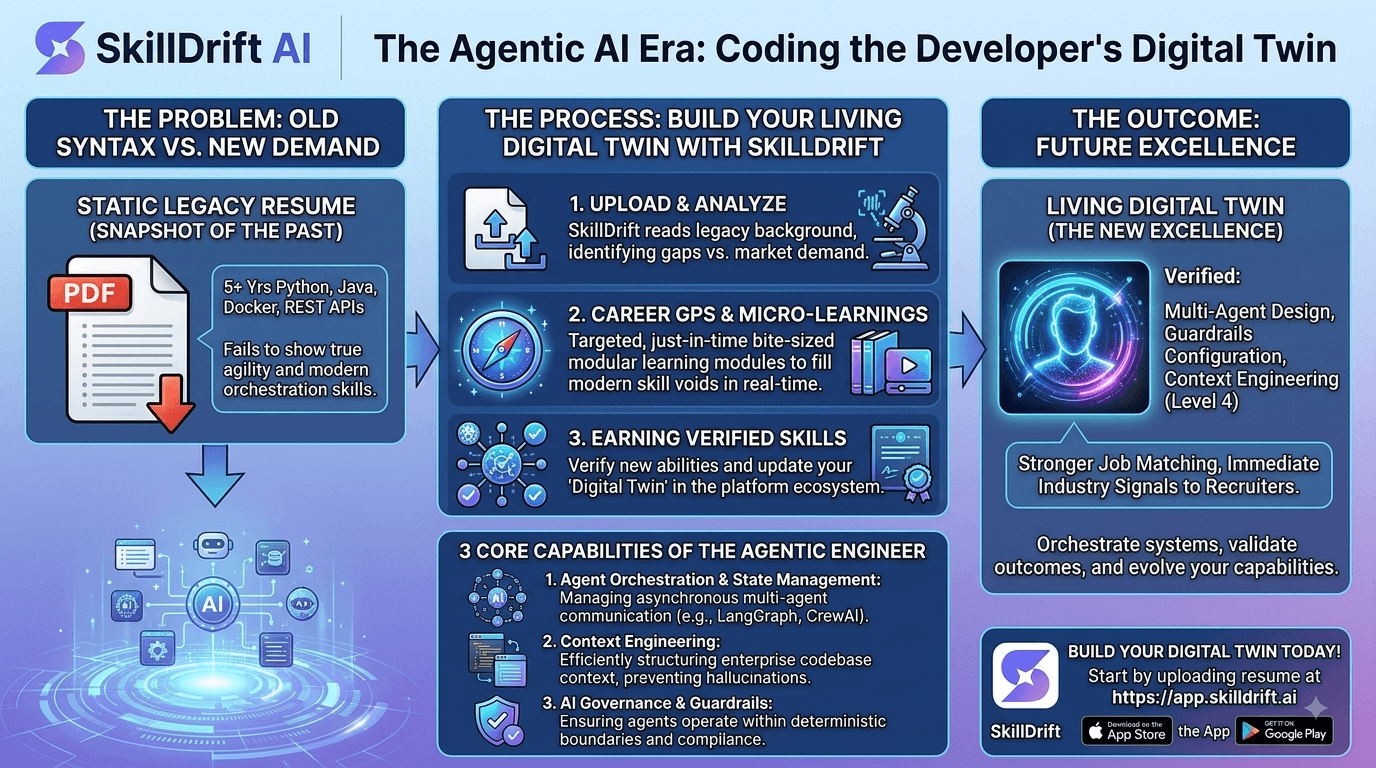
In 2026, the definition of a software engineer is undergoing a massive rewrite. There was a time when writing code was the primary skill of a software engineer. Today, many of the best developers spend less time writing code and more time directing AI systems that write, test, refactor, and review it. That shift is redefining what engineering excellence looks like.
We are no longer just writing syntax; we are orchestrating autonomous AI. The rise of Agentic AI, where large language models do not just answer prompts but reason, plan, and pursue complex, multi-step goals autonomously has fundamentally changed the developer's day-to-day workflow.
The transition from writing foundational code to architecting multi-agent systems is likely to become one of the defining career shifts of this decade. But how do developers prove they possess these new orchestration skills, and how do engineering leaders track them?
From Syntax Typist to AI Orchestrator
Today's engineers are delegating heavy coding lifting to sophisticated agentic tools. In 2026, tools like Claude Code and Cursor are acting as in-editor agents that read context, plan changes, edit across files, run tests, and open pull requests from a single instruction. At the same time, Frameworks such as LangGraph are emerging as leading choices for production-grade agentic workflows, while CrewAI has become popular for rapidly prototyping collaborative AI agents.
The modern developer is now an orchestrator operating under a clear model: "delegate, review, and own."
The 3 Core Capabilities of the Agentic Engineer
To stay relevant in this ecosystem, developers must master three specific hybrid skills that go beyond traditional syntax:
- Agent Orchestration & State Management: Moving from writing standalone scripts to managing asynchronous multi-agent communication via frameworks like LangGraph or CrewAI.
- Context Engineering: Efficiently structuring enterprise codebase context so autonomous agents do not hallucinate or waste computational resources.
- AI Governance & Guardrails: Ensuring AI agents operate within strict deterministic boundaries and enterprise compliance protocols without executing unsafe commands.
Why the Engineering Resume is Dead
As we explored in our previous post, The Resume is Dead: Your Digital Twin is Getting Hired, static paper credentials fail to capture a professional's true agility. A PDF listing "Python, Java, and C++" is a snapshot of the past. It tells an employer nothing about your ability to govern a unified system or configure secure, multi-agent environments.
Consider the stark difference in how skills are evaluated today:
- Static Resume (Outdated): "5+ years Python, Java, Docker, REST APIs"
- Living Digital Twin (2026 Standard): "Verified: Multi-Agent System Design (CrewAI/LangGraph), Autonomous CI/CD Guardrail Configuration, Prompt Lifecycle Engineering (Level 4 Verified)"
What Happens When Your Resume Falls Short?
If you are like most developers, your current resume does not reflect these new realities. So, what happens when you upload that legacy resume to build your Digital Twin?
The SkillDrift platform does not magically fabricate new skills to make you look better. Instead, it acts as a diagnostic engine and a proactive career roadmap.
- The Gap Analysis: SkillDrift ingests your foundational background and immediately cross-references it against current market demands. It flags exactly what is missing- for example, it will recognize your Python mastery but identify a critical gap in Agent Orchestration.
- Targeted Micro-Learnings: Once the gap is identified, the platform acts as your Career GPS. Instead of telling you to go back to school for six months, it distributes highly specific, bite-sized micro-learnings directly to your dashboard. You receive the exact upskilling needed to master framework integration today.
- Earning the Living Resume: You do not get the skill added to your profile just for reading about it. As you complete these learnings and verify your new capabilities within the ecosystem, your Digital Twin updates instantly.
Your static, outdated resume is replaced by a "living resume" that constantly evolves in lockstep with your proven abilities.
Sending the Right Signals
This real-time, verified capability mapping dramatically improves job matching accuracy. Your updated Digital Twin sends immediate, high-fidelity signals to industries and recruiters, proving that you possess the precise, verified orchestration skills they need right now.
The next generation of engineers won't be judged by how many lines of code they write.They'll be judged by how effectively they can direct intelligent systems, validate outcomes, and continuously evolve their capabilities.
In the age of Agentic AI, your greatest asset isn't your resume - it's your Digital Twin.
For the skills a software engineer needs in 2026, split into what every posting asks for and what decides the offer, see skills needed for a software engineer in 2026.
The software engineer skills page on our site lists the technical and human skills most postings ask for, and how to show them on your resume.
Where to start this week
If you are a developer, look at the gaps rather than the job ads. They tell you more.
- Upload your resume at app.skilldrift.ai and see your gaps against the role you actually want.
- Take the highest impact gap and start the roadmap for it.
- Run one mock interview for the engineering role you want next and read the report honestly.
Prefer to do it on your phone? SkillDrift is on Google Play and the Apple App Store.
Writing the code is the part AI is closing. Orchestrating it is the part that is opening.
Ready to bridge the gap and build your digital twin? Start by uploading your resume at https://app.skilldrift.ai or download the SkillDrift app from the Apple App Store and Google Play Store today.
If you are rebuilding your skills for this, make the result legible to the systems that screen you. Start with how to check whether your resume is ATS friendly, then build a career roadmap for the role you are aiming at, and keep it honest with what a good ATS score really is.
#FutureOfWork #AgenticAI #SoftwareEngineering #DigitalTwin #AIOrchestration #TechCareers #Upskilling #SkillDrift #AI #LangGraph #CrewAI #CareerGPS #TechTalent #FutureTech #AIAgents #MicroLearning #DeveloperCommunity