Skills Needed for a Software Engineer in 2026, and the Ones Your Resume Does Not Show
Most lists of software engineer skills are the same list. A few languages, a framework, Git, "problem solving". The list is not wrong. It is just not the reason people get the job.
Two engineers can carry the same list and get very different answers. The difference is usually in the skills the posting asks for but the resume does not show, and in the skills the engineer has but never wrote down. This post covers both.
What skills are needed for a software engineer?
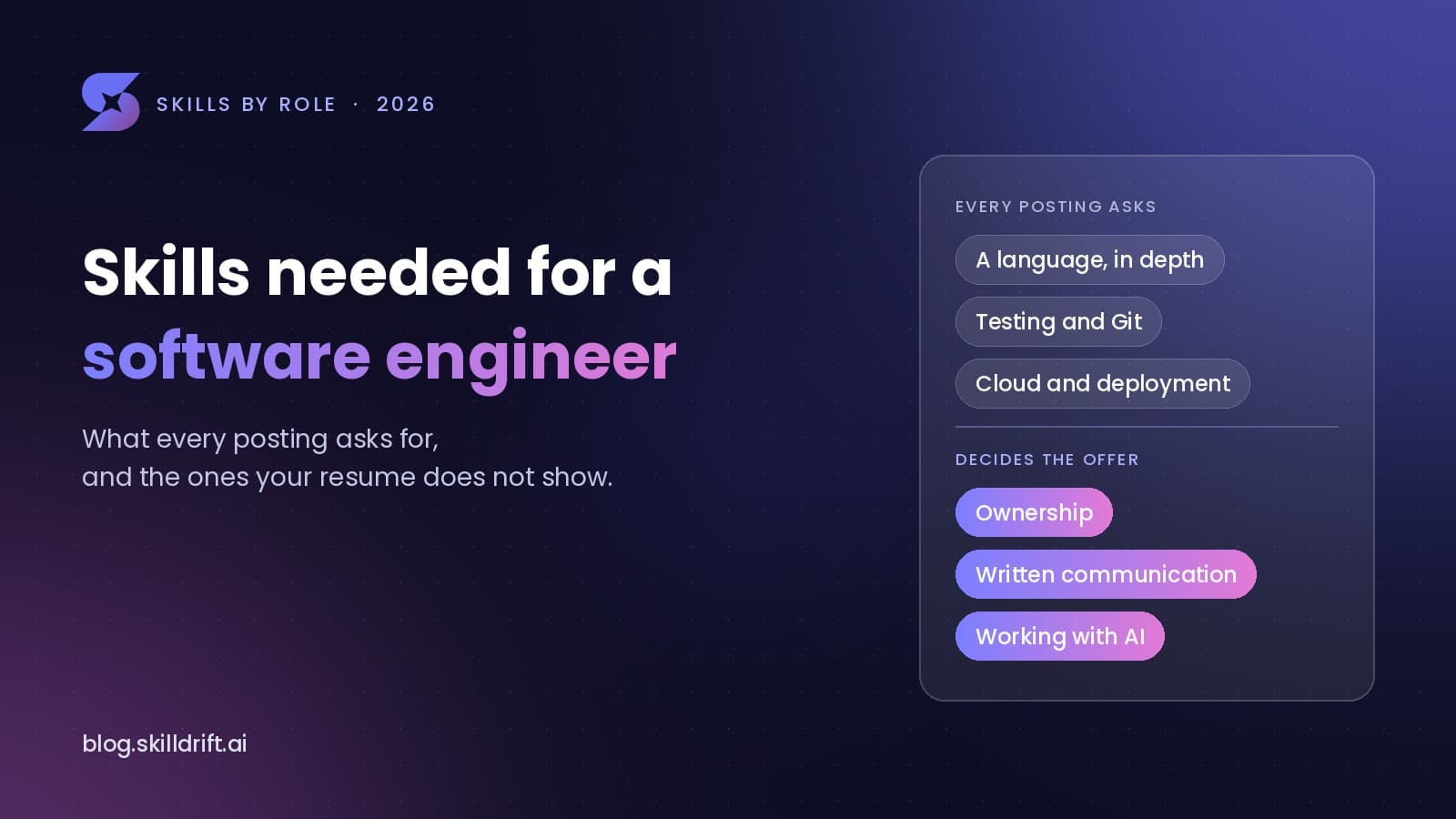
A software engineer needs four groups of skills: one or two programming languages used to a professional standard, the tools of modern delivery (version control, testing, cloud and deployment), system design, and the human skills of working in a team. The weight of each group changes with the role and the seniority. That last part is where most people go wrong.
Here is the list in plain terms.
- Languages. Depth in one language beats a long list. Python, Java, JavaScript or TypeScript, Go and C# cover most postings. A hiring team wants to see what you built with it, not only that you know it.
- Data structures and algorithms. Still tested in most interviews. Still used in daily work, even if nobody calls it that.
- Version control and code review. Git, pull requests, and the habit of writing changes someone else can read.
- Testing. Unit tests, integration tests, and the judgment to know what is worth testing.
- Cloud and deployment. At least one cloud platform, containers, and a working idea of how code reaches production.
- Databases. SQL first. Then one non-relational store and when to use it.
- System design. How services talk to each other, how they fail, and how they scale. This grows in weight with seniority.
- Working with AI tools. Using assistants to write, review and test code, and knowing when their output is wrong.
- Communication. Writing a clear ticket, a clear design note and a clear message in a code review.
The skills that decide the offer
The first seven items above are the entry ticket. Most people who reach the interview have them. What separates candidates is usually further down the list.
Communication is the clearest example. In the SkillDrift Jobs Index, communication was the most requested skill across job postings until 13 September 2026, when Python passed it. It is still asked for in more than one posting in seven. You can read the method and the numbers in the third reading of the Jobs Index. For engineers, communication does not mean presenting. It means code review comments that teach, design notes that a new joiner can follow, and incident write ups that do not blame anyone.
The second is ownership. A posting that says "end to end" or "full lifecycle" is asking whether you have taken something from an idea to production and kept it running. Many engineers have done this and describe it as "worked on the backend".
The third is working with AI. The daily work of a developer has changed. Postings now ask for engineers who can direct AI tools, check their output and stay accountable for the result. We looked at this shift in the new way of work for developers and in what agentic AI means for how developers work.
Why your resume hides the skills you already have
Here is a common pattern. An engineer has built a payments service, set up its alerts, written its runbook and trained two new joiners on it. The resume says "Developed backend services in Java."
That one line hides four skills a posting asks for: system design, observability, documentation and mentoring. A recruiter reading fast will not infer them. An applicant tracking system will not either. It matches words, and the words are not there.
If you are not sure how a screening system reads your resume, start with what a good ATS score actually means. The score is less important than what it is made of.
The fix is not to stuff keywords. It is to describe what you did in the words the role uses. "Designed and ran a payments service in Java, including alerting, runbooks and on call" says the same thing and shows five skills instead of one.
Software developer or software engineer: do the skills differ?
In most postings the two titles are used for the same job. Where they differ, the engineer title leans more on system design, reliability and scale. The developer title leans more on building features inside an existing system.
The practical point is this. Do not choose skills by the title. Choose them by the posting you want. Two jobs called "software engineer" at two companies can ask for very different things. One wants a React developer who can talk to designers. The other wants someone who can run a Kubernetes cluster at three in the morning.
This is why a generic skills list only gets you so far. The useful question is not "what does a software engineer need?" It is "what does this role need that I have not shown yet?"
How to find your own gap against a real role
The quickest way to start today is an AI chatbot. Paste a job posting and your resume into ChatGPT, Claude or any other assistant, and ask which skills the posting names that your resume does not show. You will get a useful answer in a minute. Ask it to rewrite your weakest lines in the words the posting uses, and it will do that too.
A chatbot answers the question you ask, once, about the posting you paste. That is where it stops. It does not know which other jobs you would fit. It does not remember your gaps next month. It cannot tell you whether you have closed one.
SkillDrift is built for what comes after that first answer. Upload a resume once and it reads it against the role you want and against real jobs on the platform. Each job is scored out of 100, so you can see which roles are within reach and which are a stretch. It builds a learning path for each gap. As you close a gap, your gaps and your job scores update. When you finish a course, the SkillDrift certificate is added to your resume. And a mock interview for the same role finds the gaps a resume cannot show, and turns them into a roadmap too.
An example of how that plays out. A job scores 58 out of 100 against a resume. Stretch. Two skills are missing from the resume. The engineer closes both through the learning path. The same job now scores 81, Good fit. The resume did not get longer. It got more accurate.
For the full skill list grouped by what every posting asks for and what decides the offer, see the skills needed for a software engineer in 2026 page. If you want to turn the gap into a plan with dates, read how to build a career roadmap step by step.
Before your next application
Pick one role you want. Not five. Run the gap check above against that role's posting, with a chatbot or with SkillDrift. Rewrite the three weakest lines on your resume so they name the skill the posting uses. Then practise the interview for that exact role, because the skills that cost the offer are often not the ones people worry about. Our guide on preparing for an interview in 2026 covers why.
This post is part of our series on skills by role. For five roles side by side, and a template to find your own gap, see skills needed for a job.
Where to start this week
A skills list tells you what the market wants. Your gap tells you what to do next.
- Upload your resume at app.skilldrift.ai and see your gaps against the software role you actually want.
- Take the highest impact gap and start the roadmap for it.
- Run one mock interview for that target role and read the report honestly.
Prefer to do it on your phone? SkillDrift is on Google Play and the Apple App Store.
The code you write is only half the job. The other half is showing it.